I believe you are talking about nodes on a standing wave and not notch frequencies of a comb filter. These are different.The same results can also be arrived at by simply looking at the node locations above the pickup for different notes.
The A string is convenient for it's integral value of 55 Hz. With a pickup at one fourth the open string length, the open string will have harmonic nodes over the pickup at the 4th, 8th, and 12th harmonics (to exemplify just the first three). The respective frequencies are 220, 440, 660 Hz. The output is minimum at these frequencies, and represent notch frequencies in the comb filter. These notches continue upward at 220 Hz intervals.
The A at the 12th fret is also convenient for the same reason. This note, at half the speaking length, will have harmonic nodes above the pickup at the 2nd, 4th, and 6th harmonics. But the respective frequencies are the same as for the open string, 220, 440, 660, and represent the same comb filter response.
To look at one more example, a just intoned D (73.333... Hz) on the A string will have harmonic nodes above the pickup at the 3rd and 6th harmonics. Once again, the respective frequencies at 220 and 440, are two of the comb filter notch frequencies.
So the comb filter response remains fixed for a given open string length, open string pitch, and pickup location. What changes with different fretted notes, is which harmonic nodes become aligned with the pickup aperture, and therefore which harmonics are rejected for each individual note. For the pickup location above, the open string will retain its 2nd harmonic, while the 12th fret note will lose its 2nd harmonic.
-

Enjoy the benefits of a premium membership!
Upgrade Account
-
TalkBass has been independent since 1998. Add your voice.
Create a free account to reply to discussions, view embedded media, and browse with fewer display ads.
Join free Log in
Want zero display ads or expanded classifieds tools? Compare plans.
You are using an out of date browser. It may not display this or other websites correctly.
You should upgrade or use an alternative browser.
You should upgrade or use an alternative browser.
hum-buckers - how they function
- Thread starter Killed_by_Death
- Start date
More options
Who Replied?
I believe you are talking about nodes on a standing wave and not notch frequencies of a comb filter. These are different.
I am talking about both, and they are indeed different. That was my point.
The comb filter response is determined by the frequency of the open string and the proportional position of the pickup aperture beneath that string. So for a 55 Hz open string pitch, and 1/4 length pickup position, the comb filter will have notches at 220, 440, 660, etc.
These comb filter frequencies do not change with the note played (fretted). If a harmonic node of any note just happens to lie above the pickup, then the frequency of that harmonic will be rejected.
The harmonic nodes of various fretted notes slide up and down along the length of the string along with the fretted position, and so slide over the pickup aperture. Therefore, different notes will have different harmonics rejected. But the frequencies of those rejected will be those of the comb filter notches.
-
I just mean that the terms node and antinode are correctly applied to the description of a standing waves. Standing waves or strings are not comb filters. A standing wave is created by a wave and its reflection which sets up a situation to create a comb filter, but it is not a comb filter. The nodes and antinodes get created by resonance. There are accentuated amplitude peaks and unmoving nodes, but no notches and no filters. Other waves can exist, but resonant frequencies have much greater amplitude because of resonance.I am talking about both, and they are indeed different. That was my point.
The comb filter response is determined by the frequency of the open string and the proportional position of the pickup aperture beneath that string. So for a 55 Hz open string pitch, and 1/4 length pickup position, the comb filter will have notches at 220, 440, 660, etc.
These comb filter frequencies do not change with the note played (fretted). If a harmonic node of any note just happens to lie above the pickup, then the frequency of that harmonic will be rejected.
The harmonic nodes of various fretted notes slide up and down along the length of the string along with the fretted position, and so slide over the pickup aperture. Therefore, different notes will have different harmonics rejected. But the frequencies of those rejected will be those of the comb filter notches.
-
A comb filter needs a point of reference to listen from. The location of the pickup creates a comb filter with the two waves bouncing back and forth. The pickup only senses a sliver of the standing wave which is built of multiple overlapped frequencies. Some of those frequencies are not the harmonics even. Some of those frequencies will be cancelled at that location. Some of the frequencies will be amplified. This creates the pattern of notched frequencies that gives a comb filter its name.
The reason you ended up with a cancellation of the 4th harmonic in your scenario is because of the pickup location. I think the way you described it makes it sound like the notches are always at 220, 440, etc for a 55 hz string. However, that only works like this for that one pickup location.
In your post I commented on, you just were not referencing the pickup location and you made it seem like the notch frequencies would be at nodes always. If you set the pickup under a node, that will be the notch frequency. But the notch frequencies are not necessarily at a node at all. In fairness, I did think you explained it well, but it seemed too much like the notches would be the same as the nodes always.
On a 34" scale, you could set the pickup at 6" for a string with a fundamental frequency of 55 hz (the same string above, just with a different pickup location). That gives notches at 311, 622, etc. That is in between harmonics.
My point was that people were over using comb filter and notch frequency when what they were describing was a standing wave and an antinode. The two are definitely related, but not synonymous.
We are saying the same thing and in agreement with what is happening. I didn't even describe all that for your understanding. I think you have an excellent grasp of the topic. I wanted to try to clarify what is happening for other readers that don't understand and might confuse the two topics as the same.
You might like this page. It lets you see what happens when you change parameters on a guitar or bass.
Guitar Pickup Response Demonstration
Disclaimer: my last physics class was a decade ago.
Last edited:


It's been brought to my attention that some believe all you need is two coils to have a humbucker, but for it to be silent the Inductance & output Voltage of the two coils should be as similar as possible.
The strings might only be over one coil, but the noise being Induced by EMI is being received equally by both coils, which is how the whole scenario works.
Don't P bass strings pass over only one coil?
The strings might only be over one coil, but the noise being Induced by EMI is being received equally by both coils, which is how the whole scenario works.

No, they have a "fatter" sound because the two identical coils in series increases the inductance of the pickup, which lowers the resonant frequency of the pickup, which our ears perceive as a bump in the mids and a rolloff of the treble.Humbucker pickups are also expected to have a fatter sound because both coils span across the entire string area, and are picking up the same signal.

It's been brought to my attention that some believe all you need is two coils to have a humbucker, but for it to be silent the Inductance & output Voltage of the two coils should be as similar as possible.
Or they should be quite different, no? Like those “Ilitch” large diameter, low turn dummy coils? My understanding was that because of the large diameter you need fewer turns (a couple hundred), which means that the coil doesn’t color the sound, but effectively cancels the hum. I never got around to trying this setup, but from reading about it, my sense was it’s a legit method, particularly useful for passive instruments.
This is the second time you've mentioned the Ilitch, & Ilitch ask when you're purchasing, about the pickups you're using, to try & match the Inductance & Voltage output:

https://www.ilitchelectronics.com/product/bpncs-fender-stratocaster
Here's the formula for Inductance:
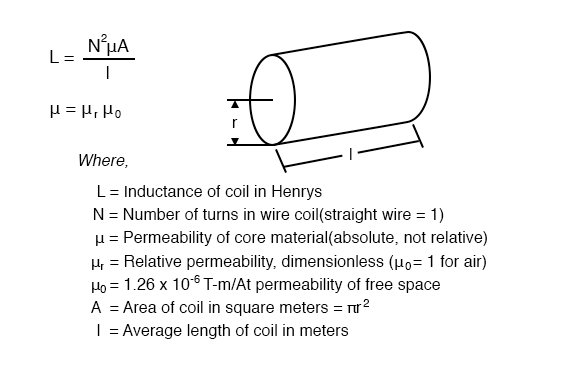
I'm not sure what Ilitch are doing to get an Inductance similar to the pickup, but the closer it is, the more silent the system will be.
https://www.ilitchelectronics.com/product/bpncs-fender-stratocaster
Here's the formula for Inductance:
I'm not sure what Ilitch are doing to get an Inductance similar to the pickup, but the closer it is, the more silent the system will be.
Last edited:
LoveThatBass
Supporting Member
It's been brought to my attention that some believe all you need is two coils to have a humbucker, but for it to be silent the Inductance & output Voltage of the two coils should be as similar as possible.
The strings might only be over one coil, but the noise being Induced by EMI is being received equally by both coils, which is how the whole scenario works.
Well sorta. You have two coils wound opposite polarity and equal windings so noise of one coil is same amplitude as other but in opposite polarity so net sum is +1 + -1 =0
P bass pickups (4 string bass for this illustration) are technically split coil humbuckers
same amplitude as other but in opposite polarity
This is the second time you've mentioned something I covered in the opening-post. Are you pulling my leg or summat?


