First, electromagnetic induction:
Electromagnetic induction - Wikipedia
In the case of noise that we're trying to cancel, EMI is inducing electrical noise into the coils of the pickup.
Some use the term RFI, but much of the interference falls outside the realm of what the FCC has designated as radio-waves.
Here's a rudimentary drawing of how a hum-bucker is wired:
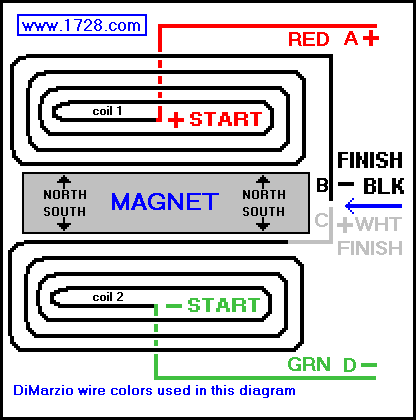
Because one of the coils is reverse-polarity (North vs. South) & reverse-wound from the other, hum-cancelling occurs.
The same noise is induced into both coils, but one side is reversed, so it cancels the hum from the other coil.
To work perfectly both coils must be matched in output, so that all the hum is canceled.
Assuming that both coils are using the same diameter of wire, they'd need to have the same amount of windings & be the same size.
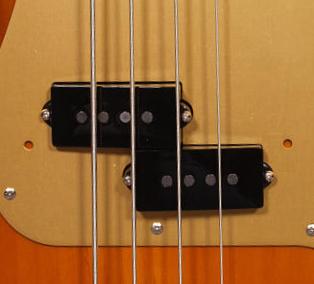
A split-coil Precision-style pickup operates in the same manner, just with the coils in a different orientation to one another:
Electromagnetic induction - Wikipedia
In the case of noise that we're trying to cancel, EMI is inducing electrical noise into the coils of the pickup.
Some use the term RFI, but much of the interference falls outside the realm of what the FCC has designated as radio-waves.
Here's a rudimentary drawing of how a hum-bucker is wired:
Because one of the coils is reverse-polarity (North vs. South) & reverse-wound from the other, hum-cancelling occurs.
The same noise is induced into both coils, but one side is reversed, so it cancels the hum from the other coil.
To work perfectly both coils must be matched in output, so that all the hum is canceled.
Assuming that both coils are using the same diameter of wire, they'd need to have the same amount of windings & be the same size.
A split-coil Precision-style pickup operates in the same manner, just with the coils in a different orientation to one another: