• TalkBass has been independent since 1998. Add your voice.
    Create a free account to reply to discussions, view embedded media, and browse with fewer display ads.
    Join freeLog in
    Want zero display ads or expanded classifieds tools? Compare plans.

Double Bass Hungarian, aprox. 1900

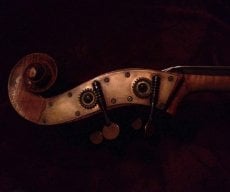
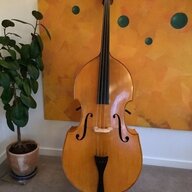
Hi everybody! I just bought this great sounding instrument from Kanzian & Traunstein in Vienna. All I know about it is that it's a Hungarian made bass, likely from Budapest around 1900. If anyone from seeing the pictures could say anything about the bass I would be most grateful, I've been struggling to find information online about Hungarian bass making traditions.
All the best,
Jesper
 

Attachments

  • att.vgWp7EDnaw8eumcbNJLhSrtVxkIVEhHT_cWWxszCu18.jpg
    att.vgWp7EDnaw8eumcbNJLhSrtVxkIVEhHT_cWWxszCu18.jpg
    787.8 KB · Views: 86
  • att.oU-G5NTR35rQ_S0neUhfooGcNrJr979nOQL-Z4CFjSs.jpg
    att.oU-G5NTR35rQ_S0neUhfooGcNrJr979nOQL-Z4CFjSs.jpg
    799.9 KB · Views: 71
I don't think there is a lot of information on the Hungarian makers. They used to make a lot of fakes, made basses for other people, and now seem to be coming in to their own. K&T is highly respected so you have their insurance that it is a good instrument.
I agree, I think K&T (who have actually handled the bass) are going to know way more than and bunch of random internet people.

From the pictures, I'd say the bass has really nice lines. How does it sound and feel?
 
  • Like
Reactions: SAlcott
I agree, I think K&T (who have actually handled the bass) are going to know way more than and bunch of random internet people.

From the pictures, I'd say the bass has really nice lines. How does it sound and feel?
Powerful and well defined sound. Very comfortable to play, good set up (before K & T got the bass Horst Grünert did some work as well) and well built - I'm waiting for it to be shipped to Sweden from Austria. Neither K & T nor the previous owner know a lot about the bass, except the aproximate age, origin and build quality. Perhaps a long shot, but I thought it was worth a try to see if anyone recognizes, if not the bass itself, the style of bass and perhaps knows something about the history of Hungarian bass making. As for the quality of the bass I'm very confident it's a good instrument and as both you and David Perrott said, Kanzian & Traunstein are very reliable people and good builders.
 
  • Like
Reactions: Adjectives
Hi everybody! I just bought this great sounding instrument from Kanzian & Traunstein in Vienna. All I know about it is that it's a Hungarian made bass, likely from Budapest around 1900. If anyone from seeing the pictures could say anything about the bass I would be most grateful, I've been struggling to find information online about Hungarian bass making traditions.
All the best,
Jesper
A beauty!
 
If anyone from seeing the pictures could say anything about the bass I would be most grateful ...

Hi Jesper,

Well, since you asked.... I live in North America and don't know a thing about K and T but (as Garrett2 said), the varnish seems in very good shape for a 125 year old bass. Kind of "too good to be true" shape. Unless that bass lived in a closet for most of its life, I'd question the age estimate.

... Neither K & T nor the previous owner know a lot about the bass ...

This statement doesn't inspire confidence. It could be a very nice instrument, and I hope it is, however I really wonder about the supposed age and the lack of information. I'm offering this opinion as someone who has owned a lot of basses, and been misled a couple of times.

If you do want more informed opinions, a range of pics, including closeups, would be helpful.

Best wishes,

Paul
 
Thank you for your answers. I see no reason to doubt K & T's assessment of the age of the bass - they sell a lot of new basses too and are not in the "fake old Hungarian bass" business, also the bass doesn't look like one of those at all... It is in very good shape though, as is expected for the price that it was sold. I'll try and reach out to the Hungarian builders mentioned above and see if they might know something.
 
@Jespernordberg
I just bought a more modern, used, 'Vienna Style Bass' a couple of months ago so have been digging into a bit of research about them. There is an interesting article here about the history. You need premium but the free trial doesn't ask for payment details.
Here's an extract which describes the 'characteristics' of the Viennese Bass, (although if it's Hungarian made it's a Viennese 'style' bass, as is mine, since it needs to be made in Vienna to be a true Viennese bass, not that that changes how amazing these deep bodied instruments sound!)
Hope it helps.

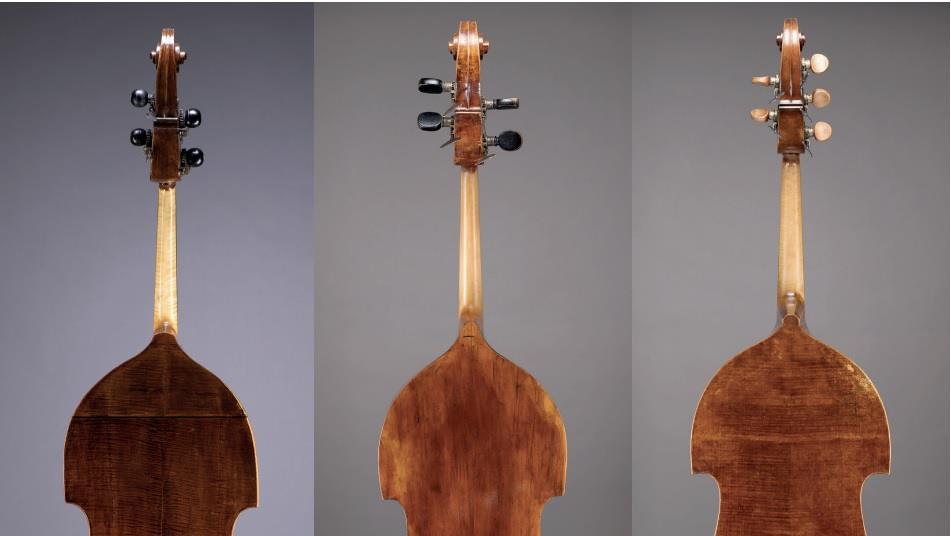
"But what exactly are those typical Viennese characteristics? Very often, Viennese basses can not only be described by a few of those characteristics: they bear all of them. Summarised together, the most important aspects are the following:

- An elongated gamba contour at the corpus
- An elongated pegbox with a protruding section halfway down, notched in either two or three lines, with no pronounced heel
- Originally constructed as a five-stringed instrument, without tuning mechanisms
- No overhang on either the top or the back: the ribs are flush with the plates
- A butt-jointed (not inserted) neck, set in place with a dowel
- High arching of the top plate
- Straight f-holes, with deeply turned wings
- A flat back with a rather high bend, the plate bent to a convex shape
- Three braces on the back plate
- Purfling only in the top plate, none on the back
Of course, every maker will put their own aesthetic on to those points. Viennese makers were part of a guild, so a strict eye was kept on the executors of the craft. The usual exceptions aside, we see phenomenal workmanship and innovative designs to create a very strong instrument with an enormous sound."
 
Since Hungary and Austria were united until WWI, and since the instrument making traditions presumably go back long before that, aren't Hungary and Austria the same tradition? I wonder if all of these characteristics hold of some of the older Hungarian basses as well.
Exactly, the article actually states that makers from outside Vienna were travelling to Vienna to learn the style and spread the tradition to the area. It's not that 'Viennes-Style-Bass' is worse than 'Viennes-Bass'. More similar to the distinction that a Sparkling white wine not made in the Champagne region of France can't be called Champagne, despite the fact it may well taste better than 'Champagne'. (Poor example since I can't stand sparkling white wine, but you get the point)

From the article:
"The real Viennese bass, however, is indeed made in Vienna, even though many famous makers of Viennese-style basses from Prague, Bratislava and Budapest were all trained there."

Mine was made in Budapest from what I can tell and sounds fantastic, in part due to all the traditions from bass makers in that part of the world.
 
Last edited:
  • Like
Reactions: Jespernordberg
It's a great looking bass. Is the circle on the bass side of the top a repair? Maybe it's common but I don't think I've seen that before, is it used when a hole (not a crack) is present?
Thank you. Yes it is, it's an old repair, and a weird one too - how would you end up with a hole that size on the body? A bullethole seems like the most plausible explanation ...
 
@Jespernordberg
I just bought a more modern, used, 'Vienna Style Bass' a couple of months ago so have been digging into a bit of research about them. There is an interesting article here about the history. You need premium but the free trial doesn't ask for payment details.
Here's an extract which describes the 'characteristics' of the Viennese Bass, (although if it's Hungarian made it's a Viennese 'style' bass, as is mine, since it needs to be made in Vienna to be a true Viennese bass, not that that changes how amazing these deep bodied instruments sound!)
Hope it helps.

"But what exactly are those typical Viennese characteristics? Very often, Viennese basses can not only be described by a few of those characteristics: they bear all of them. Summarised together, the most important aspects are the following:

- An elongated gamba contour at the corpus
- An elongated pegbox with a protruding section halfway down, notched in either two or three lines, with no pronounced heel
- Originally constructed as a five-stringed instrument, without tuning mechanisms
- No overhang on either the top or the back: the ribs are flush with the plates
- A butt-jointed (not inserted) neck, set in place with a dowel
- High arching of the top plate
- Straight f-holes, with deeply turned wings
- A flat back with a rather high bend, the plate bent to a convex shape
- Three braces on the back plate
- Purfling only in the top plate, none on the back
Of course, every maker will put their own aesthetic on to those points. Viennese makers were part of a guild, so a strict eye was kept on the executors of the craft. The usual exceptions aside, we see phenomenal workmanship and innovative designs to create a very strong instrument with an enormous sound."
Something like this is what I was looking for, thank you!!
 

Latest posts