• TalkBass has been independent since 1998. Add your voice.
    Create a free account to reply to discussions, view embedded media, and browse with fewer display ads.
    Join freeLog in
    Want zero display ads or expanded classifieds tools? Compare plans.

Double Bass Hybrid top graduation

Hi Guys,
i have a chezch made hybrid from probably mid 80's that i now have as a second bass (just bought a used carved) anyway this bass has always sounded somewhat choked no matter what strings or setup.

When i checked the top plate thickness in comparison with the carved its about double the thickness so i'm thinking if i took the top off it and shaved it down it might make a big difference to the sound.

Of course never having done this before i was wondering
A how difficult is it to do and
B how would one go about it.
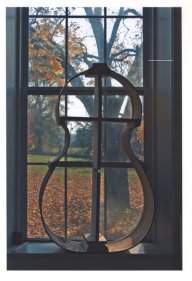
 
It's a big job! One needs planes, scrapers, gouges, some method of measuring thicknesses, and the skill to use them. A calm demeanor is needed for the top removal. Some sort of fixture must be made to support the top as you work. Will the bass bar need to be replaced? A couple of dozen clamps are required for the re-installation. Be prepared to fit a new sound-post. Varnish touchups are almost certain.
It's not a project for a novice. Support your local luthier.
 
You need to visit a luthier for a quote or estimate. Everyone has a different approach and hourly rate.

But it's probably worth mentioning what's involved in ANY top-off work, in my experience.

Remove strings and bridge. Remove top carefully trying not to damage varnish or glue surfaces; open all seams and release all blocks; neck blocks and end blocks are often stuck hard. Blocks may have hard-to-see pins/dowels/nails in them. Allow an hour?

Clean up edges and blocks; often the ends of the blocks are heavily caked in glue. Clean up old glue drips and re-glue chips that may have split off in the opening process. Often there are areas that need cleaning out with a chisel and new wood glued in then trued-up to the original surface. Re-glue or remake and replace linings as necessary. Allow an hour? maybe two?

Check fit of top, clamping dry-run ensuring all edges project evenly. Check neck/fingerboard alignment. Re-glue entire perimeter. Clean up external drips. Another hour?

Remove clamps. Re-check neck alignment. Clean off any residual glue around perimeter and allow to dry. Re-touch varnish to bare wood all around perimeter, several coats. Replace soundpost, replace strings and bridge, tune-up and adjust setup. Another hour?

Hmmmm ... that's a minimum of around 5 hours* work for someone who knows how to do it, without even touching any internal repairs or regraduating, and assuming there are no other problems like crooked neck and so on! Some basses are easier than others but its hard to see how you can do all that in any less time, nor would you really want a luthier to try.

And regraduating the top? I guess you'd need to allow probably 1-3 hours work for that. But anyone quoting without seeing the bass really has to cover their back side.

*and when I say this, I don't mean continuous hours either. Sometimes its a matter of set something to soak and go away for a few hours, come back to it, wait, resume, wait etc etc. And luthiers probably put in more time than they bill you for!
 
Haha, yes ... probably I am off the mark there!

But we're talking a '80's Czech hybrid bass - and I'm assuming not a really expensive one - and I was taking a stab at the bare minimum time to bring down the thicknesses near the edges up to the linings where it will probably make most difference. Most of the too-thick tops I've seen here, on student-grade european and chinese basses, all seem to have hugely thick edges, a flat shelf just inside the linings for sometimes an inch. The rest of the grads are kind of okay. I think the machines used are set up so as not to get too close to the edge!

I agree, regraduating a top on a more valuable bass is a more lengthy proposition, you take your time. And the better the bass the more carefully you go!
 
Here's another opportunity for someone to bite my head off...

Anyway, my take as follows:

- it is major surgery.
- Productivity in Oz indeed appears admirable! But often you will find that people who work fast, also have a high hourly rate, so that it may still not be an economically viable proposition to have it done, on a hybrid, by a luthier. But of course a quote can't hurt, and his/her opinion could be worthwhile, also in revealing alternative improvement opportunities.
- Just thinning-down the top might improve the instruments characteristics, but it may also deteriorate the instrument. Doing it unjudicially, by someone without experience in it, really is a major gamble, and this is where a luthiers experience really can improve chances (POS). Though probably still not guarantee.

Good luck, Koen.
 
The cost of regraduating may be close to or exceed the cost of this bass - a new hybrid is $2000.00+. Is it worth putting significant work and money into a bass that does not have a high resale value? Wouldn't it be better to save your money, sell this bass and get one that fits the sound you're after? The bottom line is you don't know what the bass is going to sound like after all that money and work.
 
++1 powerbass
If you don't love the bass' sound, money is better spent on another bass after selling the one you're thinking about working on. In that price range there's a pretty good sellers market. Luthiery is priced at the same hourly rate whether your bass is a $1500, $15k or $150k. Investing lots of hours for major surgery on a lower end instrument is rarely a good investment.
 
You need to visit a luthier for a quote or estimate. Everyone has a different approach and hourly rate.

But it's probably worth mentioning what's involved in ANY top-off work, in my experience.


Hmmmm ... that's a minimum of around 5 hours* work for someone who knows how to do it, without even touching any internal repairs or regraduating, and assuming there are no other problems like crooked neck and so on! Some basses are easier than others but its hard to see how you can do all that in any less time, nor would you really want a luthier to try.

Are you saying you can pop off a top and glue it back on in five hours? You are Superman! I was discussing this topic with a luthier in my area recently, and he said that he charged in the neighborhood of 5k for this. And that's Euros! Of course the customers here can suffer no micro-splinter to be out of place, so that must be taken into consideration. But still... I've removed and replaced tops on student instruments as hobbyist, and it didn't take days or weeks or anything.

Regraduating a top yourself without years of luthier training and experience? I do many repairs on low end instruments, but this I would never try.