Thanks for all the interest, guys. I’ll do my best to clear things up:
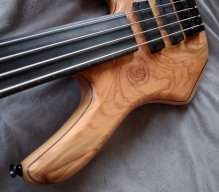
The Hyperbass has 3 ceramic pickups built into the body and 1 in the headstock. These pick up the resonance of the instrument from the inside, and offer an interesting alternative tone source. They also allow me to produce rhythmic sounds on the body of the bass itself, as I do in “Diagonal Head Trauma” and “When We Were Asleep in the Earth.” Unfortunately, I’m rarely able to bring enough gear with me to use this feature live as it’s part of the 5-way output system of the instrument.
The Hipshots are designed to drop a string down by a specific interval which you preset with a little thumbscrew. It’s easy to change this interval and I do it frequently between pieces in a show. Of course, you can start with the key lever open and use the Hipshot to raise the pitch rather than lower it, if you choose. The range you’ll get out of the Hipshots depends on several factors -- the gauge and tension of the string, the diameter of the tuning post, etc., but I have no trouble getting my E string down to B and even A. I use a light gauge E and it is a bit floppy when tuned down to low B, but I still find it functional for almost every instance in which I need that low register.
I think there’s some confusion about getting more then two notes out of the Hipshots because folks have heard me use a technique I’ve developed of pulling on the tuning key to get a higher pitch than the closed-lever tone. Hipshots aren’t made for this, so it’s a bit dodgy at times, but I love the sound, so it’s something I enjoy using.
The Hyperbass bridge operates by changing the tension on each string separately. The strings are connected to individual saddle pieces which rest on either a fixed plate, or one of two cams, depending on the positions of the levers that control the cams. Tunings are preset by adjusting set screws on the saddles to determine the degree to which each tuning position affects the string. Basically, you can setup any three tunings as long as they are sequential -- a high tuning, a medium tuning and a low tuning. You can have string pitches stay the same between tunings, but you can’t have contrary motion by using the Hyperbass bridge alone, i.e., some strings moving up in pitch while others move down. I believe it would be possible to setup the bridge so that one lever changes the higher two strings and the other changes the lower two, but I’ve never tried that. As with the Hipshots, it’s very easy to setup the bridge to either raise or lower the strings (or both) from some standard pitch.
I hope that helps. Have fun with “Excuse Me, Mr. Manring”!
The Hyperbass has 3 ceramic pickups built into the body and 1 in the headstock. These pick up the resonance of the instrument from the inside, and offer an interesting alternative tone source. They also allow me to produce rhythmic sounds on the body of the bass itself, as I do in “Diagonal Head Trauma” and “When We Were Asleep in the Earth.” Unfortunately, I’m rarely able to bring enough gear with me to use this feature live as it’s part of the 5-way output system of the instrument.
The Hipshots are designed to drop a string down by a specific interval which you preset with a little thumbscrew. It’s easy to change this interval and I do it frequently between pieces in a show. Of course, you can start with the key lever open and use the Hipshot to raise the pitch rather than lower it, if you choose. The range you’ll get out of the Hipshots depends on several factors -- the gauge and tension of the string, the diameter of the tuning post, etc., but I have no trouble getting my E string down to B and even A. I use a light gauge E and it is a bit floppy when tuned down to low B, but I still find it functional for almost every instance in which I need that low register.
I think there’s some confusion about getting more then two notes out of the Hipshots because folks have heard me use a technique I’ve developed of pulling on the tuning key to get a higher pitch than the closed-lever tone. Hipshots aren’t made for this, so it’s a bit dodgy at times, but I love the sound, so it’s something I enjoy using.
The Hyperbass bridge operates by changing the tension on each string separately. The strings are connected to individual saddle pieces which rest on either a fixed plate, or one of two cams, depending on the positions of the levers that control the cams. Tunings are preset by adjusting set screws on the saddles to determine the degree to which each tuning position affects the string. Basically, you can setup any three tunings as long as they are sequential -- a high tuning, a medium tuning and a low tuning. You can have string pitches stay the same between tunings, but you can’t have contrary motion by using the Hyperbass bridge alone, i.e., some strings moving up in pitch while others move down. I believe it would be possible to setup the bridge so that one lever changes the higher two strings and the other changes the lower two, but I’ve never tried that. As with the Hipshots, it’s very easy to setup the bridge to either raise or lower the strings (or both) from some standard pitch.
I hope that helps. Have fun with “Excuse Me, Mr. Manring”!