• TalkBass has been independent since 1998. Add your voice.
    Create a free account to reply to discussions, view embedded media, and browse with fewer display ads.
    Join freeLog in
    Want zero display ads or expanded classifieds tools? Compare plans.

Double Bass I forgot the string order.

Axtman

Supporting Member
Mar 3, 2008
2,573
4,708
Seattle, WA
I removed the strings on my upright travel bass a year or so ago in order to store it. Now I am putting the strings back on but have forgotten the string order. Can you please look at the headstock and tell me what string goes where?

I use standard tuning so the strings are from thickest to thinnest (E A D G). And for the sake of reference lets call the tuning pegs from top (1) to bottom (4) in the picture below.

I am used to a Fender bass guitar where E is placed on the tuning machine closest to the body and G is placed on the tuning machine farthest from the body.

Thanks!
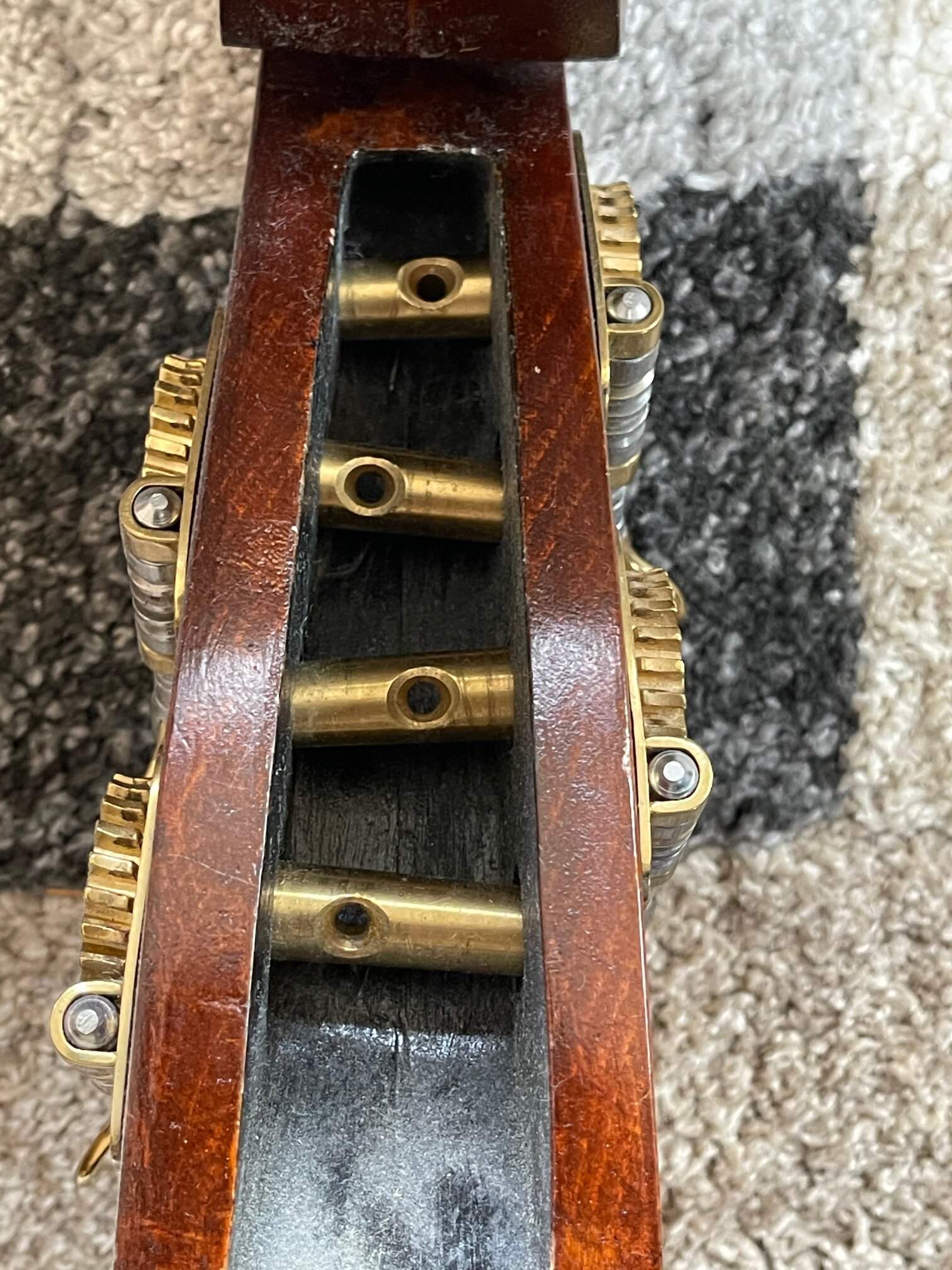
IMG_3644.jpg
 
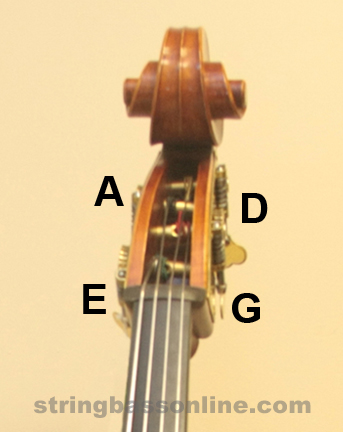
If another player walks up to play your bass, they'll expect that E is on the lowest barrel, 4 in your example, and the G is on 3. That's standard.

For myself I sometimes prefer to put heavier strings on higher pegs for less stress over the nut, so: 1-E, 2-A, 3-D, 4-G, and I control winding the strings onto the barrel to position the string for the nut in an orderly way.
 
Oh geez do I feel like an idiot! Once again I did not think it through! Of course I should have known the string order! It is just like a bass with a 2x2 headstock.

Before I totally condem myself and in my defense, this is how I got confused. I looked at two other basses and noticed that they are strung differently.

This is a Kay:
IMG_3645.jpg


This is an Upton:
IMG_3646.jpg
 
This is the standard stringing.

Some people do it differently.

The Upton and Kay photos you show are just different because they have the machines on the two sides in a different order; but the string positions are still the same as to which knob turns which string.

On the side facing you is E closest to the nut then A near the scroll; on the far side D is nearest the scroll and G closest to the nut.

For a while I tried changing it around, on some theory about the value of the lengths of string in the pegbox, but I got tired of twisting the wrong knob and switched it back to the standard. It's also the same way an acoustic guitar is strung; starting with the lowest pitch string, up the side closest to you and then back down the side away from you. I was switching back and forth from guitar to bass and got confused a lot.
 
I wonder would alternate stringing help eliminate wolf notes by changing the "fore-lengths"?
There is a tail piece by Moser which allows numerous combinations of after-lengths for this purpose.
Never heard of this, but maybe there is some merit in alternative stringing.
 
On the Kay the grayish D and the gold E look like they're up against the side of the peg box.
On the Upton the turquoise E and the red G seem to be up against the peg box.
I'm just a newbie... I think you would want to avoid more tightening which could put more sideways pressure on the box and/or bend the tuning machines.

Troy... beat me to it
 
  • Like
Reactions: TroyK
To the OP or anyone else re-stringing, just in case you haven't already tended to it...

If you've slacked all the strings during this process, you might want to make sure your sound post has not fallen or moved dangerously out of place before bringing the strings back up to tension.

Just like other Viol/Violin family instruments, many double basses' sound posts will fall or move into bad positions when string tension is slacked (sound posts are typically not glued in place). Bringing strings back up to tension without a sound post properly in place can cause damage to the double bass top.

(If your sound post has fallen or moved, there are a number of threads here in TB/DB that discuss re-stringing with the double bass on its back, and/or re-positioning the sound post. Or, see your local double bass luthier for sound post help... Before bringing the strings back up to tension.)