
Enjoy the benefits of a premium membership!
Upgrade Account
-
TalkBass has been independent since 1998. Add your voice.
Create a free account to reply to discussions, view embedded media, and browse with fewer display ads.
Join free Log in
Want zero display ads or expanded classifieds tools? Compare plans.
You are using an out of date browser. It may not display this or other websites correctly.
You should upgrade or use an alternative browser.
You should upgrade or use an alternative browser.
I hate switching basses...who's with me?
- Thread starter JimmyM
- Start date
More options
Who Replied?


Speaking of switching out basses, I have always loved this Rig Rundown from ZZ Top, where their clean shaven tech-turned-long bearded bassist Elwood Francis shows Billy Gibbons' rig. Billy's got a lot of guitars he switches in and out...Pauls, Teles, Gretsches, who knows what else...and he wants them all to sound just like his Pearly Gates Les Paul. Pretty cool how he does it. Samples Pearly with a G chord, then goes to a programmable Digitech EQ and tries to match the EQ curve.
I'll also post this one which shows Dusty's rig (RIP) and basses in case anyone's interested.
I'll also post this one which shows Dusty's rig (RIP) and basses in case anyone's interested.
Last edited:

Like you, I went through a multi-bass gigging “phase”, outboard pre, A/B switch, etc., and like you, it got a little old. Especially since I often run PA as well. I felt like the wizard behind the curtain at times.
In recent years I’ve taken more joy in seeing just how well I can cover it all with just one - a different challenge! Playing a five does help with that. …and more and more venues provide sound. …so it gets easier .
.
There are situations that I’m not in at present where that might not work - doubling on upright, some multiple tunings, and possibly fretless, though I’m not so sure about that last one.
Get well soon!
In recent years I’ve taken more joy in seeing just how well I can cover it all with just one - a different challenge! Playing a five does help with that. …and more and more venues provide sound. …so it gets easier
.There are situations that I’m not in at present where that might not work - doubling on upright, some multiple tunings, and possibly fretless, though I’m not so sure about that last one.
Get well soon!
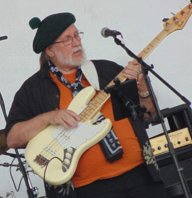
I would only have one bass if I could get away with it, but I have two. Love my '82 maple-necked passive Jazz 4-string and would prefer to always play it. However, when it comes to tuning down the E string, I'd rather grab my 5-string. It doesn't sound as good as my Jazz but it does sound decent. I usually use it in passive mode so I don't have to change the gain back and forth with the basses.Nobody likes showing off my basses more than me. They're not super special or anything, but I used to be in love with the idea of switching basses just to show off the collection a little, plus it's cool to have different basses for different sounds and tunings. I've tried to enjoy it, especially since I spent a good many years doubling on upright on most of my gigs. Sounded like a good idea at the time.
Here's why I ended up hating it...
---It either slows the show down or it leaves you hanging and looking like amateur night because you're not ready when they start the next song. And many bandleaders don't care if you're switching and they'll count the song off anyway. So I just want to play one bass that can do it all.
---It's easy to switch basses that all have similar sound and output, but switching between a Stingray with new rounds and a Hofner with old flats is going to take some EQ to keep levels consistent and tones not so different that it throws the mix into a meltdown. And the more different basses, the more EQ's you need. Some folks will use programmable EQ's or pres and that's what I did most of the time, but it can take some effort to get it right. And I just don't want to spend time screwing with it. Once saw Heart's sound tech have to rebuild the bass mix from scratch for every other song because Steve Fossen switched every other song and never used the same bass twice.
---Two basses are manageable, but any more than that gets on my nerves during setups and teardowns. Have I done it? Sure I have! How do you think I know???
Anyway, thx for listening to me yak while I try to get over health problems. Been a while I had this much free time since going corporate. And feel free to comment either pro or con.
I really like using my line6 G10s wireless when switching basses because it makes switching basses a snap. Strap on the other bass, unplug the transmitter from the first bass and plug it into the second bass - done!. No need to pull off a strap-pack or belt-pack transmitter because the transmitter is built onto the plug. Point is that when I can use that G10s, it really does make changing basses a snap instead of a pain in the neck.
I suppose I could get a 5-string Jazz to get the sound I want but then I'd have to put up with a wider neck all the time. I don't mind the wider neck on a 5-string but love the 60's slim C-shape neck with 7.25" radius on my 4-string and since that's all I need to play all but a couple of songs, I'll keep using it most of the time.

Nobody likes showing off my basses more than me. They're not super special or anything, but I used to be in love with the idea of switching basses just to show off the collection a little, plus it's cool to have different basses for different sounds and tunings. I've tried to enjoy it, especially since I spent a good many years doubling on upright on most of my gigs. Sounded like a good idea at the time.
Here's why I ended up hating it...
---It either slows the show down or it leaves you hanging and looking like amateur night because you're not ready when they start the next song. And many bandleaders don't care if you're switching and they'll count the song off anyway. So I just want to play one bass that can do it all.
---It's easy to switch basses that all have similar sound and output, but switching between a Stingray with new rounds and a Hofner with old flats is going to take some EQ to keep levels consistent and tones not so different that it throws the mix into a meltdown. And the more different basses, the more EQ's you need. Some folks will use programmable EQ's or pres and that's what I did most of the time, but it can take some effort to get it right. And I just don't want to spend time screwing with it. Once saw Heart's sound tech have to rebuild the bass mix from scratch for every other song because Steve Fossen switched every other song and never used the same bass twice.
---Two basses are manageable, but any more than that gets on my nerves during setups and teardowns. Have I done it? Sure I have! How do you think I know???
Anyway, thx for listening to me yak while I try to get over health problems. Been a while I had this much free time since going corporate. And feel free to comment either pro or con.
I play fretless on 70% of the tunes we currently play. If the other 30% didn't work significantly better with frets I would do it all fretless. But for a number of valid musical reasons they do. So I swap.
An ABY negates cable pulling and B3n takes care of EQ and other song-specific stuff: Each bass has it's own general-purpose patch named for the bass. These patches, combined with the actives, handle most of the songs. I've also programmed the B3n with a 12 dozen or so song-specific patches named for the song. Swapping takes about 10 seconds, including the mini tap-dance.

I used to switch in a prog-rock band in the 90s, only because I played fretless on most songs, but switched to frets for some songs where I was doing a lot of tapping. I got so sick of switching that I spent 8 hours a day over a long weekend until I could do all the tapping accurately on fretless.
I think, though, that I just might be about to start playing a fretted bass again for a few songs, so I might give it another go. If so I'll be looking for a Bassbone or similar. I do have a double gig bag at least, so I'm set with transport.
I think, though, that I just might be about to start playing a fretted bass again for a few songs, so I might give it another go. If so I'll be looking for a Bassbone or similar. I do have a double gig bag at least, so I'm set with transport.


I have this Radial Bassbone - bass switcher DI and it is perfect for 2 basses. One channel has flat. a mid scoop and a mid/low-mid bump selector switch and the other is TMB and a boost. Max on each channel if EQ is flat is a smidge lower than just plugging it straight and that is why it has a boost switch if you want louder. I have noted which setting for what bass and I use the amp EQ for the room.
If I double with an upright then I have a preamp that handles mic and piezo pickup and my main amp is an Acoustic Image with 2 channels. Works when I do not have the Bassbone. But that pedal is the best for 2 basses.
If I double with an upright then I have a preamp that handles mic and piezo pickup and my main amp is an Acoustic Image with 2 channels. Works when I do not have the Bassbone. But that pedal is the best for 2 basses.
I usually bring three. One each fretted and fretless and a backup for whichever one gets the most (or most important) duty. If the night only features one fretless song the backup is a fretted instrument. It's much easier to make a fretless sound fretted than vice versa. (For me it is.) If the night is more evenly split between the two the backup is a fretless. It's no fun trying to play a convincing "Tears In Heaven" on a fretted bass. I'm not fond of changing in between songs but it's okay if you only have to do it a couple of times. Clumping the fretless and fretted songs together when making the set list doesn't usually matter to most BLs even if they're aware of the difference. Depending on the band, some don't mind switching the order of tunes to benefit the show or at least create a diversion (drum solo?!!!) that allows for a seamless switch. Guitarists switch from slide to standard tuned to alternate tuned instruments over the course of the night without there being a dramatic pause. We should be able to do that, too. Even more so considering that we're invisible.
Last edited:
I did similar with the upright and the electric, though I bought an AB switch to avoid inadvertently hitting the Y after a horrible feedback accident on a gig. But I used pedals. Call me crazy but I still prefer pedals over multis.I play fretless on 70% of the tunes we currently play. If the other 30% didn't work significantly better with frets I would do it all fretless. But for a number of valid musical reasons they do. So I swap.
An ABY negates cable pulling and B3n takes care of EQ and other song-specific stuff: Each bass has it's own general-purpose patch named for the bass. These patches, combined with the actives, handle most of the songs. I've also programmed the B3n with a 12 dozen or so song-specific patches named for the song. Swapping takes about 10 seconds, including the mini tap-dance.
I did similar with the upright and the electric, though I bought an AB switch to avoid inadvertently hitting the Y after a horrible feedback accident on a gig. But I used pedals. Call me crazy but I still prefer pedals over multis.
I've done the same, but with ABY the worse that can happen is both connect at the same time. With passives, the controls of both are then connected together which can cause some embarrassment in the form of deathly silence or muffled tone where the controls of the bass in the stand are rolled off. As it is, I've put the ABY on the board in such a way that the A+B switch is almost impossible to hit and the 'OR' button can't be missed:
I'd risk being flamed, tarred and feathered by my TalkBass family here by asserting that the audience isn't likely to hear the sonic differences between basses anywhere near as easily as differences in guitars. Maybe it's something to do with the frequency ranges guitars live in versus where basses are but I'd rather my guitarists trade instruments at a show than myself unless there's a specifically long-written break I can take advantage of to do so.
This is the exact reason that I called up the Sadowsky shop a few years back and commissioned my current #1, the Super PJ:
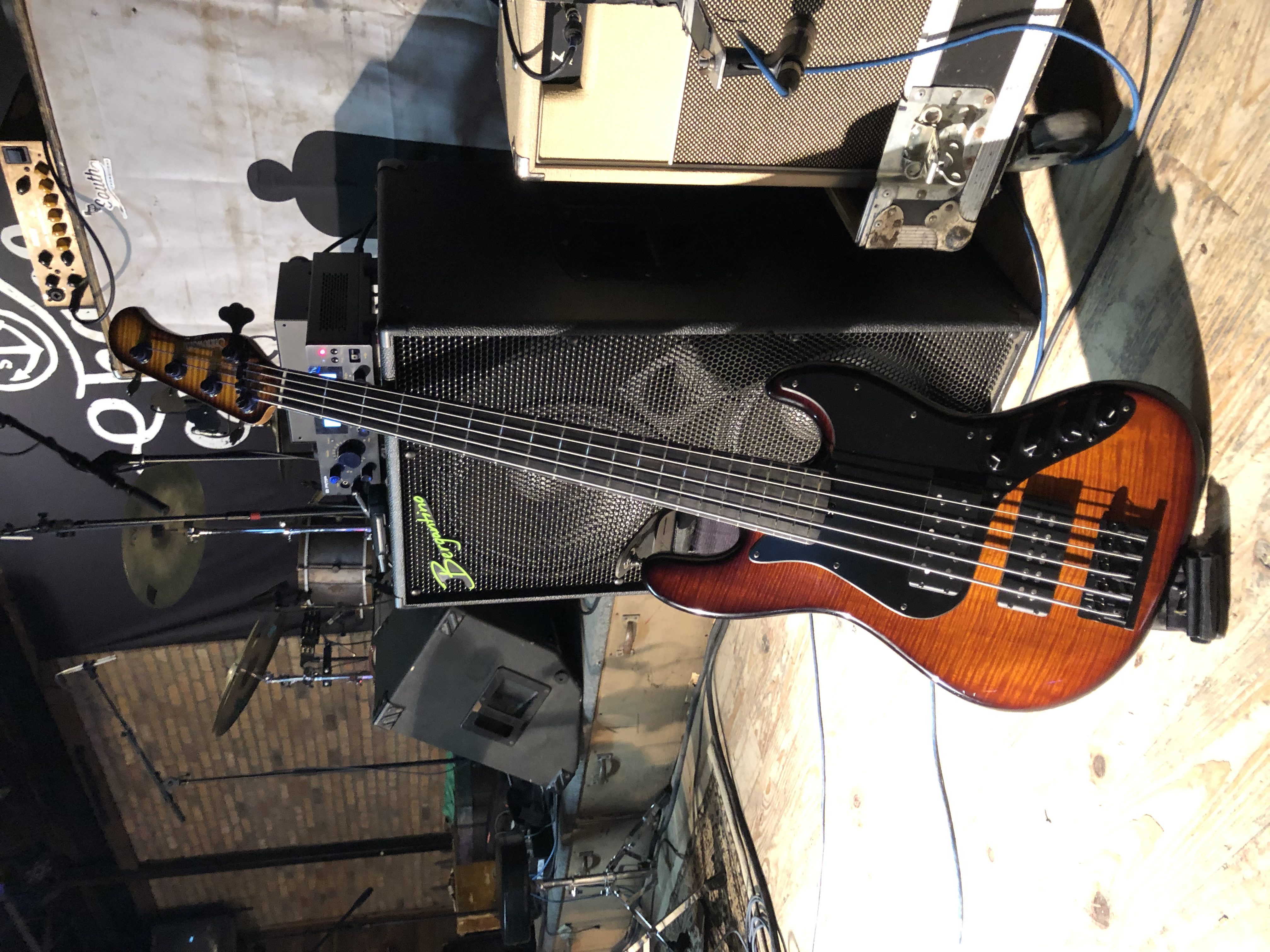
The issue I kept running into was that when I played in bands as the bassist and MD I was arranging shows and writing transitions that allowed the guitarists (and occasionally fiddlers) just enough time to change instruments and retune, but I never had any time to change instruments myself. I had to be able to get every sound I'd need out of a bass on one instrument and I'm very satisfied with what Roger, Ellis and Sadowsky were able to make for me with the Super P and Super J pickups.
I'd still love to be able to change instruments between my #1 pictured above and other instruments in a show but I haven't yet played for the right artist with the appropriate songs and show tempo that I could get away with swapping basses without causing the show itself to drag needlessly. That said, it's strangely freeing in a way to not have to worry about changing basses and just focusing on the show, the crowd and what's going on onstage.
This is the exact reason that I called up the Sadowsky shop a few years back and commissioned my current #1, the Super PJ:
The issue I kept running into was that when I played in bands as the bassist and MD I was arranging shows and writing transitions that allowed the guitarists (and occasionally fiddlers) just enough time to change instruments and retune, but I never had any time to change instruments myself. I had to be able to get every sound I'd need out of a bass on one instrument and I'm very satisfied with what Roger, Ellis and Sadowsky were able to make for me with the Super P and Super J pickups.
I'd still love to be able to change instruments between my #1 pictured above and other instruments in a show but I haven't yet played for the right artist with the appropriate songs and show tempo that I could get away with swapping basses without causing the show itself to drag needlessly. That said, it's strangely freeing in a way to not have to worry about changing basses and just focusing on the show, the crowd and what's going on onstage.
I love switching basses on set. Switching to the violin bass for I Want Tol Hold Your Hand usually gets an intrigued murmer from the crowd, followed by a round of applause at the opening bars.
Aside from that my Harley Benton MB4 is my main live plank, with my Ibanez PJ as a backup in case of string breakages, and I otherwise don't during the set.
Our second guitarist, however, swaps axes every 3 seconds, but hes peretty smooth at it.
Aside from that my Harley Benton MB4 is my main live plank, with my Ibanez PJ as a backup in case of string breakages, and I otherwise don't during the set.
Our second guitarist, however, swaps axes every 3 seconds, but hes peretty smooth at it.
I don't do invisible, ever.I usually bring three. One each fretted and fretless and a backup for whichever one gets the most (or most important) duty. If the night only features one fretless song the backup is a fretted instrument. It's much easier to make a fretless sound fretted than vice versa. (For me it is.) If the night is more evenly split between the two the backup is a fretless. It's no fun trying to play a convincing "Tears In Heaven" on a fretted bass. I'm not fond of changing in between songs but it's okay if you only have to do it a couple of times. Clumping the fretless and fretted songs together when making the set list doesn't usually matter to most BLs even if they're aware of the difference. Depending on the band, some don't mind switching the order of tunes to benefit the show or at least create a diversion (drum solo?!!!) that allows for a seamless switch. Guitarists switch from slide to standard tuned to alternate tuned instruments over the course of the night without there being a dramatic pause. We should be able to do that, too. Even more so considering that we're invisible.
But it takes the same kind of organization and prep to switch between different guitars and not have a dramatic pause, too. You're darn right that many BL's don't mind changing the set list on the fly or not even using one, and not worrying about you wanting to change basses before they count off the next tune. Those same BL's also have a disregard for guitarists and their need to change up for certain songs.
I don't know...I think most people can tell if you go from a Geddy Lee sound to a James Jamerson soundI'd risk being flamed, tarred and feathered by my TalkBass family here by asserting that the audience isn't likely to hear the sonic differences between basses anywhere near as easily as differences in guitars.


For nearly fifty years I only took one bass to the gig. These days I’ve started taking two because it’s quicker to grab the other bass if I break a string (very very rare - not for many years has it happened). So far I’ve never played the second bass. If I’m up and running I tend to stay in that lane. I don’t play diverse genres so I don’t need to change my sound that much. Plucking attack and location can give me what I want.
Last edited:
Ditto here. I’ve somehow magically managed to make my p bass work in every situation.
I'm with you. I'd rather play one instrument all night, if I can. Doesn't always work that way, but I'm happy when it does.
I’d love it if the people who hired me cared enough about the minutiae of different bass sounds to make it possible to switch.
Outside of theatre shows, I haven’t been a part of that.
But I agree with the poster who wrote that it is strangely satisfying to get hired and make it all happen with one bass. And to not have to ask to stop the show for any reason, including to switch.
At some point, I realized why I was getting hired. And it wasn’t because of my ability to own different basses and bring them to the gig.
Outside of theatre shows, I haven’t been a part of that.
But I agree with the poster who wrote that it is strangely satisfying to get hired and make it all happen with one bass. And to not have to ask to stop the show for any reason, including to switch.
At some point, I realized why I was getting hired. And it wasn’t because of my ability to own different basses and bring them to the gig.


