• TalkBass has been independent since 1998. Add your voice.
    Create a free account to reply to discussions, view embedded media, and browse with fewer display ads.
    Join freeLog in
    Want zero display ads or expanded classifieds tools? Compare plans.

Identifying Mahogany

Apr 7, 2010
4,421
3,833
37
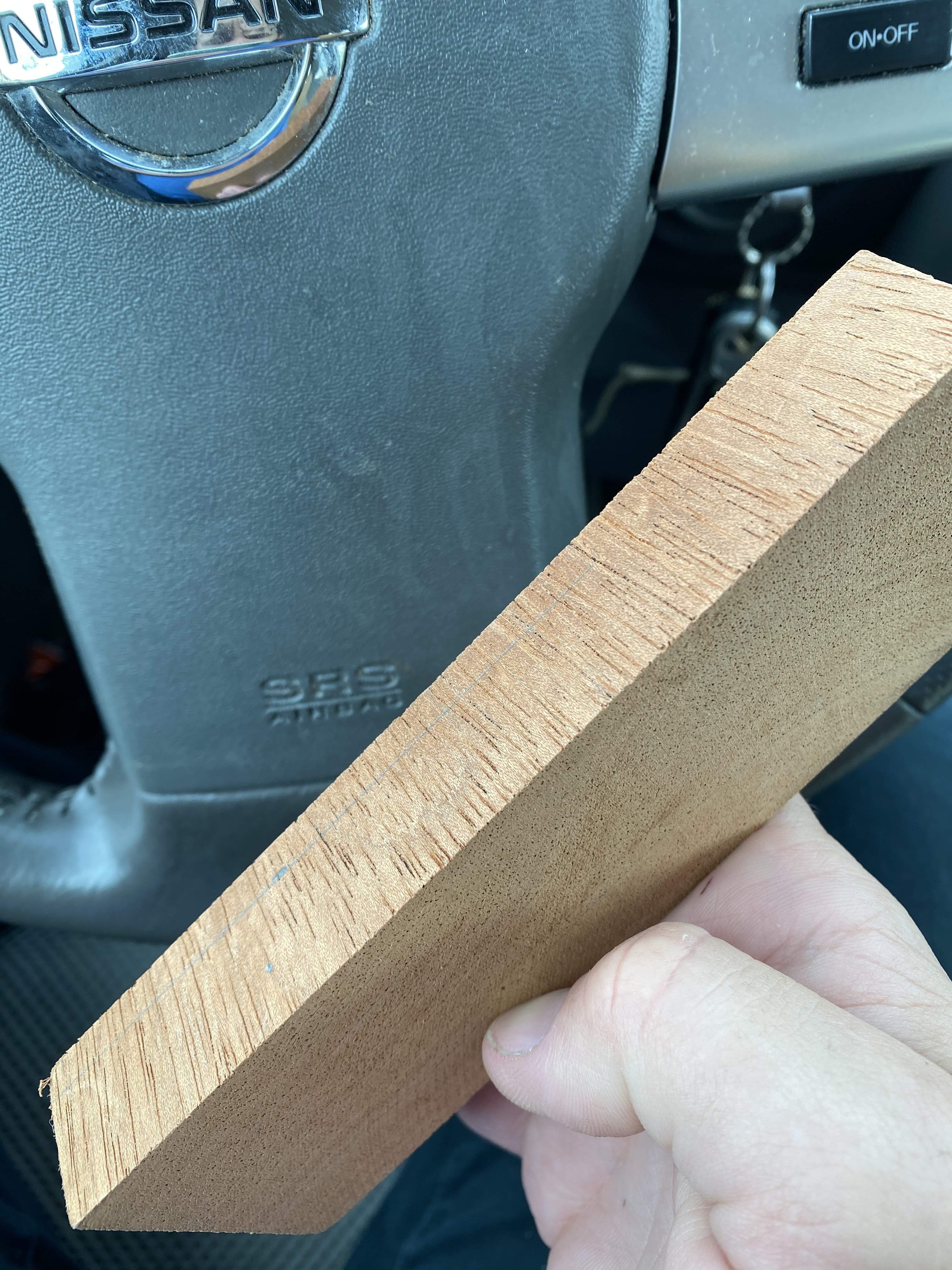
I have a large mahogany beam (or something) that I rescued from the dumpster of a construction site like a decade ago.. I’ve started chopping it up and making use of it, finally, and I’d really love to figure out what kind of mahogany it is.

It doesn’t look like the African mahogany or Sapele at my local place, and the best I’ve gotten from the guys over there is ‘yep it’s some kind of mahogany.’ It has a peppery smell, it’s really really easy and interesting to work with.. the color is this rich orange when freshly cut.. I’ll include pictures of course

968FF4B5-556F-45B2-9EF0-402DCCF8DB80.jpeg

raw and freshly cut
12683EF4-1AB1-4B43-B242-F2AE78BDE367.jpeg

Raw
4E5F42AB-8DE2-498D-91AA-20DF9BDA46F6.jpeg

Finished with shellac and paste wax


If anybody is confident that they would be able to discern the variety accurately, I’d be happy to send you that small cut off to look at.. it’s not much, but you would keep it as your prize :)
 
  • Like
Reactions: turindev
There are three species of true mahogany (in the genus Sweitenia). There are a handful of other species sometimes sold as Mahogany, or as replacements for Mahogany (commonly Sapele and Khaya, when it comes to guitar building). There are a handful of other trees with "Mahogany" in their common name that bear no resemblance whatsoever to the real thing (swamp mahogany, mountain mahogany, etc), so at least we can rule them out.

Part of the confusion with Mahogany is that the three Sweitenia species are all named after places (Mexican - which isn't common, I've never seen any in person, Cuban, and Honduran). Yet, they're sometimes grown outside of those actual places.

Any chance you know the backstory, or how old the building was? Cuban mahogany really started to disappear maybe 60 or 70 years ago. Cuba shut down all export in the 40's. It's grown some places outside of Cuba (i.e. Florida, other islands in the Caribbean) but is super rare except for salvaged stuff or trees that came down naturally and were havested.

Judging by the lack of any ribbon figure (more common in the "fake" mahoganies like Sapele) and the pale lines between the growth rings on the endgrain, I'd guess it's one of the true mahogany species. It can be very difficult to tell the difference between Cuban mahogany and Honduran mahogany, as far as I'm concerned you might as well guess based on age (if it's older than the 1940's, there's a much higher chance it's Cuban. Newer than that, probably Honduran, unless you know it came from a Cuban tree, i.e. you got it from someone who cut one down in Florida).

Can you do a super close up photo of a flatsawn surface, and the endgrain?
 
  • Like
Reactions: Huw Phillips
There are three species of true mahogany (in the genus Sweitenia). There are a handful of other species sometimes sold as Mahogany, or as replacements for Mahogany (commonly Sapele and Khaya, when it comes to guitar building). There are a handful of other trees with "Mahogany" in their common name that bear no resemblance whatsoever to the real thing (swamp mahogany, mountain mahogany, etc), so at least we can rule them out.

Part of the confusion with Mahogany is that the three Sweitenia species are all named after places (Mexican - which isn't common, I've never seen any in person, Cuban, and Honduran). Yet, they're sometimes grown outside of those actual places.

Any chance you know the backstory, or how old the building was? Cuban mahogany really started to disappear maybe 60 or 70 years ago. Cuba shut down all export in the 40's. It's grown some places outside of Cuba (i.e. Florida, other islands in the Caribbean) but is super rare except for salvaged stuff or trees that came down naturally and were havested.

Judging by the lack of any ribbon figure (more common in the "fake" mahoganies like Sapele) and the pale lines between the growth rings on the endgrain, I'd guess it's one of the true mahogany species. It can be very difficult to tell the difference between Cuban mahogany and Honduran mahogany, as far as I'm concerned you might as well guess based on age (if it's older than the 1940's, there's a much higher chance it's Cuban. Newer than that, probably Honduran, unless you know it came from a Cuban tree, i.e. you got it from someone who cut one down in Florida).

Can you do a super close up photo of a flatsawn surface, and the endgrain?

great insight, thanks... my dad said the house was likely the 20s or teens.

Here’s the coat rack I made- it had some very stunning figuring that I intuitively called ‘ribbons’ but I didn’t know that’s an actual term, so here’s a picture.. ‘ribbon’ figure in the bottom right
D9C27CA9-00A9-492A-AFCC-38D40C79DC59.jpeg


On the neck blank this part is close to flat sawn- or at least it’s the side of something almost quarter-sawn, followed by end grain
C741EAEC-E84A-45E6-B1EC-AA6AB9747106.jpeg

0E44AA54-B9F6-49A5-86A1-28305A7A3E50.jpeg


Here’s the actual big flat sawn portion Of the beam, but it’s stained by , well stain and a little bit of watermark.. and the end grain of the whole beam, though obviously obscured, and then a rough cut... I’ll try to mill the end of the beam flat and maybe sand the back clean tomorrow if it will help

0FB33594-C923-497C-92CC-33AACFD2BC24.jpeg
2EF5829A-F8CB-4A06-9547-BCC744EAE68B.jpeg
35FC78EF-8DA1-4E5F-A6A5-F9D2E347001F.jpeg

A880EE08-E220-4E2B-8B41-02226C8B76D6.jpeg
 
  • Like
Reactions: Beej
Interestingly, I’ve looked at it next to the sapele and African mahogany at my hardwood place, and they just plain don’t look the same. Unfortunately the only genuine mahogany they have are some slab/live edge stuff where you don’t see a lot of the straight flat grain of it... but looking online at what I can find, it certainly looks way more like Cuban mahogany than anything else I can find, including looking wide at meranti and stuff like that...

Is this where actually Cuban mahogany, I guess that would mean I have something pretty special.. I find that pretty exciting, for some thing going into my first build… It also makes me pretty nervous

It came from a pretty swanky house from the early 20th century, in south Louisiana, so it doesn’t seem crazy.
 
-a "peppery smell" is associated with cedro as well as the "really, really, easy and interesting to work with" statement.

-hog has interlocking grain. easy to figure out when running a plane along it and your awesome chip instantly turns into a ugly tear.

-cedro is very light compared to hog and kinda "fuzzy" when sanded and can also have pitch pockets. it's been a traditional neck wood for well over a hundred years but i can't imagine anyone knowingly using it for house work.

-hog can have tons of mineral deposits in it's feeders which occasionally show up as sparks under power sanding and as "clogged pores" under the microscope.
 
-a "peppery smell" is associated with cedro as well as the "really, really, easy and interesting to work with" statement.

-hog has interlocking grain. easy to figure out when running a plane along it and your awesome chip instantly turns into a ugly tear.

-cedro is very light compared to hog and kinda "fuzzy" when sanded and can also have pitch pockets. it's been a traditional neck wood for well over a hundred years but i can't imagine anyone knowingly using it for house work.

-hog can have tons of mineral deposits in it's feeders which occasionally show up as sparks under power sanding and as "clogged pores" under the microscope.
Interesting! Now they do have Spanish cedar at my place, and the grain is really similar but the color is NOT. The smell is peppery.. I haven’t picked up any Spanish Cedar over there, but they told me it smells like regular eastern cedar, that hamster cage smell, which definitely is not the same
 
i think i see pitch pockets in your second picture and your last pic seems to have some of the fuzziness i'm talking about.

it absolutely creates big piles of fuzzy sawdust, it’s very unlike any other wood I’ve ruined..

I wonder if there are two different kinds of Cedro/ Spanish cedar? maybe I’ll have to grab a board.. with what I have, it’s enough to run your finger nail over it to get the smell out of it, and I couldn’t replicate that with Spanish Cedar or anything else at the store.

what are the pitch pockets, those white streaks?

If you mean the big goopy stain at the bottom right, that’s just glue thumb prints (I think, but I’ll check when I get back home)
 
i used to raise rodents. no cedro i've every cut, smells nor looks like what i used to put in their cages. i'm no expert and cedro is not a true cedar, but the peppery smell is a strong giveaway. you can still smell it in martin's made in the 1860's

you'll notice that the wood database claims that hog has no odor. your piece smells peppery. hence it's highly likely to be cedro. it's all i use for neck wood these days on acoustics because it's so light.
 
i used to raise rodents. no cedro i've every cut, smells nor looks like what i used to put in their cages. i'm no expert and cedro is not a true cedar, but the peppery smell is a strong giveaway. you can still smell it in martin's made in the 1860's

fascinating... I’m looking into if the LSU Ag office would identify it, but would you be willing to give it a sniff if I sent you a scrap?
 
uh.. hah! that's an odd request. surely there's some mahogany down there in LA to compare to? or you can order a small piece of hog from rockler or amazon. and you have pitch pockets in your found wood which mahogany does not. and it appears to sand pretty fuzzily.
 
Last edited:
I don't think it's spanish cedar - the rings present in the endgrain in your photo aren't there in cedro.

Can you determine the density? Cedro is very light (and pretty soft), usually in the mid high 20's in terms of pounds per square foot. True mahogany is usually in the high 30's or low 40's.

I've never seen spanish cedar used for interior woodwork (exterior - yeah, it's somewhat common since it's rot resistant) but mahogany was a wood of choice for fine interior woodwork in the timeframe you're claiming for that house. Did your beam come from the inside or outside?
 
I don't think it's spanish cedar - the rings present in the endgrain in your photo aren't there in cedro.

Can you determine the density? Cedro is very light (and pretty soft), usually in the mid high 20's in terms of pounds per square foot. True mahogany is usually in the high 30's or low 40's.

I've never seen spanish cedar used for interior woodwork (exterior - yeah, it's somewhat common since it's rot resistant) but mahogany was a wood of choice for fine interior woodwork in the timeframe you're claiming for that house. Did your beam come from the inside or outside?
Unfortunately, we don’t know anything other than it was ripped out of the house and thrown in a dumpster..

I’m a bit torn, I am pretty biased towards mahogany, largely because that’s what I was told it was for so long… But the more I look into it, the less I see any descriptive characteristics the lineup with mahogany of any kind, and the more clues towards Spanish Cedar.i’m a bit torn, I am pretty biased towards mahogany, largely because that’s what I was told it was for so long… But the more I look into it, the less I see any descriptive characteristics the lineup with mahogany of any kind, and the more clues towards Spanish Cedar/cedro. I have found some descriptions and pictures of Cedro that show this distinct bright orange color, so if it indeed has that kind of color variety in the species, and the more typical stuff is simply that pinkish color then we may simply have a winner.

one thing keeps coming back- the smell.
Looking at some wood identifier/ databases, all of the mahoganies and imitations say ‘no distinct odor’
This has the most distinct odor I’ve ever encountered of an object on earth. I had to move the neck blank out of the bedroom because it was driving my wife crazy. I’ve had to make a case in order to keep it in the house at all, that’s how much the smell fills up any room it’s in I’ve had to make a case in order to keep it in the house at all, that’s how much the smell fills up any room it’s in.. I had to take down that coat rack and finish the back as thoroughly as the front, because it was making all of the hats and coats smell like it- adding finish didn’t completely work. It’s a very pleasant smell, mind you, but it’s absolutely distinct.
 
I’m going to have to either find a wood that smells like it, or send it to someone who would know the smell..I’m going to have to either find a wood that smells like it, or send it to someone who would know the smell..


I can certainly wrap my head around discerning the density, at least on paper, but I don’t really have any precise equipment, nor even less do I have time for science lol
 
I don't think it's spanish cedar - the rings present in the endgrain in your photo aren't there in cedro.

Can you determine the density? Cedro is very light (and pretty soft), usually in the mid high 20's in terms of pounds per square foot. True mahogany is usually in the high 30's or low 40's.

I've never seen spanish cedar used for interior woodwork (exterior - yeah, it's somewhat common since it's rot resistant) but mahogany was a wood of choice for fine interior woodwork in the timeframe you're claiming for that house. Did your beam come from the inside or outside?
Yknow I hadn’t really realized it, but for such a big beam (8 ft long, 2”x6”) it really wasn’t all that heavy to begin with.. maybe I’ll get a scale
 
  • Like
Reactions: dwizum