

Enjoy the benefits of a premium membership!
Upgrade Account
-
TalkBass has been independent since 1998. Add your voice.
Create a free account to reply to discussions, view embedded media, and browse with fewer display ads.
Join free Log in
Want zero display ads or expanded classifieds tools? Compare plans.
You are using an out of date browser. It may not display this or other websites correctly.
You should upgrade or use an alternative browser.
You should upgrade or use an alternative browser.
If a longer 'B' string length is better...
- Thread starter LutherHeggs00
- Start date
- Status
- Not open for further replies.
More options
Who Replied?
Because the length of string that matters is only the length between the nut and the bridge.
lowsound
lowsound

Thats not really doing much for string length.... the connection at the nut cuts that... I may be wrong though.
Well someone beat me to it...
Well someone beat me to it...

- Feb 2, 2001
- 12,719
- 1,291
- Disclosures
- Builder: Valenti Basses
Why is a fight gonna start.
Why I ought knock you out!!!!!!


People will disagree with physics and start an argument.
lowsound
i like em for the look, really classy in my opinion
if you want real results, go with fanned frets...
if you want real results, go with fanned frets...

Quite frankly, longer B strings may be better, in terms of tightness, but good luthiers have construction skills that do not require a longer scale to have a solid B string. Furthermore, the theory that reverse headstocks create a tighter sounding B string have not been proven to the point of getting entire industry buy-in.
In fact, I have played a few 33" scale basses with better B strings than some 35" scale basses. Furthermore, very few builders have employed the method you inquire about, but very many have developed basses with great sounding B strings.
In other words, if it works, it ain't broke.
In fact, I have played a few 33" scale basses with better B strings than some 35" scale basses. Furthermore, very few builders have employed the method you inquire about, but very many have developed basses with great sounding B strings.
In other words, if it works, it ain't broke.

Bryan R. Tyler
TalkBass: Usurping My Practice Time Since 2002
Staff member
Administrator
Gold Supporting Member
Supporting Member
- May 3, 2002
- 28,949
- 20,946
- Disclosures
- Reviewer: Bass Player Magazine
Physics will tel you that the additional length after the breaking points on the nut or bridge will do nothing to add tension. If it did, we'd all have 2-foot long extenders on our headstocks for the B string tuners to attach to.
Unless you like a floppy B. Also, I would take a floppy B over neck dive anyday.Physics will tel you that the additional length after the breaking points on the nut or bridge will do nothing to add tension. If it did, we'd all have 2-foot long extenders on our headstocks for the B string tuners to attach to.
lowsound

Bryan R. Tyler
TalkBass: Usurping My Practice Time Since 2002
Staff member
Administrator
Gold Supporting Member
Supporting Member
- May 3, 2002
- 28,949
- 20,946
- Disclosures
- Reviewer: Bass Player Magazine
Ah, then how about a 3-foot extender at your bridge then?
Barker bass? I would go for it.
lowsound
Bryan R. Tyler
TalkBass: Usurping My Practice Time Since 2002
Staff member
Administrator
Gold Supporting Member
Supporting Member
- May 3, 2002
- 28,949
- 20,946
- Disclosures
- Reviewer: Bass Player Magazine
If only for those pesky physical laws.....
I for one am glad that I don't just start floating off into space, although that would be interesting for a bit.
lowsound

Quite frankly, longer B strings may be better, in terms of tightness, but good luthiers have construction skills that do not require a longer scale to have a solid B string. Furthermore, the theory that reverse headstocks create a tighter sounding B string have not been proven to the point of getting entire industry buy-in.
In fact, I have played a few 33" scale basses with better B strings than some 35" scale basses. Furthermore, very few builders have employed the method you inquire about, but very many have developed basses with great sounding B strings.
I've heard this over and over on here. Always vague stuff like you said. "Good construction", etc. But what exactly is it? Type of bridge? Type of nut? Type of string? What factors contribute?
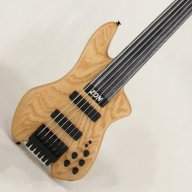
I've heard this over and over on here. Always vague stuff like you said. "Good construction", etc. But what exactly is it? Type of bridge? Type of nut? Type of string? What factors contribute?
well, it's not just about the nut, bridge or string.
When the string is not vibrating, tension is the SAME on all 34" scale basses, no matter what the construction.
However, i believe what affects the feel of the tension on the string is not just static tension, but the play of forces involved when the string is vibrating. The string is "stretched" (because its longer when it's vibrating), and some of that tension is used to pull the string back into its original position... Many forces are involved that i do not know how to calculate.
(You can see this when you pluck hard into a tuner, the pitch drops slightly as the string vibrates less, stretching less)
The stiffness of the neck can affect this play of forces. IMHO this can have an effect on how the string feels, which is what laymen call tension.
Physics will tel you that the additional length after the breaking points on the nut or bridge will do nothing to add tension. If it did, we'd all have 2-foot long extenders on our headstocks for the B string tuners to attach to.
I can tell you, as someone who taught physics lab in college, that the additional length after the nut does affect the tension. Tension is going to be equal on both sides of the nut. There are different things that bass builders do to add to the quality of the B-string. Guiding the string downward after the nut will help with the tension a little, for example.
I actually had a conversation with Roscoe Beck about his signature basses. He told me that he wanted a reverse headstock to help especially his 5 string model but Fender thought it would hurt sales. So they feel looks are more important.

I think the extra string length past the nut does impart something special (as does my luthier), but the "look" is a compromise to traditionalists
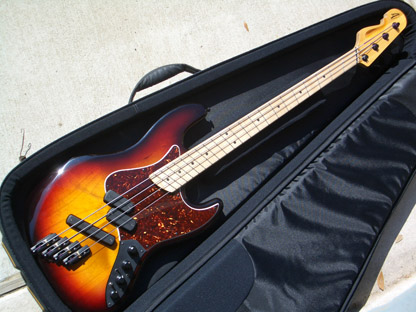
frank
frank
- Status
- Not open for further replies.

