• TalkBass has been independent since 1998. Add your voice.
    Create a free account to reply to discussions, view embedded media, and browse with fewer display ads.
    Join freeLog in
    Want zero display ads or expanded classifieds tools? Compare plans.

If it sounds good FOH does onstage matter?

Anyone who says stage mix doesn't matter is obviously not singing any challenging vocals.

The better the band hears, the better the band plays. I do not like suffering while playing music.

Not only that, but if anyone videotapes you, their camera may pick up more stage mix than FOH. Why wouldn't you want to hear something similar to what the audience hears?

I get sound guys all the time "explaining" to me (as if I am a small, fairly unintelligent child,) "why" there should never be effects on vocals when they are in monitors.

I ask them if they would be explaining that to Aerosmith, if they were doing their sound.

Of course you want effects in your monitors. Effects mean you have to eq better, or you will get feedback. And these guys don't want to work that hard.

But effects also mean you know what your voice sounds like in the mains, and that means you temper your PERFORMANCE based on the ACTUAL SOUND, and not dry monitors. Does it make a difference? I'd swear to it.

As for instruments, I think the same thing is true, only to a lesser degree.

Put the guitar player in his sweet spot. Get his amp UP and pointing at his HEAD and EARS, not his KNEES, and he won't turn that amp up to ungodly levels.

Put a shield around the drummer. Not only does it make the stage more tolerable for everyone, but you don't have cymbals bleeding into vocal mics.

Our stage volume is such that we can talk to each other during songs, without screaming.

That comes in handy.

Bottom line: if you care about your performance, you should work to have a great stage mix. And don't let anyone bully you out of it, just because they don't feel the need.

Yep...+1

 
Anyone who says stage mix doesn't matter is obviously not singing any challenging vocals.

The better the band hears, the better the band plays. I do not like suffering while playing music.

Not only that, but if anyone videotapes you, their camera may pick up more stage mix than FOH. Why wouldn't you want to hear something similar to what the audience hears?

I get sound guys all the time "explaining" to me (as if I am a small, fairly unintelligent child,) "why" there should never be effects on vocals when they are in monitors.

I ask them if they would be explaining that to Aerosmith, if they were doing their sound.

Of course you want effects in your monitors. Effects mean you have to eq better, or you will get feedback. And these guys don't want to work that hard.

But effects also mean you know what your voice sounds like in the mains, and that means you temper your PERFORMANCE based on the ACTUAL SOUND, and not dry monitors. Does it make a difference? I'd swear to it.

As for instruments, I think the same thing is true, only to a lesser degree.

Put the guitar player in his sweet spot. Get his amp UP and pointing at his HEAD and EARS, not his KNEES, and he won't turn that amp up to ungodly levels.

Put a shield around the drummer. Not only does it make the stage more tolerable for everyone, but you don't have cymbals bleeding into vocal mics.

Our stage volume is such that we can talk to each other during songs, without screaming.

That comes in handy.

Bottom line: if you care about your performance, you should work to have a great stage mix. And don't let anyone bully you out of it, just because they don't feel the need.

where the evening is about you, sure....

2nd bar out of 3 in a night with a 15min set-up and sound check window? You better learn to sound good with whatever you have/get....:bassist:
 
A good stage mix means you should be able to hear everything you need to hear to have a great performance. it does nOT mean that it's a mix that would make an excellent FOH mix.

My left side of the stage is mixed totally different than the right, and the drummer has his own monitor mix. Three mixes on the stage, and none of them sound worth a crap except to the person that they are aimed toward, and that's all that matters
 
You play three bars in one night?

15 minute set up?

Can't do it.

sure - a lot of original projects I have been in worked that way - 2 or 3 sets at different bars as part of 4-5 band bills.

45-50min set 10-15min between bands - few bucks and a couple drinks and back on the subway/in the taxi/on the scooter with guitarist's Les Paul duck taped to the side...

arrive at next venue and repeat :) :bassist:


also at some of the big venues I have played (5-7000 - so not big like stadium big...but pretty big for a guy like me) if you aren't the headliner - you get what you get - 10-15min sound check focused on the vocals and levels...stage mix is what you get...deal with it or poop the bed :bassist:

EDIT: and in all these settings the bass amp tends to be whatever they have for backline...so at least 5mins of your time can be spent getting a workable tone out of whatever they have....(Sans-Amp is my friend here...hello effects loop) :)
 
The reason bands with a clue don't have effects in their monitors is so they can hear their harmonies better.

Bands with a clue?

You seem to post that people who do things your way "have a clue," as an insult to those who don't.

And you're pretty consistent about it.

There are a lot of great bands that use effects in their monitors. It is up to those bands; those singers, whether they want to do that.

Do you know who it is NOT up to?

Do you want to guess?

The Sound Engineer.

Or some guy in another band.

Now give us the scientific explanation of how reverb makes it difficult to hear harmonies.

And then, perhaps send a note along to the Dixie Chicks, explaining how you know more about monitors, harmonies, and music and live sound in general than they do.
 
On stage matters but perfect stage mixes are few and far between IMO.

I quit fighting INDOOR PA's with huge/loud bass rigs.
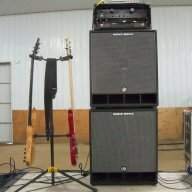
Now I let the FOH subs do the heavy lifting and bring 1 or 2 of these that I use for low-mid, mid, and highs. No problems hearing on-stage anymore:
BX1200.jpg
 
Bands with a clue?

You seem to post that people who do things your way "have a clue," as an insult to those who don't.

And you're pretty consistent about it.

There are a lot of great bands that use effects in their monitors. It is up to those bands; those singers, whether they want to do that.

Do you know who it is NOT up to?

Do you want to guess?

The Sound Engineer.

Or some guy in another band.

Now give us the scientific explanation of how reverb makes it difficult to hear harmonies.

And then, perhaps send a note along to the Dixie Chicks, explaining how you know more about monitors, harmonies, and music and live sound in general than they do.

Here is a little light reading for you.[Invalid or Expired Link Removed] BTW how do you know that I don't know about monitors or live sound than the dixie chicks? Do they run sound for themselves. For that matter how do you know they were useing effects in their monitors were you and Natalie singing a duet together?
 
+1

You should never listen to a guitarist about sound.

++1

I am convinced that guitarists all have music systems at home that have no bass at all. When I first started playing with the band I'm with now, the guitarist I stand next to (we have two guitarists) kept telling me I was too loud, when his volume was practically taking my head off. I had to fiddle and fiddle with my eq to get a sound that would fit, and not engender his complaints. Finally, we had a band meeting and decided that we needed to work on our stage volume (as in, bringing it down), which I agreed with, as it was too loud. We all got smaller rigs, and we now really pay attention to the onstage volume. It has made a difference, and our ears don't ring for two days afterward.

We also cut down our PA system (we run our sound from the stage), and there are enough other musicians we trust who come to hear us that we know will tell us if anything is out of whack. After 40+ years of playing, I pretty much know where my sound needs to set in the mix.

There is one place we play that has some truly strange acoustics. We stand in front a a corner of plate glass windows. We have experimented with where we set up, and most of the time we can get a good sound with a little work. One time, though, I was forced to set my rig in what can only be called an acoustic black hole. I could not hear a note I played, even though I was assured by everyone I asked that they could hear me just fine, in fact, they thought my sound was absolutely awesome, and I'm talking other bass players, too. But, I could not hear myself AT ALL! I told the guys afterward that the next time we play there, I cannot set up in that spot because I can't hear myself. I couldn't even hear the vocal monitors very well (if I can't hear my voice in the monitors, I tend to blow my voice out). At first they thought I was over-reacting, but I insisted, asking them, "how would you feel if you couldn't hear yourself? Could you play well, and get into it?" I had to remind them that I have worked in a recording studio, and took a course in sound reinforcement. I know a bit about those subjects, and I knew right away that I had set up in a null node in the room. After laboriously explaining it to them (several times), they agreed to modify the setup so I wouldn't have to set my rig in that spot. The next time we played there I was not in the null node, and could hear myself very well, and the gig went great. I think they may have learned a little from that.

Guitarists tend to think that if they sound good (to their own ears) that that is all that's important. They seem to look at the bass as something akin to an appendix. That's why the perception of bass players for years was "the fat kid in the back". It was guys like McCartney, Jack Bruce, Chris Squire, Phil Lynott, and others who brought the bass to the front and made it something to be heard and appreciated, and guitarists have been slightly jealous ever since....

Link Removed
 
How it sounds on stage matters MORE.

I can't stand when soundmen say "I'll make it sound good out in the audience!" Well, call me crazy but I feel it's their job to make MY sound the best it can be , not by making my sound lousy and then fixing it in the P.A.

I do not agree. It is harder to get a good mix onstage because (for one thing) you are standing in the middle of a lot of other sound sources besides the monitors. The mix will change for you as you move around in and out from in front of beamy guitar amps, closer and farther from the drums, bass amp, etc. If you have a live wall behind you, it's worse. It's a compromise with the conditions. If you are the Dixie Chicks playing on huge stages in arena venues with gazillions of dollars worth of gear at your disposal, then sure, you can pretty much get what you want, but most of us are playing much smaller stages and venues with less sophisticated sound systems; many times we just have to suck it up in favor of the best FOH mix possible.

In an ideal world everyone in the room would be hearing a studio quality mix, but that's not reality for most of us. Your audience is out front, and getting the best mix for them is more important than for you. Sometimes just being able to hear everyone else is the best we can hope for. Occasionally I don't even get that. Grin and bear it. :D
 
this thread is so full of fail. It's obvious that most of you have never spend two seconds behind a real mixing board and had to deal with the challenges of a monitor mix and prima donna musicians who don't care about how their inappropriately sized cabs ruin the chance for a good house mix.

Suck it up guys, and realize that it's not about YOU, it's about making a good show for the audience. I've been performing live for longer than most of you have been alive, and eventually you will grow up and learn to ask for what you need, not what you want
 
this thread is so full of fail. It's obvious that most of you have never spend two seconds behind a real mixing board and had to deal with the challenges of a monitor mix and prima donna musicians who don't care about how their inappropriately sized cabs ruin the chance for a good house mix.

Suck it up guys, and realize that it's not about YOU, it's about making a good show for the audience. I've been performing live for longer than most of you have been alive, and eventually you will grow up and learn to ask for what you need, not what you want
Although I agree with you in principle, you do come across as a bit condescending. And I'm probably older than you are. :p
 
That's completely irrelevant. My point is it has to sound as good as possible TO ME. I need to hear myself and the balance of other instruments as best I can. THEN...it's up to the soundman to take THAT and make it sound as good as possible out front.


You run the monitor board onstage ?

You never play on bigger stage or places where they have monitoring ?

If you play on a festival with their backline and have 15 minutes setup/soundcheck , will you take the 15 minutes to setup your sound onstage or give it to the FOH guy ?


Of course we all want a good sound on stage , who would not , I think but the point of the thread is wich one is more important