
I started playing at 1/12/26 I SUCK SO MUCH, I NEED HELPLPLPLPLPLPLPLP

Enjoy the benefits of a premium membership!
Upgrade Account
-
TalkBass has been independent since 1998. Add your voice.
Create a free account to reply to discussions, view embedded media, and browse with fewer display ads.
Join free Log in
Want zero display ads or expanded classifieds tools? Compare plans.
You are using an out of date browser. It may not display this or other websites correctly.
You should upgrade or use an alternative browser.
You should upgrade or use an alternative browser.
Im a new player, anything I need to know?
- Thread starter firealarm
- Start date
More options
Who Replied?

Kind of hard to say what you need to know.
Start with what your goal is (playing alone for fun, playing with other people for fun, playing for money, becoming a rock star, etc.)
Do you have any previous experience playing a musical instrument?
Can you afford to study with a teacher?
Where do you live?
What instrument do you have?
What amplification are you using…a bass amp, headphones, etc. ?
Start with what your goal is (playing alone for fun, playing with other people for fun, playing for money, becoming a rock star, etc.)
Do you have any previous experience playing a musical instrument?
Can you afford to study with a teacher?
Where do you live?
What instrument do you have?
What amplification are you using…a bass amp, headphones, etc. ?
I agree with everything @brianrost said, but let's back up even further: What exactly do you mean when you say that you "started playing" (in January)? What have you been doing, or trying to do, over the last four months?

Go invest in some lessons. They'll help you figure out what you need to work on, what you don't know that you don't know, and adjust technique issues to avoid developing bad habits which you are going to have to unlearn later.
Try and look up some tabs of easy songs like cranberries- zombie, four non blondes - what’s up. And just have some fun trying to learn those. Or any other song that you may like. In the beginning sticking with it is one of the hardest things. Try not to get discouraged and just have some fun playing the songs you like. Theory and scales are important, too, but it’s ok to just have fun.
Last edited:
Begin with songs that are simple to play. Like quarter notes at a reasonable tempo.
Listen to what bass players are doing on recordings. Not just the notes, but also the "feel," the little nuances. This may involve some ear training on your part. This is a huge part of learning to play bass, because getting even marginally good at it is a hell of a lot more than just hitting the right notes at the right time.
Play along with recordings (with the recordings' bottom end rolled off) and record everything you do. It can be as simple as playing music through a stereo system, playing your bass guitar through a small bass amp, and using a stereo handheld recorder to record the mix, i.e. the "session." Then listen to how well you did.
You will have to invest serious time for practice, that is if you want to get reasonably good by, say, the end of the year. You may have to dump other things you like to do off your schedule. Going back several decades, I can tell you exactly when I transitioned from Suck to Pretty Good. It was when I was practicing 4-5 hours a day. When I began working professionally, those hours went to 8-10 hours a day, not counting performance time.
Make sure your instrument isn't holding you back because there's something wrong with it that makes it hard to play. If you don't yet know how to do setups, take it to someone who does. Just be careful on that point, because there are plenty of butchers out there whose work can cause long term damage, some with tens of thousands of Youtube subs.
Find a tone you like, and watch that person's technique, especially his/her right hand position. Some people play close to the neck, some close to the bridge, some somewhere in between. The advanced players can adjust that position on the fly to fit particular songs or specific parts of a song, but you can save that for later.
Don't bang the strings. Keep your fingers' first joints flexible and gently come across the tops of the strings. There are lots of players out there whose plucking fingers look like they're trying to pick at a scab or a callus. That's not the path to a good tone.
Metronome. But one and spend time with it. Boring? You bet. But it pays off.
I could keep going but I'll quit here.
Listen to what bass players are doing on recordings. Not just the notes, but also the "feel," the little nuances. This may involve some ear training on your part. This is a huge part of learning to play bass, because getting even marginally good at it is a hell of a lot more than just hitting the right notes at the right time.
Play along with recordings (with the recordings' bottom end rolled off) and record everything you do. It can be as simple as playing music through a stereo system, playing your bass guitar through a small bass amp, and using a stereo handheld recorder to record the mix, i.e. the "session." Then listen to how well you did.
You will have to invest serious time for practice, that is if you want to get reasonably good by, say, the end of the year. You may have to dump other things you like to do off your schedule. Going back several decades, I can tell you exactly when I transitioned from Suck to Pretty Good. It was when I was practicing 4-5 hours a day. When I began working professionally, those hours went to 8-10 hours a day, not counting performance time.
Make sure your instrument isn't holding you back because there's something wrong with it that makes it hard to play. If you don't yet know how to do setups, take it to someone who does. Just be careful on that point, because there are plenty of butchers out there whose work can cause long term damage, some with tens of thousands of Youtube subs.
Find a tone you like, and watch that person's technique, especially his/her right hand position. Some people play close to the neck, some close to the bridge, some somewhere in between. The advanced players can adjust that position on the fly to fit particular songs or specific parts of a song, but you can save that for later.
Don't bang the strings. Keep your fingers' first joints flexible and gently come across the tops of the strings. There are lots of players out there whose plucking fingers look like they're trying to pick at a scab or a callus. That's not the path to a good tone.
Metronome. But one and spend time with it. Boring? You bet. But it pays off.
I could keep going but I'll quit here.
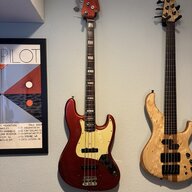
This is TalkBass so I'll tell it to you straight.
You need at least 12 different basses to play well.
You need at least 12 different basses to play well.

I’m old school. My answer is consistent.
Learn to play the instrument. Learning to play songs on an instrument is not learning the instrument.
Get a teacher whose primary instrument is bass. Learn to read standard notation while learning the instrument. The learning process becomes one thought process instead of two. Standard notation is a language that facilitates explaining musical structure. Do not put any effort into learning tab. I’ve been gigging over 60 years, playing by ear, using fake books and chord sheets, and reading fully orchestrated charts. I have never been paid to read tab.
Learn to play the instrument. Learning to play songs on an instrument is not learning the instrument.
Get a teacher whose primary instrument is bass. Learn to read standard notation while learning the instrument. The learning process becomes one thought process instead of two. Standard notation is a language that facilitates explaining musical structure. Do not put any effort into learning tab. I’ve been gigging over 60 years, playing by ear, using fake books and chord sheets, and reading fully orchestrated charts. I have never been paid to read tab.
Play Bass is a physical thing. Don't worry about songs..... it'll take you a few months to get yourself physically capable. Right now is a very important time for you. It's critical that you spend the time - go slow - use meticulous form. Do everything exceptionally well, even if it's embarrassingly SLOW. In the coming weeks / months the speed will come on its own - Don't try to be fast - TRY to be perfect. It'll all pay off later on.
Is your bass set up properly/easy to play ?I started playing at 1/12/26 I SUCK SO MUCH, I NEED HELPLPLPLPLPLPLPLP
Also, Rich Brown lessons are good.
Last edited:


buldog5151bass
Kibble, milkbones, and P Basses. And redheads.
Get a few lessons if you feel that lost. Get a base so you feel comfortable, whether or not you keep up with the lessons.

This right here. There are a lot of great suggestions in this thread, but absolutely nothing beats some 1-on-1 instruction for bringing yourself up-to-speed quickly.Get a few lessons if you feel that lost.
Don’t be too hard on yourself. (That’s our job.
 ) You’ve only been playing for 4 months; of course you suck. But stick with the lessons, keep practicing, and in another 4 months you won’t suck as much. In fact, nowhere near as much, and you’ll have a solid foundation to build on.
Welcome to Talkbass.

Is your bass set up properly/easy to play ?
Also, Rich Brown lessons are good.
+++1
Rich B. explains things clearly, and makes it easy to follow along.. good call

Josquin des Prés - Bass Fitness pdf
(*Using a metronome will help with your timing.)
The 200 exercises are designed to help increase your speed, improve your dexterity, develop accuracy and promote finger independence. Recommended by world-acclaimed bass players, music schools and music magazines, this is the ultimate bass handbook. All exercises are written in standard notation and tab. This updated edition also includes a bonus section on 5-string bass.


Dont worry too much. Just get a bass hold it and try and pluck a note down by the tuners....and repeat. If absolutely hopeless try and find a teacher. I do think the internet creates probs where there isnt any. 40 yrs ago we just picked it up and plucked.


Start practicing immediately. Now.
Repeat the same exercises each day several times a day. Play in tune and train your ears to listen to the regularity of the sound in parallel to your playing and hand movements. Follow with your ears. Train yourself this way.
Systematic. Develop a system of repetition for a practice routine.
Practice anything. Practice things that most make you want to play and keep playing.
Try to maximize your practice time.
You will not be motivated every day. Practice anyway if possible. This is called systematic training. It guarantees results.
Repeat the same exercises each day several times a day. Play in tune and train your ears to listen to the regularity of the sound in parallel to your playing and hand movements. Follow with your ears. Train yourself this way.
Systematic. Develop a system of repetition for a practice routine.
Practice anything. Practice things that most make you want to play and keep playing.
Try to maximize your practice time.
You will not be motivated every day. Practice anyway if possible. This is called systematic training. It guarantees results.


