I'm an old-school guy who's used nothing but floor monitors. I am not here to discuss which is the best in-ear brand. I just wanna know what the allure is with this equipment in general. I don't do well with earpieces (I think my canals are deformed!!), and nothing irritates me more than being at a show and watching one fall out (or get yanked out, which many people seem to do),then getting to spend the next five minutes watching them fumble to get it back in and adjusted properly (while a song's in progress). It seems at times that these may be more of a nuisance than they're worth. Are they beneficial, superior, trendy....I don't know. Lend me your thoughts.

Enjoy the benefits of a premium membership!
Upgrade Account
-
TalkBass has been independent since 1998. Add your voice.
Create a free account to reply to discussions, view embedded media, and browse with fewer display ads.
Join free Log in
Want zero display ads or expanded classifieds tools? Compare plans.
You are using an out of date browser. It may not display this or other websites correctly.
You should upgrade or use an alternative browser.
You should upgrade or use an alternative browser.
In-Ear Monitors
- Thread starter D.E.C.
- Start date
More options
Who Replied?Ear molds. That will be step one. Anything under $1K are junk IMHO. Buy junk and you will hate it. Buy really good ones, and you will happier. Some people just don't like them no matter what. You might be one of those guys. Mutual admiration socity, (nickelcreek,etc, with JPJ on bass) JPJ still wanted a wedge. Everyone else was ears.
Sennhieser and shure both make really nice ears units, but the ear buds are critical to the end result. Cheap out on any of them and you probably will not like the transistion.
Ears are turly a "you get what you pay for" deal. YMMV.
Sennhieser and shure both make really nice ears units, but the ear buds are critical to the end result. Cheap out on any of them and you probably will not like the transistion.
Ears are turly a "you get what you pay for" deal. YMMV.
I have a pair of Shure SE530s (with the push-to-hear module, which is pretty cool, but don't use it live). I had Sensaphonics custom make me a set of molds.
The plus side is enormous:
- The frequency response is incredible, going as low as I could want as a bassist
- The comfort is (relatively) great, providing excellent sound isolation. And, since they're custom made for my ears, they fit very well
- Because they fit so snugly, they do a great job of blocking out everything, allowing me to play at lower volumes which translates to less hearing damage in the long run
- With the custom molds, there's no chance mine are going to fall out. Furthermore, they're made to fit MY ears, so I don't have to wrangle with awkward shaped ear buds
- Using IEMs instead of wedges / monitors enables you to carry less equipment, which, in itself, has numerous advantages
The down side is also significant:
- There's no substitute for moving air, regardless of how great the frequency response is
- Because they're so snug, onstage communication and audience "cheering" is barely audible. There are ways around this, such as having a microphone set up just to pick up the audience, then having that fed directly into your headphone mix. Still, it's not the same
- While I'm comfortable with putting them in and taking them out, it's still an effort. I'd say you get used to it after a while, but it's still more effort than not having to use them at all
The best thing, IMO, is that when using IEMs is you can hear your playing (and singing, if you do that) with much greater detail. For singers especially, there's a lot less screaming you have to do to hear yourself, which can result in an easier time putting on a great performance.
My preference is to not use them, since I like the sound and feel of moving air, but given the convenience and safety factors (of preserving your hearing), it's easy to justify using them.
One word of caution: as a bass player, finding a good pair is crucial, since many lack the low end frequency range. In the Shure line, IMO, none below the 500 series are worth it for bass-work. The cool thing is, you can find NIB (it's disgusting to use someone else's used ear buds) on e-Bay or elsewhere for a fraction of their list price.
The plus side is enormous:
- The frequency response is incredible, going as low as I could want as a bassist
- The comfort is (relatively) great, providing excellent sound isolation. And, since they're custom made for my ears, they fit very well
- Because they fit so snugly, they do a great job of blocking out everything, allowing me to play at lower volumes which translates to less hearing damage in the long run
- With the custom molds, there's no chance mine are going to fall out. Furthermore, they're made to fit MY ears, so I don't have to wrangle with awkward shaped ear buds
- Using IEMs instead of wedges / monitors enables you to carry less equipment, which, in itself, has numerous advantages
The down side is also significant:
- There's no substitute for moving air, regardless of how great the frequency response is
- Because they're so snug, onstage communication and audience "cheering" is barely audible. There are ways around this, such as having a microphone set up just to pick up the audience, then having that fed directly into your headphone mix. Still, it's not the same
- While I'm comfortable with putting them in and taking them out, it's still an effort. I'd say you get used to it after a while, but it's still more effort than not having to use them at all
The best thing, IMO, is that when using IEMs is you can hear your playing (and singing, if you do that) with much greater detail. For singers especially, there's a lot less screaming you have to do to hear yourself, which can result in an easier time putting on a great performance.
My preference is to not use them, since I like the sound and feel of moving air, but given the convenience and safety factors (of preserving your hearing), it's easy to justify using them.
One word of caution: as a bass player, finding a good pair is crucial, since many lack the low end frequency range. In the Shure line, IMO, none below the 500 series are worth it for bass-work. The cool thing is, you can find NIB (it's disgusting to use someone else's used ear buds) on e-Bay or elsewhere for a fraction of their list price.
Aside from eliminating floor monitors and onstage amplification, theres another application of these, namely where the goal is mostly to hear yourself onstage...if you are in a loud band but still want to hear the subtleties of your playing, using ear monitors with only your bass in the mix is something i have found both saves my hearing and helps me play better.
key is a sound isolating earbud, a simple equalizer to choose what frequencies to send thru your earbuds, and a headphone mixer so that you can reduce the decibles of the other loud instruments onstage while dialing in the amount of bass u want to hear. My entire in ear system costs under $200. It does not replace my onstage rig, it supplements it.
key is a sound isolating earbud, a simple equalizer to choose what frequencies to send thru your earbuds, and a headphone mixer so that you can reduce the decibles of the other loud instruments onstage while dialing in the amount of bass u want to hear. My entire in ear system costs under $200. It does not replace my onstage rig, it supplements it.
I have to agree that you get what you pay for. I also agree with others above that they just might not be for you. I just changed from a Shure psm200 to a Senheisser 300 I think and there is a huge diffenece. I use Westone U2's I think for ears so no change there but the quality was amazing. I found the Senn on ebay as a refurb with full warranty for almost half off. They are fine for me. I use both ears now and the safety an isolation is fine. I played a very noisy stage this weekend with a 5 peice band and feedback was everywhere becasue of the stage. The back was a hugh window and all surfaces were hard wood. I had no issues hearing myself and the band. As others say it may not be for you. Oh my buds never fall out and I don't have a custom mold job.
Chris P.
Chris P.
pros...
- you can hear yourself play
- you won't be yanking on the strings and choking your pickups
- you'll save your hearing
- you'll groove better, cause you can hear better
- your tone will be better because you can play with a lighter touch
cons
- uh, I guess you won't be moving air
I have a $150 pair of Shures, no custom molds, and they're great, and don't fall out.
Mark
- you can hear yourself play
- you won't be yanking on the strings and choking your pickups
- you'll save your hearing
- you'll groove better, cause you can hear better
- your tone will be better because you can play with a lighter touch
cons
- uh, I guess you won't be moving air
I have a $150 pair of Shures, no custom molds, and they're great, and don't fall out.
Mark
Agree with what everyone's said so far.
I've got a pair of custom molded dual drivers, and they reproduce my bass (even my B string) great.
There are some good companies out there, including some that have already been mentioned: Shure, Westone, Sensaphonics. You may want to look at LiveWires as well.
This was mentioned earlier, but one trick is to have the sound guy mix in a bit of room, if he has a mic on the crowd. That gives it more of a "live" feel.
But at the end of the day, it just may not feel right to you!
I've got a pair of custom molded dual drivers, and they reproduce my bass (even my B string) great.
There are some good companies out there, including some that have already been mentioned: Shure, Westone, Sensaphonics. You may want to look at LiveWires as well.
This was mentioned earlier, but one trick is to have the sound guy mix in a bit of room, if he has a mic on the crowd. That gives it more of a "live" feel.
But at the end of the day, it just may not feel right to you!
i'm another one in agreement with what's been said so far.
To me Custom molded are a BIG plus. I've tried a wide variety of universal fit inears, with some limited success. Bass response was marginal and there was still quite a bit of bleed through for the stage. just got a set of 3 way molded Inearz brand IE-550 (www.Inearz.com). What a difference. Best spent money in a long time. Bass sounds great all the way down to B.
The only thing i have to say is that live mics and a good mix are now even more critical. Thankfully we're able to have a splitter board with 6 mixes, so i can have anything i want in my mix.
Bill
To me Custom molded are a BIG plus. I've tried a wide variety of universal fit inears, with some limited success. Bass response was marginal and there was still quite a bit of bleed through for the stage. just got a set of 3 way molded Inearz brand IE-550 (www.Inearz.com). What a difference. Best spent money in a long time. Bass sounds great all the way down to B.
The only thing i have to say is that live mics and a good mix are now even more critical. Thankfully we're able to have a splitter board with 6 mixes, so i can have anything i want in my mix.
Bill
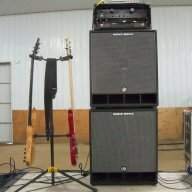
A couple of other advantages of IEMs. Size and weight, My band has 4 IEMs in a rack that weighs about 20 pounds. The same set-up with wedges would weigh at least 10 times that and take up alot more room onstage and in your vehicle/trailer. Your band should sound better and be able to play at less volume because your FOH isn't having to compete with your monitor wash. These alone make them worth it IMO.

this is a nice resource: http://www.audiologyonline.com/articles/pf_article_detail.asp?article_id=2115
this is a nice resource: http://www.audiologyonline.com/articles/pf_article_detail.asp?article_id=2115
Very good article.
I use IEM but the rest of my 5 peice band is so old school they basically laugh at me behind my ear
 But I hear better most nights.
CP
I've been playing for 30 years and since converting to IEM's 10 years ago here are my observations
The pros:
No more pounding headaches after a gig.....
I'm not hoarse from singing at the top of my lungs to hear myself...
No more extra amps and wedges...
And, surprisingly, less fatigue. I guess when you're not digging in all night to hear your bass or screaming your head off to hear your vocals, it takes a lot less out of you physically.
The real benefit is in being able to hear yourself very clearly. That improves your touch, feel and articulation and when you can hear yourself, you'll sound better out front and play better.
Cons: None. I'd rather keep my hearing intact than to feel a little bit of air moving around.
One final thought...the previous posts are right about cheap IEM's. Get the good stuff (custom molds if you can afford it) and you won't miss the bottom end and the only thing you'll regret is that you didn't so it sooner.
The pros:
No more pounding headaches after a gig.....
I'm not hoarse from singing at the top of my lungs to hear myself...
No more extra amps and wedges...
And, surprisingly, less fatigue. I guess when you're not digging in all night to hear your bass or screaming your head off to hear your vocals, it takes a lot less out of you physically.
The real benefit is in being able to hear yourself very clearly. That improves your touch, feel and articulation and when you can hear yourself, you'll sound better out front and play better.
Cons: None. I'd rather keep my hearing intact than to feel a little bit of air moving around.
One final thought...the previous posts are right about cheap IEM's. Get the good stuff (custom molds if you can afford it) and you won't miss the bottom end and the only thing you'll regret is that you didn't so it sooner.

I've been giving real thought to switching to IEM's. Mainly because most venues we've been playing already have a sort of a bass rig there (although it's not always great), i do have good equipment but most of the time it seems to be spending more time at home than on stage.I've also moved out of town and with no car its a pain to try and get my stuff into town for local gigs(even though my bass rig is small)
So if i'm going for In Ears what would i need?
Also alot of gigs we play (especially smaller cafe's and bars)there is no sound engineer but there is usually an in house PA of sort.
Would it be possible for me to have a small mixer of my own for my in Ear mix (like a personal monitor mixer)??
So if i'm going for In Ears what would i need?
Also alot of gigs we play (especially smaller cafe's and bars)there is no sound engineer but there is usually an in house PA of sort.
Would it be possible for me to have a small mixer of my own for my in Ear mix (like a personal monitor mixer)??
I use UE5 dual drivers. $300, and they're fantastic. They have cords that wrap around the back of the ear with a wire, so I've never had one fall out.
Incredible frequency response.
Plus, they make your ipod sound AMAZING
Incredible frequency response.
Plus, they make your ipod sound AMAZING
I love my molds and Im SOOOOO glad I got ambient hearing..so no need of a room mic... Having the ambient still gives me the live feel of the room.. not so isolated..
No more volume wars!
One 410 with a head instead of two 410s with a head and a power amp!
Stereo for my Keyboards!
Smaller vehicle with less gas use!
The pros list goes on and on.
The only real con I find is extra batteries. The transition sucks and you need to commit to it but it is worth it in the end. The sound in my ear buds is so good I cringe if I have to play with out them for a moment.
One 410 with a head instead of two 410s with a head and a power amp!
Stereo for my Keyboards!
Smaller vehicle with less gas use!
The pros list goes on and on.
The only real con I find is extra batteries. The transition sucks and you need to commit to it but it is worth it in the end. The sound in my ear buds is so good I cringe if I have to play with out them for a moment.


