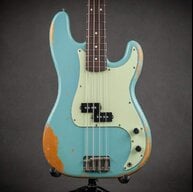
I don't think Fender has their own foam factory with a proprietary formula.
Tone foam, my man, and as we established in that capacitor thread, vintage tone foam is always better!

TalkBass has been independent since 1998. Add your voice.
Create a free account to reply to discussions, view embedded media, and browse with fewer display ads.
Join free Log in
Want zero display ads or expanded classifieds tools? Compare plans.
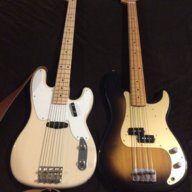

Agree, I always use the foam packing. I bought a set of screws with springs on Amazon but the packaging foam worked better.I remember a video when the GZR’s first came out where Geezer said he wanted that foam in the packaging specifically to be cut down and used under the pickups. I had the same pickups and used that foam. It’s waaaay more useful than the little bars that come with some pickups since you can cut it up into whatever shape.
What? I never thought of that!!!!! Thanks!Another way to do it is to slide a little surgical tubing on the screw to act as a spring, that’s my preferred method. Not that there’s anything wrong with the foam. I believe best bass gear and stewmac both sell small lengths of tubing for this purpose.


My two cents, before thinking about what to use first check your fretboard curvature, to determine pickup orientation.
You can measure the distance from the top of each string to the bottom of the pickup cavity and from there, estimate the amount of foam, flip-flops or tubing you will need. Remember: The most important thing to get balanced output, is to keep the bottom of each string to pickup poles distance as even as possible.
View attachment 4603982
I recently installed the ashtray covers in my P bass and I looked up the recommended drill bit size for the screws. So if you know the size of the screws you can find out the right size for the pilot holes. It should help you avoid problems.You guys are awesome. Thank you for all the valuable information and for not making me feel like an idiot.
This is good advice. A lot of cheap P-bass clones come with the pickups adjusted parallell to the surface of the pickguard. If you only have experience with cheaper P-basses it's easy to make this mistake. The pickup needs to be slanted downwards under the outer strings for an even balance across the strings. This of course means than when the action is set correctly the pickups will more or less follow the radius of the fingerboard. The pickups will have a steeper angle with a 7.25" fingerboard than with 9.5" or 12". Use your ears. This isn't an exact science and the perfect position will depend on the strings, the pickup in question and your style of playing.
I've even seen Squier CVs manufacturer by Cort/Samick come with the pickups adjusted parallell to the pickguard. I can understand why the cheapest Chinese knockoffs come like this but I would expect better from an official Fender product made by experienced manufacturers like Cort/Samick. Very poor.

 ).
).
Undoubtedly true. But they probably get someone to manufacture it to their specifications. And FWIW, their foam works very well. Better than sponges, flip-flops, packaging foam, etc. It has just the right amount of give and lasts pretty long. And it's not really very expensive. Best Bass Gear foam is cheaper and also very good, however.
You can just add more pieces of foam under the pickups for more support.


This method won't give even string-to-string balance. The magnetic flux is less dense on the outer strings (E and G) because the A and D strings have a field that is supported on both sides by the magnets of the E and G string respectively. The E and G strings have no additional outer edge support. So use your ears, not a ruler, to set the string-to-string balance.Remember: The most important thing to get balanced output, is to keep the bottom of each string to pickup poles distance as even as possible.
View attachment 4603982
And the E (or B) and the G are presenting vastly different masses to the magnetic fields.This method won't give even string-to-string balance. The magnetic flux is less dense on the outer strings (E and G) because the A and D strings have a field that is supported on both sides by the magnets of the E and G string respectively. The E and G strings have no additional outer edge support. So use your ears, not a ruler, to set the string-to-string balance.
This method won't give even string-to-string balance. The magnetic flux is less dense on the outer strings (E and G) because the A and D strings have a field that is supported on both sides by the magnets of the E and G string respectively. The E and G strings have no additional outer edge support. So use your ears, not a ruler, to set the string-to-string balance.

The electrical impulses in the coils are caused by a disturbance in the magnetic field that surrounds the coils. Something that is not ferrous will not disturb the magnetic field, whereas something that is ferrous will, magnetized or not. The more intense the magnetic field, the more disturbance.Relative to the magnet flux density comment and E and G string not having additional outer support is not the way conventional pickups work. The idea of a vibrating string cutting magnetic field lines to generate current is not correct.
The pickup magnets function is to magnetize the strings, so they generate an electrical signal when vibrating over the coils, which extend way beyond the poles to provide "edge support".
View attachment 4610230
Indeed, which would suggest that the pickup should be closer to the G string than any other string, the E string (or B) the furthest away. But it doesn't work out so well like that. You will most often see staggered pole pieces on guitars where the G string pole is the one furthest away from the string. That doesn't follow the fingerboard radius. Same is true on many basses, where the G string is hot if the pickup is at the same distance as the other strings.And the E (or B) and the G are presenting vastly different masses to the magnetic fields.