
Enjoy the benefits of a premium membership!
Upgrade Account
-
TalkBass has been independent since 1998. Add your voice.
Create a free account to reply to discussions, view embedded media, and browse with fewer display ads.
Join free Log in
Want zero display ads or expanded classifieds tools? Compare plans.
You are using an out of date browser. It may not display this or other websites correctly.
You should upgrade or use an alternative browser.
You should upgrade or use an alternative browser.
Is anyone doing a ToneStyler type control at a cheaper price?
- Thread starter Blues Cat
- Start date
More options
Who Replied?

Depending on what values you want ..
I guess
Invalid Link Removed
Now down to Values, if you can find out what values they use, might be able to get some thing simlar
I can get a 2P12T Switch but its BIG talking a Inch PLUS
I guess
Invalid Link Removed
Now down to Values, if you can find out what values they use, might be able to get some thing simlar
I can get a 2P12T Switch but its BIG talking a Inch PLUS



I was just thinking the same thing yesterday... I love the tone of one of my basses rolled down but kind of hate it rolled up.
I've heard people say that the Tonestyler is an RC network, or a bunch of RC networks, but website guy seems to have a bunch of the same resistor (2M) to prevent popping. You could do the same thing with a shorting (make before break) rotary switch. Pick whatever 6/12/18 cap values you like.
I'm going to have to do this.
I've heard people say that the Tonestyler is an RC network, or a bunch of RC networks, but website guy seems to have a bunch of the same resistor (2M) to prevent popping. You could do the same thing with a shorting (make before break) rotary switch. Pick whatever 6/12/18 cap values you like.
I'm going to have to do this.
I did that megatone, but I used two hexadecimal switches and a push pull tone pot to switch between the two. But both use the same caps but only one resister in parallel with the caps.
It dose 220p to 100nF in about 200pF step up 9bit switching
Just need to stream line it more so only uses one hexadecimal switch
It dose 220p to 100nF in about 200pF step up 9bit switching
Just need to stream line it more so only uses one hexadecimal switch

What's the difference between this and a Stellartone varitone?
If you mean the Tonestyler, I'd imagine not much. Some people have said that the TS is about changing resonance, not capacitance, which I'm not entirely convinced is true, but I could be wrong. This is a cheap way to experiment.

- Aug 5, 2005
- 7,243
- 92
- Disclosures
- Endorsing Artist: J.C. Basses
If you mean the Tonestyler, I'd imagine not much. Some people have said that the TS is about changing resonance, not capacitance, which I'm not entirely convinced is true, but I could be wrong. This is a cheap way to experiment.
Changing the capacitance or resistance will inherently shift the resonant peak, so I don't think they're mutually exclusive.

Changing the capacitance or resistance will inherently shift the resonant peak, so I don't think they're mutually exclusive.
Yeah, they are not mutually exclusive, they are joined at the hip. A switched capacitor tone control has a response something like this:
You get a resonant peak just below the cutoff frequency due to the inductance of the pickup and the capacitance of the tone control. Selecting bigger and bigger capacitors moves the resonant peak and the cutoff frequency lower and lower. You don't see this effect with a traditional tone control because the resistance of the tone pot damps the resonance. However as the tone pot reaches its minimum value you will see a resonant peak even with a traditional tone control. The difference is that the "tonestyler" has a resonant peak at every setting where the traditional tone control has one only when nearly completely rolled off. At higher settings it has a smooth, peak free (overdamped), roll off whose cutoff frequency varies with the pot setting.
BTW, the natural frequency of the resonance in radians/second is:
w = 1 / sqrt( C * L )
where w is the frequency, C is the tone capacitance plus any stray capacitance in the wiring, and L is the pickup inductance. The sqrt() function just means you need to take the square root of L * C. If you want the frequency in Hz you divide w by 2*pi. You cannot change C without changing f and w.
Ken
You don't see this effect with a traditional tone control because the resistance of the tone pot damps the resonance. However as the tone pot reaches its minimum value you will see a resonant peak even with a traditional tone control. The difference is that the "tonestyler" has a resonant peak at every setting where the traditional tone control has one only when nearly completely rolled off.
This... was what I was trying to say.
I know they're not mutually exclusive, I just suck at explaining. lol. I mean, I don't see much of a difference between a Tonestyler and any other switched-cap tone control (including the homebrewed ones.) Is there some other kind of mojo going on with them or...?
This... was what I was trying to say.
One significant difference is the caps in the Tonestyler are small and custom made to very tight tolerances so the unit will fit into a typical Fender size control cavity.
Yeah, they are not mutually exclusive, they are joined at the hip. A switched capacitor tone control has a response something like this:
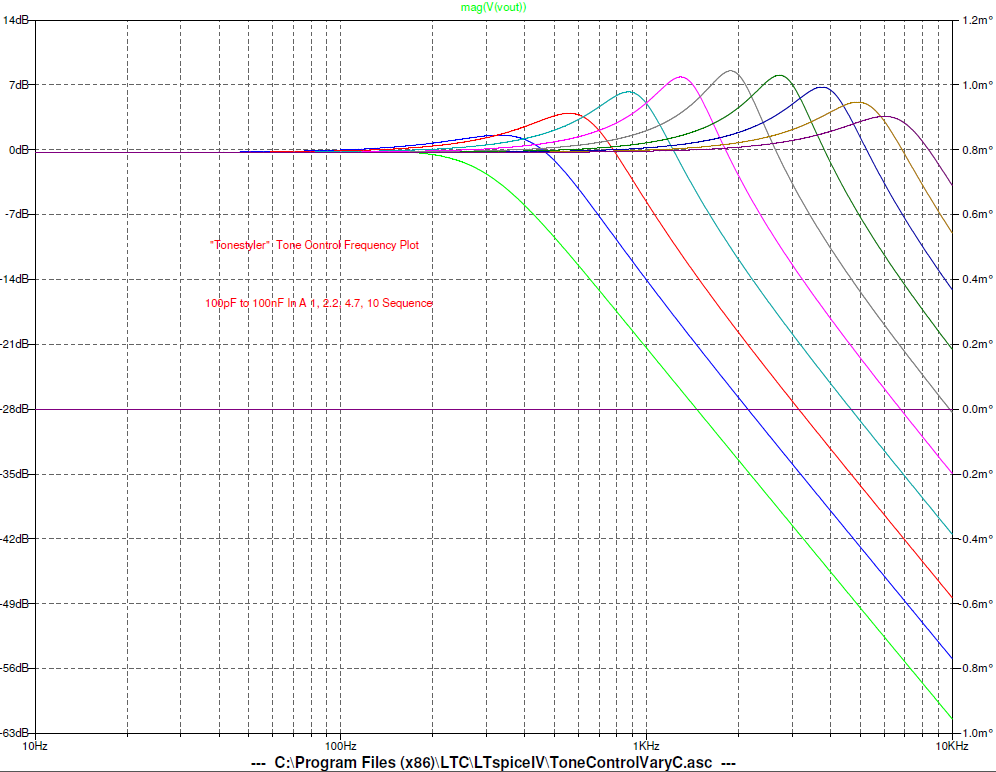
You get a resonant peak just below the cutoff frequency due to the inductance of the pickup and the capacitance of the tone control. Selecting bigger and bigger capacitors moves the resonant peak and the cutoff frequency lower and lower. You don't see this effect with a traditional tone control because the resistance of the tone pot damps the resonance. However as the tone pot reaches its minimum value you will see a resonant peak even with a traditional tone control. The difference is that the "tonestyler" has a resonant peak at every setting where the traditional tone control has one only when nearly completely rolled off. At higher settings it has a smooth, peak free (overdamped), roll off whose cutoff frequency varies with the pot setting.
BTW, the natural frequency of the resonance in radians/second is:
w = 1 / sqrt( C * L )
where w is the frequency, C is the tone capacitance plus any stray capacitance in the wiring, and L is the pickup inductance. The sqrt() function just means you need to take the square root of L * C. If you want the frequency in Hz you divide w by 2*pi. You cannot change C without changing f and w.
Ken
winner! this is the best description so far of the way it works, even after there was a full thread about this recently (while being off topic, it was something about precision basses initially).
GREAT post! +1
This is a 11 Positions with one being off.
If you had a On/Off/On Toggle with a 2P6T you can have 12 Positions with 1 Resisters only.
ill try and recall if there was any other ways like a on/on
There is a 2P12T but its a FAT thing and costly
Sorry it was very late when i typed that
If you had a On/Off/On Toggle with a 2P6T you can have 12 Positions with 1 Resisters only.
ill try and recall if there was any other ways like a on/on
There is a 2P12T but its a FAT thing and costly
Sorry it was very late when i typed that


