• TalkBass has been independent since 1998. Add your voice.
    Create a free account to reply to discussions, view embedded media, and browse with fewer display ads.
    Join freeLog in
    Want zero display ads or expanded classifieds tools? Compare plans.

Is creating a frankenbass worth it?

There is a point where resale is not that relevant.

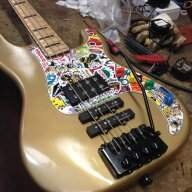
For a little over 500 bucks I made a FB from Ebay, Lowe's Custom, and various vendors that is totally unique and gigable. I learned to solder and had an absolute blast finding all the stuff and making it work. I already had a cordless drill, cheapo V/O meter and hex wrenches and only had to buy a few minor small tools.

I do have the decal sheets and design but haven't applied the, as I am considering painting the headstock, logo yet.
084.JPG


Go for it. Have fun. I probably could not give it away but since it is what I play who cares.

One piece of advice. Don't scrimp on tuners!
 
For a little over 500 bucks I made a FB from Ebay, Lowe's Custom, and various vendors that is totally unique and gigable. I learned to solder and had an absolute blast finding all the stuff and making it work. I already had a cordless drill, cheapo V/O meter and hex wrenches and only had to buy a few minor small tools.

That's a beaut, LT131. Where'd you get the red tort pickguard?
 
There is a point where resale is not that relevant.

For a little over 500 bucks I made a FB from Ebay, Lowe's Custom, and various vendors that is totally unique and gigable. I learned to solder and had an absolute blast finding all the stuff and making it work. I already had a cordless drill, cheapo V/O meter and hex wrenches and only had to buy a few minor small tools.

I do have the decal sheets and design but haven't applied the, as I am considering painting the headstock, logo yet.View attachment 689808

Go for it. Have fun. I probably could not give it away but since it is what I play who cares.

One piece of advice. Don't scrimp on tuners!

Wow, that white and tort looks great!
 
  • Like
Reactions: FlatwoundFunk
I agree about the woodworking equipment. But wiring (for a bass) is pretty easy. A soldering iron (*), some solder, some wire, a third hand, and some sort of desoldering tool (either pump or tape). The third hand is not required but very handy. A multimeter is also very handy to check the results. The cheapest one will work just fine, although I like one that can "beep" out continuity.

(*) I use a 35W pencil soldering iron. Nothing special and not a high end soldering station. I would not recommend the 20 or 25W pencils.. they are for electronics not soldering to pots. You need enough heat... but not too much.

As much as I'd like to, every time I pick up electronic wiring gear, the angry ghost of Nicola Tesla rises up and warns me away from doing something that might End the World. :eek: :dead:
 
No offense intended, people get touchy about fake logos because some bozo is always hawking an obvious fake on Ebay with a counterfeit decal for high dollars. When you get into the stratospheric level of rare vintage instruments, there is a thriving forgery underworld, the same characters who make fake painting and antiques. Most guitar forgeries are pretty blatant, but an expertly relic'd instrument, often built from at least some genuine parts, can fool even the experts. Unlike paintings, most guitars have little to no provenance. There's a guy who keeps trying to sell what is clearly a Jazz parts bass supposedly once owned by Jaco for thousands, can't remember what it is now
As he keeps changing the price. What balls! Its funny unless you are the sap that buys the fake.
I think it could be okay if the neck was deeply embossed "All Parts" or "Warmouth" or whatever it is on the back, while having a Fender logo on the front. As long as it's marked in a permanent manner.
 
I enjoyed piecing mine together. Few parts from the States (tremolo bridge, D-Tuner) and some cheap pickups just to see how it went. Was a fun exercise even if I did make a pooey job of the repaint!
 

Attachments

  • image.jpg
    image.jpg
    576.8 KB · Views: 39
  • Like
Reactions: hintz
Interested to know how many people create exactly what they want from parts, or spare themselves the fuss and pay extra for the real thing?

I'm personally pondering how to get a bass that looks like a '75 natural ash Jazz with maple fretboard and white block inlay neck (and not pay crazy vintage USA prices). Which route would you take?

1. Pay close to grand for a Japanese '75 reissue on ebay, which looks perfect and they're generally known to be quality instruments. The pros are I can start playing straight away. The cons are it's a little pricier than a frankenbass, possible customs tax, and if I don't like it I can't send it back.

2. Use a MIM natural ash body I have, buy a maple and white block inlay neck from Allparts, and slap a CUSTOM logo decal (Edit, won't be using Fender branding) on it. The pros are it's a little cheaper than the Japanese option. The cons are hiring a tech to get everything set up right and troubleshooting possible incompatibilities.

Given what you want, I'd say option #1 is better. Building basses is fun and rewarding, but (and I say this as someone who has built only two from parts) if you haven't done it before it could turn into a point of frustration for you as you have a pretty specific bass you want. If you're comfortable building and doing setups yourself I would answer differently.
 
Interested to know how many people create exactly what they want from parts, or spare themselves the fuss and pay extra for the real thing?

I'm personally pondering how to get a bass that looks like a '75 natural ash Jazz with maple fretboard and white block inlay neck (and not pay crazy vintage USA prices). Which route would you take?

1. Pay close to grand for a Japanese '75 reissue on ebay, which looks perfect and they're generally known to be quality instruments. The pros are I can start playing straight away. The cons are it's a little pricier than a frankenbass, possible customs tax, and if I don't like it I can't send it back.

2. Use a MIM natural ash body I have, buy a maple and white block inlay neck from Allparts, and slap a CUSTOM logo decal (Edit, won't be using Fender branding) on it. The pros are it's a little cheaper than the Japanese option. The cons are hiring a tech to get everything set up right and troubleshooting possible incompatibilities.

I have put together a few parts basses and guitars for myself or other people because of the cost aspect. You can get a little more for your money if you're buying the more expensive parts, however if you're putting together a parts Squier it can end up costing more money to get it done unless you're really shopping around. Still, you get a custom instrument for far less than custom shop prices either way. IMO it's worth it.

Lately I have bought basses as complete packages. That is mostly because it's a lot harder to build your own parts G&L, and I love this manufacturer. Still, I would like to do a custom Warmoth build here when I get some cash.

It's pretty easy to put together a Fender-style bass yourself. The parts usually fit if you plan it a little bit. Leo Fender industrialized and standardized the production of instruments so that every part can be exchanged with another similar one. An AllParts neck will likely fit an MIM body perfectly. The wiring might be the hardest part, and even then you can get solderless harnesses made so you just put some wires in a hole and screw them down.

Here's a guy to contact for custom harnesses : kellingsound88 on eBay

He can get you one with a prewired jack, and solderless components, but he also customizes your wiring scheme however you want. He's pretty reasonable price-wise.

For the rest you just need a screwdriver, a ratchet set, and (possibly) a drill. You don't need the drill usually if you make sure to buy pre-drilled parts. AllParts should be drilling the neck just fine for MIM bodies, but sometimes the neck drill holes won't line up properly with the holes in the body if you use cheaper necks or cheaper bodies (as in Squiers or other budget ones). If you do have to drill neck holes, you need a wood workers clamp of some sort to clamp the neck down in the pocket, then you drill a shallow hole through the body holes, using them as a reference.

Having a tech do a setup is nice, but you can get pretty close yourself if you buy a ruler that has 1/64" marks on it, a capo, and an automotive feeler gauge. Here's a guide : Invalid Link Removed that I used to learn how to do it. I don't have any formal training, but after doing it a few times I can get pretty close to mimicing my guitar tech's setup. It's really just about getting accurate measurements, then taking baby-steps to tweak your setup to get the measurements within spec.

One thing that has aided my home setups is getting some radius gauges though. They just make setting the string height way easier because you can set the E and G string, then rest the radius gauge on the strings and raise or lower the middle two using the gauge as a reference.
 
Last edited:
As an eBay Associate, TalkBass may earn a commission from qualifying purchases.