The question itself doesn't really make any sense, because you're asking if it is correct to equate two terms, when each of those terms describes something different.
"Electric bass" and "bass guitar" are terms that indicate different features of the instrument.
"Electric bass" is used vs. "acoustic bass." Whether you use "electric" or "acoustic" depends on whether the instrument is designed to be played directly into an amplifier in order to acheive its intended tone, or whether it's designed to acheive its intended tone without amplification. The term differentiates between an electric and an acoustic, regardless of whether you're talking about a bass guitar or a double bass.
"Bass guitar" is used vs. "double (or 'upright' or 'stand-up') bass." Whether you use "guitar" or "double/upright/standup" depends on whether the instrument is a shorter scale instrument designed to be played largely horizontally, or a longer scale instrument designed to be played largely vertically.
There are acoustic double basses, electric double basses, acoustic-electric double basses, acoustic bass guitars, electric bass guitars, and acoustic-electric bass guitars – likely all within the catalog of most large full-range music shops. So, as you can see, the question is fundamentally flawed; it can't be directly answered as it was asked. Is electric bass a guitar? Yes, if it's a bass guitar...and no, if it's not a bass guitar.
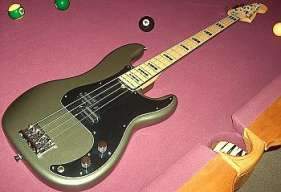
If the question were to be rephrased as, "Should a bass guitar really be called a member of the guitar sub-family," I'd say yes. It's a type of guitar that uses a double bass range and tuning. It's a hybrid instrument, but it largely handles like, is constructed like, and resembles a guitar more so than it does a double bass.
Take this argument the other way, and look at higher ranged guitars. A tenor guitar is a guitar that, when tuned in the typical way, has about the same range as, and exactly the same tuning as, a viola. It's a hybrid of viola and guitar, but it is largely considered to be a guitar, not a plucked viola. Why? The way it is constructed, the way it is handled/played, and the general way it looks.
Bottom line: The sub-family of instruments that an instrument belongs to isn't simply determined by range, tuning, or place in the musical arrangement (i.e whether or not one instrument was historically designed to take the place of the other). Instruments that cross over in these criteria do not necessarily belong in the same sub-family of instruments. The sub-family to which an instrument belongs is largely determined by how the instrument is constructed and how it is handled/played. This is not just true of stringed instruments, but of brass, and most other types of instruments. For instance, a bass trumpet is called a bass trumpet, and a valve trombone is called a valve trombone, even though the standard versions of each cover almost exactly the same range of pitches. Why? In the physical sense, they are constructed slightly differently. Each is far closer to having the same construction as the other than a typical bass guitar is to having the same construction as a typical double bass...still, one is called the bass trumpet and the other is called the valve trombone.
"Electric bass" and "bass guitar" are terms that indicate different features of the instrument.
"Electric bass" is used vs. "acoustic bass." Whether you use "electric" or "acoustic" depends on whether the instrument is designed to be played directly into an amplifier in order to acheive its intended tone, or whether it's designed to acheive its intended tone without amplification. The term differentiates between an electric and an acoustic, regardless of whether you're talking about a bass guitar or a double bass.
"Bass guitar" is used vs. "double (or 'upright' or 'stand-up') bass." Whether you use "guitar" or "double/upright/standup" depends on whether the instrument is a shorter scale instrument designed to be played largely horizontally, or a longer scale instrument designed to be played largely vertically.
There are acoustic double basses, electric double basses, acoustic-electric double basses, acoustic bass guitars, electric bass guitars, and acoustic-electric bass guitars – likely all within the catalog of most large full-range music shops. So, as you can see, the question is fundamentally flawed; it can't be directly answered as it was asked. Is electric bass a guitar? Yes, if it's a bass guitar...and no, if it's not a bass guitar.
If the question were to be rephrased as, "Should a bass guitar really be called a member of the guitar sub-family," I'd say yes. It's a type of guitar that uses a double bass range and tuning. It's a hybrid instrument, but it largely handles like, is constructed like, and resembles a guitar more so than it does a double bass.
Take this argument the other way, and look at higher ranged guitars. A tenor guitar is a guitar that, when tuned in the typical way, has about the same range as, and exactly the same tuning as, a viola. It's a hybrid of viola and guitar, but it is largely considered to be a guitar, not a plucked viola. Why? The way it is constructed, the way it is handled/played, and the general way it looks.
Bottom line: The sub-family of instruments that an instrument belongs to isn't simply determined by range, tuning, or place in the musical arrangement (i.e whether or not one instrument was historically designed to take the place of the other). Instruments that cross over in these criteria do not necessarily belong in the same sub-family of instruments. The sub-family to which an instrument belongs is largely determined by how the instrument is constructed and how it is handled/played. This is not just true of stringed instruments, but of brass, and most other types of instruments. For instance, a bass trumpet is called a bass trumpet, and a valve trombone is called a valve trombone, even though the standard versions of each cover almost exactly the same range of pitches. Why? In the physical sense, they are constructed slightly differently. Each is far closer to having the same construction as the other than a typical bass guitar is to having the same construction as a typical double bass...still, one is called the bass trumpet and the other is called the valve trombone.
Last edited: