I'm looking into string tension and gauge for an ultra short scale bass. I notice that standard string sets have lower tension on thicker strings and higher tensions on thinner strings. Is this more desirable than equal tension on all strings?

Enjoy the benefits of a premium membership!
Upgrade Account
-
TalkBass has been independent since 1998. Add your voice.
Create a free account to reply to discussions, view embedded media, and browse with fewer display ads.
Join free Log in
Want zero display ads or expanded classifieds tools? Compare plans.
You are using an out of date browser. It may not display this or other websites correctly.
You should upgrade or use an alternative browser.
You should upgrade or use an alternative browser.
Is equal tension a good thing?
- Thread starter smart51
- Start date
More options
Who Replied?

You should have posted this in the "Strings"section for a better response.
No worries... I've already asked the moderator to move this to "Strings" for the OP.

I'm looking into string tension and gauge for an ultra short scale bass. I notice that standard string sets have lower tension on thicker strings and higher tensions on thinner strings. Is this more desirable than equal tension on all strings?
It would depend on a lot of factors...
"Balanced tension" doesn't necessarily guarantee "balanced tone" depending on the design of the bass. Some prefer a set of strings that FEEL even across all strings, while others are willing to sacrifice feel for the tonal balance.
You just have to try different sets for yourself and decide what works best for you and your bass(es).

I'm a firm believer in equal tension on bass. I also think you should play what you like the sound and feel of. Find the strings that are right for you and stick with them.

I will say sometimes. I have some basses with and some without balanced tension and sometimes it feels better and sometimes it doesn’t. So I experimented until satisfied.
I'll be getting custom strings made so I can have any gauge I like. I don't have to pick from ready made sets. Online tension calculators say I need 54 - 72 - 98 - 130 to have 36lbs of tension per string, or 65 - 87 - 118 - 159 for 57lbs. Ernie Ball will sell me 65 - 80 - 100 - 130. Do I need the extra tension in the thinner strings that Ernie Ball sell? Or do I need extra tension in the thicker strings and need to buy the heavier custom gauges?

I'd have to say that, like lots of questions here on TB, the answer is "it depends." Some string companies are focused more on equal tension than others, who seem to be more focused on equal tone. And, IME, it's pretty rare to get both. So, it depends on the person asking the question. If you prefer strings with equal tension, over equal tone? Then the answer for you, is NO. Personally? I'd much rather have equal tone, and I'll put up with unequal tension to get it. I would love to have both - I'm sure most people would - but, usually you'll have to make a choice between the two...I'm looking into string tension and gauge for an ultra short scale bass. I notice that standard string sets have lower tension on thicker strings and higher tensions on thinner strings. Is this more desirable than equal tension on all strings?

I didn't know that's what the payoff was. I'd rather have the same note played on different strings sounds the same. I don't think I've played any strings where that happens. The note is brighter played on a thinner string by the head and darker played on a thicker string nearer the body.I'd have to say that, like lots of questions here on TB, the answer is "it depends." Some string companies are focused more on equal tension than others, who seem to be more focused on equal tone. And, IME, it's pretty rare to get both. So, it depends on the person asking the question. If you prefer strings with equal tension, over equal tone? Then the answer for you, is NO. Personally? I'd much rather have equal tone, and I'll put up with unequal tension to get it. I would love to have both - I'm sure most people would - but, usually you'll have to make a choice between the two...
Does more tension on a thicker string give a brighter tone? Or does it just give more inharmonicity?

If equal tension is what you're after, get yourself a multiscale bass. I believe that Dingwall uses the Novax system which was calculated to give you equal tension without weirding out on the gauge.


String sets have unequal tension in large part because 40-60-80-100 seems like it’s a nice progression, but….it isn’t. It gets even worse if you continue the progression to a 120 for a B.
For equal tension, you want a geometric progression (each string is 4/3rds the diameter of the previous one), not an arithmetic progression (add 20 to the previous one.
If the folks making strings took Acoustical Physics in college, this wouldn’t be an issue, but unfortunately they didn’t, so we have what we have. I play 5 string basses, and have literally never bought a 5 string set, as the B is never one that matches the rest of the set. Why do people talk a lot on here about floppy B strings? It isn’t the bass’s fault, it’s a string issue - if the B string was big enough, things would be OK.
I play very light strings - a 95 for the E string. The B string with the same tension is a 130. If your E is a 105, your B should be a 140. Find me either of those sets…..
For equal tension, you want a geometric progression (each string is 4/3rds the diameter of the previous one), not an arithmetic progression (add 20 to the previous one.
If the folks making strings took Acoustical Physics in college, this wouldn’t be an issue, but unfortunately they didn’t, so we have what we have. I play 5 string basses, and have literally never bought a 5 string set, as the B is never one that matches the rest of the set. Why do people talk a lot on here about floppy B strings? It isn’t the bass’s fault, it’s a string issue - if the B string was big enough, things would be OK.
I play very light strings - a 95 for the E string. The B string with the same tension is a 130. If your E is a 105, your B should be a 140. Find me either of those sets…..
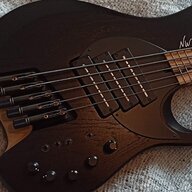
This will never happen though, if only because of the position of the pickup(s) relative to the fretted note : the pickup is relatively closer to the bridge the closer to the nut the fretted note is. It's a good thing however IMO, because you can pick how you want a particular note to sound, bright and tight or mellow and woollyI'd rather have the same note played on different strings sounds the same. I don't think I've played any strings where that happens

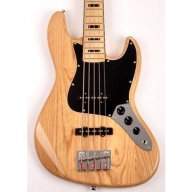
I'll be getting custom strings made so I can have any gauge I like. I don't have to pick from ready made sets. Online tension calculators say I need 54 - 72 - 98 - 130 to have 36lbs of tension per string, or 65 - 87 - 118 - 159 for 57lbs. Ernie Ball will sell me 65 - 80 - 100 - 130. Do I need the extra tension in the thinner strings that Ernie Ball sell? Or do I need extra tension in the thicker strings and need to buy the heavier custom gauges?
Some heavy strings you got goin' there. But hey, whatever works.
This will never happen though, if only because of the position of the pickup(s) relative to the fretted note : the pickup is relatively closer to the bridge the closer to the nut the fretted note is. It's a good thing however IMO, because you can pick how you want a particular note to sound, bright and tight or mellow and woolly
This is absolutely correct - with any pickup that samples the string’s motion along it’s length, the output is comb filtered, and it’s a wavelength filter - the same note on two strings that are tuned to different open notes can’t and won’t ever sound the same. With a piezo pickup (that samples pressure at the bridge), things are different - this comb filtering doesn’t happen in that case.

String sets have unequal tension in large part because 40-60-80-100 seems like it’s a nice progression, but….it isn’t. It gets even worse if you continue the progression to a 120 for a B.
For equal tension, you want a geometric progression (each string is 4/3rds the diameter of the previous one), not an arithmetic progression (add 20 to the previous one.
If the folks making strings took Acoustical Physics in college, this wouldn’t be an issue, but unfortunately they didn’t, so we have what we have. I play 5 string basses, and have literally never bought a 5 string set, as the B is never one that matches the rest of the set. Why do people talk a lot on here about floppy B strings? It isn’t the bass’s fault, it’s a string issue - if the B string was big enough, things would be OK.
I play very light strings - a 95 for the E string. The B string with the same tension is a 130. If your E is a 105, your B should be a 140. Find me either of those sets…..
DR comes close with their six-string light gauge Pro Steels: https://www.amazon.com/gp/product/B0006Z4B7C/ref=ppx_yo_dt_b_search_asin_title?ie=UTF8&th=1.
I've never had a problem with my B string on my Ibanez SR506. That said, the strings definitely aren't equal tension (mainly due to the high C). But I like it and I'm used to it.
As an Amazon Associate, TalkBass may receive commissions from qualifying purchases made via links on this site.

When BT sets came on the market, I automatically felt it was a great idea, so I bought several sets for fives.
After playing them for a while, it occurred to me that I had not realized how my hands had subconsciously gotten used to the way regular sets felt, and ingrained in muscle memory.
Because, at first in particular, my hands were telling me the same size string was in each of the five places, as if I'd strung it up with five A or D strings. Despite the fact I could look down and see five different sizes.
Over time, that sensation faded somewhat, but never went away.
The next time, I went back to my usual 45-130 set, and I stopped receiving messages from my hands, I was back home.
I can see where they might be just the thing for other guys, but I suppose this old dog couldn't learn that new trick.
After playing them for a while, it occurred to me that I had not realized how my hands had subconsciously gotten used to the way regular sets felt, and ingrained in muscle memory.
Because, at first in particular, my hands were telling me the same size string was in each of the five places, as if I'd strung it up with five A or D strings. Despite the fact I could look down and see five different sizes.
Over time, that sensation faded somewhat, but never went away.
The next time, I went back to my usual 45-130 set, and I stopped receiving messages from my hands, I was back home.
I can see where they might be just the thing for other guys, but I suppose this old dog couldn't learn that new trick.

I prefer the feel of balanced tension and have spent more time on this than any reasonable person would. I have spreadsheets and all kinds of nonsense.
Your standard 40-60-80-100 sets (or 45-65-85-105 sets) actually have the highest tension on the D and A strings, not the lowest two or highest two. As @micguy said, if you want balanced tension, the difference in gauge between each strings should NOT be constant.
This is actually pretty reasonable if your fretboard has a lot of curvature on it, because that means the D and A will be further away from the pickups. With a 7.5" radius, for instance, this is fine. But as fretboards have gotten flatter, this makes less and less sense. Once you get to 12" radius it's so flat this sounds and feels weird to me.
So for rounds on a standard-tuned 4, I usually play D'Addario EXL170BTs (45-60-80-107), which have almost perfectly uniform tension from string to string. Of course, they don't make this for short scale.
However, GHS Balanced Nickels are available for short scale and are very well-balanced from string to string. They're pretty mellow strings, though, so if you want something bright they may not be the best choice.
StringJoy also will let you build your own custom set for no extra charge, and they do short scale strings. Standard rounds, but they feel and sound a little nicer than the D'Aaddarios, but of course they cost more.
Yep, it all gets more complicated when you do a lot of drop D or a 5-string or you don't want rounds (just because it's easier to find weird gauges for rounds, not anything intrinsic to rounds).
I've given up trying to find anything pre-packaged that's balanced for my 5-string and I just get StringJoy custom sets. It's about the same price as getting a balanced tension 4-string set and one custom-gauge string anyway.
Your standard 40-60-80-100 sets (or 45-65-85-105 sets) actually have the highest tension on the D and A strings, not the lowest two or highest two. As @micguy said, if you want balanced tension, the difference in gauge between each strings should NOT be constant.
This is actually pretty reasonable if your fretboard has a lot of curvature on it, because that means the D and A will be further away from the pickups. With a 7.5" radius, for instance, this is fine. But as fretboards have gotten flatter, this makes less and less sense. Once you get to 12" radius it's so flat this sounds and feels weird to me.
So for rounds on a standard-tuned 4, I usually play D'Addario EXL170BTs (45-60-80-107), which have almost perfectly uniform tension from string to string. Of course, they don't make this for short scale.
However, GHS Balanced Nickels are available for short scale and are very well-balanced from string to string. They're pretty mellow strings, though, so if you want something bright they may not be the best choice.
StringJoy also will let you build your own custom set for no extra charge, and they do short scale strings. Standard rounds, but they feel and sound a little nicer than the D'Aaddarios, but of course they cost more.
I play very light strings - a 95 for the E string. The B string with the same tension is a 130. If your E is a 105, your B should be a 140. Find me either of those sets…..
Yep, it all gets more complicated when you do a lot of drop D or a 5-string or you don't want rounds (just because it's easier to find weird gauges for rounds, not anything intrinsic to rounds).
I've given up trying to find anything pre-packaged that's balanced for my 5-string and I just get StringJoy custom sets. It's about the same price as getting a balanced tension 4-string set and one custom-gauge string anyway.
I've been making my own balanced tension sets out of singles, for bass and guitar, since the 1990s.
It's a revelation. The D isn't tight, the E isn't floppy, and the low B isn't even worse. The sound is more balanced across strings, the feel is more balanced across strings, and my hands hurt less afterward.
There is absolutely no reason behind "standard" string gauges. They only exist because both string manufacturers and players are stuck in the 1950s and make string sets based on "round numbers look nice" instead of high school physics.
D'Addario and GHS are notable exceptions.
Furthermore:
Multiscale only exists to compensate for string manufacturers being stuck in the 1950s. Then the bass manufacturers figured out that they can use this lack of understanding to sell people an entirely new instrument, instead of simply using string gauges that made sense. It continues to blow my mind that people are willing to pay thousands of dollars for a new instrument when the problem can be solved in minutes with a $20 set of strings.
It's a revelation. The D isn't tight, the E isn't floppy, and the low B isn't even worse. The sound is more balanced across strings, the feel is more balanced across strings, and my hands hurt less afterward.
There is absolutely no reason behind "standard" string gauges. They only exist because both string manufacturers and players are stuck in the 1950s and make string sets based on "round numbers look nice" instead of high school physics.
D'Addario and GHS are notable exceptions.
Furthermore:
Multiscale only exists to compensate for string manufacturers being stuck in the 1950s. Then the bass manufacturers figured out that they can use this lack of understanding to sell people an entirely new instrument, instead of simply using string gauges that made sense. It continues to blow my mind that people are willing to pay thousands of dollars for a new instrument when the problem can be solved in minutes with a $20 set of strings.

I'm a fan of balanced tension sets, I also usually just piece them together from singles. If I were to tune to standard EADG I probably wouldn't bother. But I tune to low AEAD, and a standard 130 or 135 for low A just feels like spaghetti and has no clarity. If youre down tuning or drop tuning consider a custom balanced set.
I play very light strings - a 95 for the E string. The B string with the same tension is a 130. If your E is a 105, your B should be a 140. Find me either of those sets…..
Kalium makes them. I have stainless in 45-61-82-110-148 (49lbs per string on 35" scale). I also made a set with 45-60-80-110 D'Addario Chromes flats (46 lbs per string on 34" scale).
Why? For an even feel, and to increase tension on the lower strings for a brighter sound.


