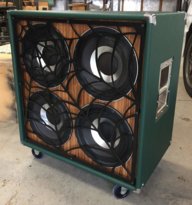
OK, everybody write that down.Beware of the results of software
Trust me, I'm a software developer.

TalkBass has been independent since 1998. Add your voice.
Create a free account to reply to discussions, view embedded media, and browse with fewer display ads.
Join free Log in
Want zero display ads or expanded classifieds tools? Compare plans.
OK, everybody write that down.Beware of the results of software

For me, a port is a helmholtz resonator and i can't understand how a port with a depth of 2 cm works …
Because a hole 10cm x 2cm has mass, just less than 10cm x 8cm.For me, a port is a helmholtz resonator and i can't understand how a port with a depth of 2 cm works …

There is still port volume with a thickness of 2cm, don't overthink it.For me, a port is a helmholtz resonator and i can't understand how a port with a depth of 2 cm works …


There's a hole in the bucket, dear Liza, dear Liza...A hole is a hole regardless of depth.
Because a hole 10cm x 2cm has mass
I once created a port with so much mass it reached singularity. Once.A hole has mass?
Just kidding! This reminded me of the old riddle "How much dirt is there in a hole 2'x3'x4'?", except that there is air in the hole.
Black, I assume. Tort pickguard?I once created a port with so much mass it reached singularity. Once.
Yeah, scrapped the whole cab, couldn't get anything out of it.Black, I assume. Tort pickguard?
The port for a bass reflex enclosure doesn't necessarily need to have any more depth than the thickness of the baffle board. Your Behringer box IS a bass reflex cab -- that doesn't necessarily mean it's tuned appropriately for the replacement driver you've chosen.


It's exactly the same within the context of the equations that govern the speaker performance.I understand the original poster's concern that the air *in* the port just doesn't have much mass;
the air in the cab, with a hole in the baffle, seems not as well defined as a "mass and spring", as the mass seems diffuse,
so is there any truth to the idea that a longer tube, with a greater mass of air in the tube, can pump more powerfully, or something?
EDIT: If it's true that the hole-in-the-baffle is less effective, then I would have something positive to say about that, that compensates.
Because at high power, it's usually difficult to achieve an acceptable tuning. Sometimes it works out ok.Then I wonder why more cab designers don't just leave holes in the baffle instead of providing tubes.
I think you are referring to either a transmission line which is a type of a vent, or to a folded horn.Educated in England - not sure if that makes a difference. I'd learned (perhaps incorrectly) - but happy to be wrong of course! Three terms to describe a nuance regarding the 'type' of opening.
Reflex - like a folded design
One distinction I heard is that "vented" applies to any enclosure that's not sealed, passive radiator for open baffle. So regardless of whether it's a bass reflex port (of any shape), a transmission line or a folded horn, all are examples of vented enclosures.Vented - like this post
Ported=Reflex=Bass reflex. Regardless of shape (folded or not) or size. IIRC, there's a formula to determine if it's just a port or if it's a transmission line.Ported - like a tube (cylinder or other shape, generally no folds.