
Enjoy the benefits of a premium membership!
Upgrade Account
-
TalkBass has been independent since 1998. Add your voice.
Create a free account to reply to discussions, view embedded media, and browse with fewer display ads.
Join free Log in
Want zero display ads or expanded classifieds tools? Compare plans.
You are using an out of date browser. It may not display this or other websites correctly.
You should upgrade or use an alternative browser.
You should upgrade or use an alternative browser.
Is it too early for vodka?
- Thread starter A.Diva
- Start date
More options
Who Replied?

By the way, Ziltoid, I like your chemical experiences so much that I was actually looking for another Mleczko's comics, but could not find it. It is going well with the vodka stories.
Two guys watching pyramids in Egypt. One of them says:
-- Not such things we used to do with my brother-in-law while drunk!

Two guys watching pyramids in Egypt. One of them says:
-- Not such things we used to do with my brother-in-law while drunk!
Actually, I chose chemical engineering (now it's called process engineering) since I correctly guessed I could earn my daily bread easier that way, and I didn't want ending up teaching children at schoolBah, I'm sure you did them all, and more
 )))
)))In fact, experimenting was a lot of fun!
That vodka rectification has given me so much understanding. Nowadays, I use a process simulator. Need to go to have some sleep, but tomorrow I'll put a story called: "How To Drink Reasonably: My Wife Sheila as A Chemical Reactor" ;-)

Mr. AntekStalich!
I've either become madly in love with you ...
or deathly afraid of you ... haven't decided which.
Maybe a bit of both.
I've either become madly in love with you ...
or deathly afraid of you ... haven't decided which.
Maybe a bit of both.

This thread become far too nerdy! I demand that it be course corrected to simply drinking and not the science behind it! All in agreement say "Aye."
This thread become far to nerdy! I demand that it be course corrected to simply drinking and not the science behind it! All in agreement say "Aye."
Aye!

This thread become far too nerdy! I demand that it be course corrected to simply drinking and not the science behind it! All in agreement say "Aye."
Are you kidding me? I will be pdf-ing this thread for posterity!!!

Agreed, especially when science provides more booze! It's a never ending circle of awesome.
DIY awesome on tap.

A. Diva: Third option you haven't considered yet would be hatred
-----
I wrote this article couple years ago. Still all what is written is true. I only could refine my English somewhat.
A Chemical Reactor Named Sheila
(Kinetics of drinking alcohol)
While on heavy hangover (waking up after having had drunk 350 cm3 of excellent Hungarian herb-liquer Invalid Link Removed the night before), I sat absent-mindedly by my PC and switched CHEMCAD Dynamics on. "How to drink reasonably next time?" I thought: "How should I drink not to get really drunk? What is the reality with the Blood Alcohol Content (BAC)?". Having the most advanced dynamic process simulator in front of me, I started analyzing a quite interesting object -- the chemical reactor of the type "Human Being" branded Sheila, happening to be my beloved wife.
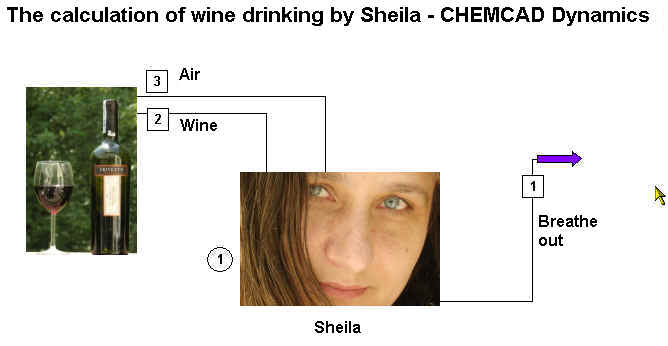
Problem definition:
The technical specs of the chemical reactor Sheila:
Problems with setting up the dynamic simulation
I managed to make those errors while setting up the dynamic simulation
Case study A. Drink at regular intervals, slowly and you gonna survive
You have to understand that once you have introduced alcohol into your body, the body starts decomposing ethanol rather soon. Therefore there are two competing processes occurring in parallel, that is, absorbing fresh alcohol and alcohol decay through liver. Certainly, there is accumulation of ethanol in the body. Practical rules of imbibing as given by various teetotaler organizations refer to body weight, sex, duration of taking in, the amount of ethanol drunk and the time necessary to get back to sobriety. There exist practical tables for Blood Alcohol Content (BAC) expressed in permils (one thousands), but apparently everyone has own alcohol-decay kinetics, so we could only talk on qualitative results. What do these qualitative results tell us?
See the amount of alcohol in Sheila's body expressed in grams and the time scale is hours. She had drunk a bottle of wine over 4 hours, taking small sips from her glass. She therefore was drinking slowly, at regular intervals.
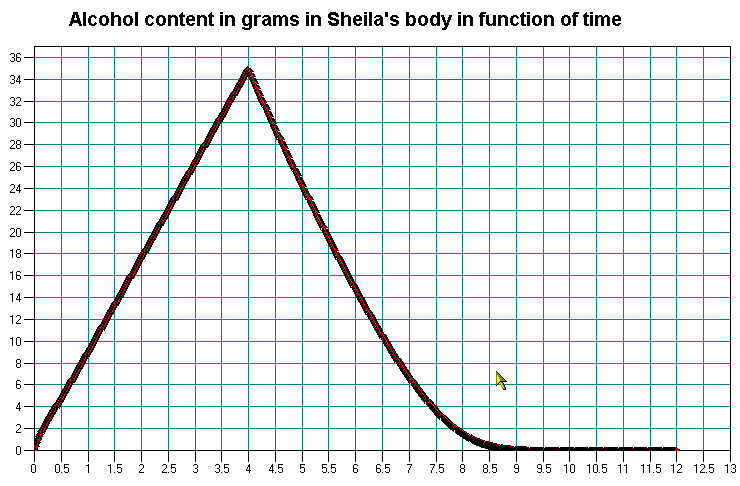
This is quite interesting! Remember that the bottle contained 80 grams of pure ethanol, but due to alcohol decomposition by the liver, the alcohol content in the body never exceeded 35 grams. Let us quickly recalculate it to BAC expressed in permils. Divide 35 grams by roughly 42 kg of body liquids and we will get 0.8 %%. In some liberal countries or states, Sheila would be still allowed to drive a car! And 0.8%% means she's in pretty jolly mood)
Drink slowly, small intakes at regular intervals, and it will be harder for you to get drunk.
Case study B. Fast intake
Let us assume that Sheila poured in a large wine glass (1/4 of the bottle) and swallowed it rather quickly, say in 2 minutes. Then she would have waited until an hour passed and repeated the procedure in regular intervals to empty the bottle. See the results:
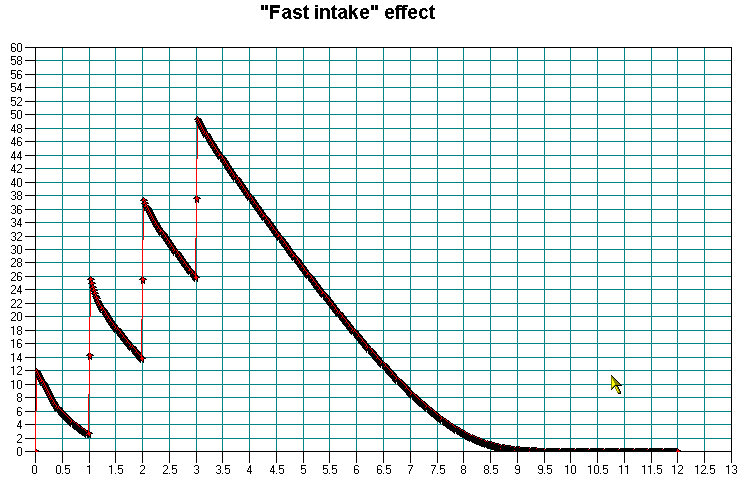
As you can see, human being gets drunk much faster this way. After the fourth glass of wine you have accumulated approximately 50 grams of ethanol, making it 50/42 = 1.2%%. Drinking fast, you get drunk faster, and the first phase of getting sober takes significantly more time..
Case study C. Hammer-down
You do not need to do any simulation to understand that if you swallow a bottle of wine quickly, you would observe a surge in BAC. If it were for Sheila (and this never happens), the BAC would be 80/42 = 1.9 %%. Having so much absorbed, you are really drunk.
Laboratory tests - model validation
The results have been later validated with breathalyzer and they proved to be true. I calibrated my kinetics to find out my liver could burn 10 g or pure ethanol per hour.
Summary
When I eventually felt sober, I thought "Why had I written this?!" It must have had been very heavy case of hangover...
------------
I have to go to band's rehearsal now!
-----
I wrote this article couple years ago. Still all what is written is true. I only could refine my English somewhat.
A Chemical Reactor Named Sheila
(Kinetics of drinking alcohol)
While on heavy hangover (waking up after having had drunk 350 cm3 of excellent Hungarian herb-liquer Invalid Link Removed the night before), I sat absent-mindedly by my PC and switched CHEMCAD Dynamics on. "How to drink reasonably next time?" I thought: "How should I drink not to get really drunk? What is the reality with the Blood Alcohol Content (BAC)?". Having the most advanced dynamic process simulator in front of me, I started analyzing a quite interesting object -- the chemical reactor of the type "Human Being" branded Sheila, happening to be my beloved wife.
Problem definition:
The technical specs of the chemical reactor Sheila:
- Reaction volume V = 70 [dm3]
- Initial volumetric charge Vo = 42 [dm3], assume that it is pure water (woman consists in 60% of body liquids)
- Unlimited oxygen available; it can be assumed that 60 g/h of oxygen will quite do to dispose all alcohol in the body
- The reactor will be fed with wine, which is aqueous solution of ethanol at 13.5 vol. % and quantity of 3/4 liter. Quick calculation informs us that the bottle of wine contains 80 g of pure ethanol.
- Stoichiometry: C2H5OH + 4 O2 -> 2 CO2 +3 H2O
- Reaction kinetics: Isothermal reaction at T = 36.6 C and under P = 1 atm (absolute).
- The frequency factor A (Arrhenius constant) for the reaction rate equation has been determined according to PARPA (State Agency for Solving Alcohol Addiction Problems of Poland), based on the fact that the female liver deposes not more than 8 g of pure ethanol an hour.
Problems with setting up the dynamic simulation
I managed to make those errors while setting up the dynamic simulation
- I killed Sheila first, forgetting to feed her with oxygen. Dead body refused decomposing ethanol ))
- Then I wrongly assumed that Sheila would not breathe the carbon dioxide out, which suffocated her...;
- After that I completely ignored the fact that Sheila breathing is a semi-batch process. Making her full of oxygen at initial charge caused serious simulation problems
- Due to my hangover, I also thought Sheila was made of one bottle of wine only
Case study A. Drink at regular intervals, slowly and you gonna survive
You have to understand that once you have introduced alcohol into your body, the body starts decomposing ethanol rather soon. Therefore there are two competing processes occurring in parallel, that is, absorbing fresh alcohol and alcohol decay through liver. Certainly, there is accumulation of ethanol in the body. Practical rules of imbibing as given by various teetotaler organizations refer to body weight, sex, duration of taking in, the amount of ethanol drunk and the time necessary to get back to sobriety. There exist practical tables for Blood Alcohol Content (BAC) expressed in permils (one thousands), but apparently everyone has own alcohol-decay kinetics, so we could only talk on qualitative results. What do these qualitative results tell us?
See the amount of alcohol in Sheila's body expressed in grams and the time scale is hours. She had drunk a bottle of wine over 4 hours, taking small sips from her glass. She therefore was drinking slowly, at regular intervals.
This is quite interesting! Remember that the bottle contained 80 grams of pure ethanol, but due to alcohol decomposition by the liver, the alcohol content in the body never exceeded 35 grams. Let us quickly recalculate it to BAC expressed in permils. Divide 35 grams by roughly 42 kg of body liquids and we will get 0.8 %%. In some liberal countries or states, Sheila would be still allowed to drive a car! And 0.8%% means she's in pretty jolly mood
) Drink slowly, small intakes at regular intervals, and it will be harder for you to get drunk.
Case study B. Fast intake
Let us assume that Sheila poured in a large wine glass (1/4 of the bottle) and swallowed it rather quickly, say in 2 minutes. Then she would have waited until an hour passed and repeated the procedure in regular intervals to empty the bottle. See the results:
As you can see, human being gets drunk much faster this way. After the fourth glass of wine you have accumulated approximately 50 grams of ethanol, making it 50/42 = 1.2%%. Drinking fast, you get drunk faster, and the first phase of getting sober takes significantly more time..
Case study C. Hammer-down
You do not need to do any simulation to understand that if you swallow a bottle of wine quickly, you would observe a surge in BAC. If it were for Sheila (and this never happens), the BAC would be 80/42 = 1.9 %%. Having so much absorbed, you are really drunk.
Laboratory tests - model validation
The results have been later validated with breathalyzer and they proved to be true. I calibrated my kinetics to find out my liver could burn 10 g or pure ethanol per hour.
Summary
When I eventually felt sober, I thought "Why had I written this?!" It must have had been very heavy case of hangover...
------------
I have to go to band's rehearsal now!
For the DIYer, my local brewshop (no affiliation, nice but weird guys) has this: Link Removed. They suggest it as suitable for making distilled water.
I missed that
They mention reflux, aha? I'd like to see a better picture or a technical drawing, but I'd say $360 could give a decent rig I only wonder how the internals of the column are made (that is, is it a packed or a tray column or just a still), how tall the column is and if they do it properly, how the reflux is controlled.There is no doubt that distillation column is necessary and the distillation is the best controlled by checking temperature at the column top and adjusting the reflux accordingly. With temperature measurement, you are absolutely sure what you are distilling at the moment. Another point is the height/internals of the column to ensure sufficient separation strength. The fusel oil is weird: Due to thermodynamics, it creates an azeotrope with ethanol and water, boiling easier than water. In proper distillation, the oil goes up the column up only to some level (I could observe a ring of fusel oil at the column that could not go up since it was kept there by sufficient reflux rate).
In batch distillation of vodka, you cannot really get rid of the light-ends (you can get rid of heavy-ends). Therefore raw material such as sugar (and especially molasses) is the most appropriate, since it makes good light-ends. Additionally, molasses contain right minerals, good for yeast.
----
It would be OK to mention it was the Americans who created chemical engineering as a discipline


