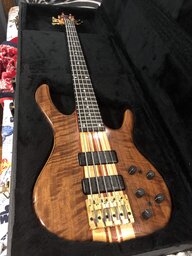
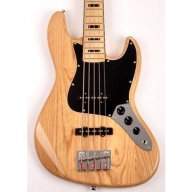
Hello mates! One does really need a 5 ? I am interested about it but since I am intermediate player I dont want to slow down my learning or even complicate my already gained progress, but maybe the 5th also teaches me new things , like expand the scales and stuff...
Its easy to say " go get one" , just keep in mind that I dont have a big budget to own 2 basses so I would have to sell mine 4 string to get a 5.
What do you guys say?
Thanks!
I've been playing fives exclusively since the late 80's. I only recently bought a 4-string Jazz Bass on a whim, the only four since then, and well, it's NOT the start of a trend for me.
I started playing fours in the mid 70's and always was put off at the 'jumps' I'd have to make. Namely, I'd start a lick
here, and then to finish the thought I'd have to slide or jump up to
there.
When fives began to be made by the major manufacturers and you could buy one for not much more that a four, it was on. Now I could play two octaves
across the fingerboard, and it fit me like a glove.
I'd say it's silly to moan about needing 'extra' notes. Pianos have 88 keys, and I can promise you nobody ever says you need pianos with less notes, 'who needs them?', that sort of thing. Conversely, if all you need is those extra low notes down to B, buying a five is more bother than it's worth.
And I can utterly guarantee you that a four-string bass and five-string bass are two different instruments. Do not fall into the 'it's just a four with an extra string' BS. It's just isn't. It's more strings on a bigger neck/fingerboard, different techniques for your hands, and really takes better amps and cabinets to legitimately push those low C's and D's. When I bought that four-string Jazz, that skinny neck and 21 frets felt like a mandolin in my hands after years of 24-fret, neckthrough fives !
For me, I play one as it's too easy to transpose keys (really handy for singers who love 'different' keys, or if you play with a lot of horns), having the occasional low C or D or E-flat is handy in that I don't have to invert to play those roots from above out of necessity, and a lot of us fold 1st position (down at the nut) and 2nd position (around E on the A string) into one 'mother position' that leaves you most any direction to play from or into.
The 'floppy B string' is what it is. To me, it's just not that 'floppy', and I think it affects more new-to-five-guys than those of us who've long since forgot about it. It's never something that kept me up nights, I just play it and don't think about it, but I know it does drive some guys a little nuts, and lots of TB ink is spilled wondering how to rectify it. Good Luck with that . . . .
So, you really play a four, or a five, or a six, or whatever you think suits you the best. Each has its advantages and disadvantages, and really there's no right answer, except what will help you make your best music.
I was not a lot further along than you are now when I switched to a five. To me, there were obvious benefits (which have proved for me as true as I thought they would) to the way I saw my method of playing and seeing the fingerboard.
THAT's how I would approach it if I were offering you advice, and only you can answer that question.