

Enjoy the benefits of a premium membership!
Upgrade Account
-
TalkBass has been independent since 1998. Add your voice.
Create a free account to reply to discussions, view embedded media, and browse with fewer display ads.
Join free Log in
Want zero display ads or expanded classifieds tools? Compare plans.
You are using an out of date browser. It may not display this or other websites correctly.
You should upgrade or use an alternative browser.
You should upgrade or use an alternative browser.
Is the short/medium scale craze over?
- Thread starter Green Knight
- Start date
More options
Who Replied?
I like my short-scale Nordstrand Acinonyx bass in part because in our small rehearsal space, I no longer am (inadvertently) hitting the lead singer in the arm or face as I would with a long-scale bass.
Last edited:


CBS owned Fender back in 1957?. I thought they bought controling interest in Fender in the mid 60’s.Blame CBS. A lot of sixties makes/models, both long- and short-scales, had limited production runs, sometimes as little as two-years. Magnatone, Supro long-scales, Eko Voxes, Standel, Kustom. Part of this is due to the influx of cheap Japanese imports (there are enough online images of mail-order catalogs for the migration from American to Japanese instruments to be traced; think 1967/68), and part of it is due to the fact that the great post-Beatles guitar boom went bust and a lot of iconic labels simply ceased to exist. Even sales of Fender and Gibson were down.
And then CBS introduced the P-bass, the maple-board P-bass from 1957. And seemingly everybody wanted one. If you saw a new P-bass, it almost certainly had a maple fingerboard. And since it was a P-bass, it had a 34" scale. The short-scale bass virtually went into hibernation.


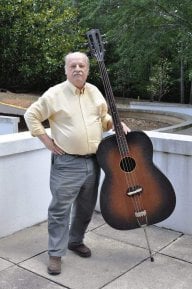
Why do older bassists need shorter instruments…?Could be just fewer instruments in general being bought and sold. I agree. Heck, I just got the shorty of my dreams. Aging bassists will continue to turn to them too, I’d imagine:
Yeah it’s slowing down I think. I absolutely understand what you mean by “craze”. They weren’t as nearly as prominent years ago. Within a couple of years every company had a model. I’m curious what the next thing will be?

Yeah it’s slowing down I think. I absolutely understand what you mean by “craze”. They weren’t as nearly as prominent years ago. Within a couple of years every company had a model. I’m curious what the next thing will be?
If an earlier post is correct, a surge in the availability for medium gauge strings, which are mostly used by short scalers that have extra space behind the bridge. This in turn will create a larger medium scale market.
I mis-spoke. I should have said, "re-introduced."CBS owned Fender back in 1957?. I thought they bought controling interest in Fender in the mid 60’s.
Arthritis in the shoulders and wrists might have something to do with it.Why do older bassists need shorter instruments…?

Passinwind
I know nothing.
- Dec 3, 2003
- 23,045
- 45,909
- Disclosures
- Designer/Toaster Tech @ Passinwind Electronics
Arthritis is the most common rationale I’ve heard locally, FWIW.Why do older bassists need shorter instruments…?

The resale market having dried up, if it has, can be an indication that the opposite of the OP's hypothesis/question is true.
Maybe it's because people are keeping them after they buy them.
This exactly. More people are discovering short scales, liking them, and keeping them.Exactly. It could very well mean more people are happy with their short scales and are keeping them.
If the marketplaces were flooded with used short scales, then you'd say they were out of favor.
I disagree, it depends on the bass more than on the scale length. I have two short scales, both tuned D standard (one whole step down). Both intonate properly. One of them (a semi hollow vintage bass) sounds better with flats, but that's more due to the rather cheap build of the bass (microphonic pickups and whatnot) than the scale length per se.Short scales (disclaimer: I have two of them) are not as, erm, "versatile" as longer scales. The lower tension does cause the lower strings to tend towards "thuddy" more than "firm". As well as having a greater tendency towards wobbly intonation. Why aren't drop tunings as popular as good old GDAE, by the way? That said, I do love my short scales, but I am of the opinion that short scales really prefer flats to rounds (which may tend to sound a bit floppy, whereas the lower harmonic content of a flat complements the shorter scale better). My Guild Starfire is sporting Cobalt flats right now and they are far too bright, the fret noise and buzz is not as... pleasing? as on a long scale, and in fact I am going to install LaBella LTFs as soon as I have some time to do so. I'd go as far as to say, in fact, that shorter scales did have a resurgence *together* with flatwound strings. Note that this may not apply, or apply less, to short scales that apply more modern construction choices (such as laminated necks, neckthrough builds, etc.) since the added rigidity may compensate somewhat.

I think we see them more because they're more widely accepted nowadays as a valid tool, thanks probably to more mainstream acts using short scale bass guitars. No complex at all on my part.
I own a pretty diverse stable (4&5 strings, from multiscale headless to fretless, Musicman, FSOs, couple old Yamahas, semihollow, DIY parts creatures) and I've owned short scales uninterruptedly for the last 15 years (an Epiphone Viola previously -strung BEAD, punked the crap out of it -, an EB-0 these days). I've even cared to mod my EB-0 with a single/series/parallel coil tap switch for the mudbucker.
Lately the MarkBass Little Yellow thingy is catching my attention. I already own a Gloxy 5er Im real happy with. I'd definitely like to add a cheap Bronco/Mustang option to have 2 alternative (and iconic) short scale flavors.
I own a pretty diverse stable (4&5 strings, from multiscale headless to fretless, Musicman, FSOs, couple old Yamahas, semihollow, DIY parts creatures) and I've owned short scales uninterruptedly for the last 15 years (an Epiphone Viola previously -strung BEAD, punked the crap out of it
-, an EB-0 these days). I've even cared to mod my EB-0 with a single/series/parallel coil tap switch for the mudbucker.Lately the MarkBass Little Yellow thingy is catching my attention. I already own a Gloxy 5er Im real happy with. I'd definitely like to add a cheap Bronco/Mustang option to have 2 alternative (and iconic) short scale flavors.

I definitely noticed it as well.Nobody thinks there was a pronounced uptick in interest in short scales within the last decade or so?
I certainly don’t think short scale is becoming less popular, the opposite in fact. I see many people turning to them after they realize the comfort, playability and fat tone they offer.

I think the craze has leveled off and now they are more widely accepted, with more variety than ever before.
Is the P bass with flats craze over? I knew we were at a fever pitch when even Fodera started making them.
Is the P bass with flats craze over? I knew we were at a fever pitch when even Fodera started making them.
Because our neck and shoulders become stiffer over time.Why do older bassists need shorter instruments…?


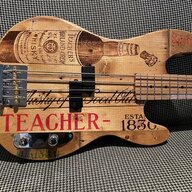
Well...To introduce a sinister element into this thread, the only market I see for the basses you post, sharp-looking though they are, are you and @GIBrat51.
There are 2 or 3 basses there that I probably wouldn't mind having, but... sorry, my Bass Herd is full; no other basses need apply. I might make an exception, but the bass would have to be one that I've lusted after for most of my life - but couldn't have, for one reason or another - or something that, once seen (and played), I couldn't live without...
That said; I was at the Sweetwater campus in Ft. Wayne, yesterday, buying some doo-dads, and looking at a possible Christmas present for a friend. They had a wrong-handed (for me) G&L Fallout Tribute bass on the wall; so, I messed around with it - for as long as my brain will let me play right-handed. I'd been vaguely interested in them for a while, but... nah. Nice bass, but it definitely wouldn't replace my '18 Warmoth Mini-Precision Bass in the "Short Scale Bolt Neck" spot. And, it's not wonderful enough to join the handful of basses with no Herd Spot - but, that I simply can't part with. In any case, the idea of a 34" scale SIZED short scale bass, is one that has - IMO - pretty limited appeal. Besides, I already have one like that - my '94 Gretsch Broadkaster. Playing something like that is... well, kind of a pain, TBH. But, to answer the OP's question...
Is the short/medium scale craze over? Well... if there ever was a craze, I guess I missed it. Out of my 27 basses, I only bought 5 basses just because they were short scale basses. They fill the 5 short scale Herd spots. The other 5 shortys? Well, if you want a violin bass? 99% of the time, it'll be a short scale. My oother 4 shortys fill non-scale specific spots. Like "Headless Bass", for example. The fact that a 31" scale, '82 Kramer "The Duke" fills the spot, is just coincidence...
 And, when I bought a Canadian '93 Fury Anthem lined fretless bass? I just wanted a lined fretless bass. I had no idea that it would be my first medium scale bass, as well. Or, that it would create a new Herd category, and result in me now having 3 more lined fretless basses...
So; like I said; if there was - or is - a craze for non-long scale basses? I mostly had other criteria in mind when I bought my basses; so I guess the craze just... passed me by...

Last edited:

If I ever buy another bass I'll be taking a hard look at short and medium scales. Probably buy another P-Bass, though, or maybe a nice surf rod combo.
Now if string manufacturers finally realized it's no longer a craze, but a established market, so they got rid of their old, one gauge-only options, and sold more versions of their long scale lines for short scale basses! It is honestly my only "con" to shorties, but when paired with the right strings among the few available, they can sound great, be articulate, etc. It's different, but still sounds like a bass should while having its own vibe.It's no longer a craze. Now it's a firmly established market segment.
The short scales I saw for the last few years were bought either by guitar players that wanted to dip a toe in the bass world or bassists that were hoping for something more comfortable.
Among the ones I know, their short scale basses are collecting dust actually.
OTHO, I also saw a few younger bass players using a Jaguar bass with a set of 6 to 12 pedals to customize their sound and making a good job with electro pop and dance music. Not the music I like to play but I must admit the results were pretty interesting.
Among the ones I know, their short scale basses are collecting dust actually.
OTHO, I also saw a few younger bass players using a Jaguar bass with a set of 6 to 12 pedals to customize their sound and making a good job with electro pop and dance music. Not the music I like to play but I must admit the results were pretty interesting.


