• TalkBass has been independent since 1998. Add your voice.
    Create a free account to reply to discussions, view embedded media, and browse with fewer display ads.
    Join freeLog in
    Want zero display ads or expanded classifieds tools? Compare plans.

Is there a 5 string whose B actually matches the other strings?

I play a Dingwall NG-2, and the B string is just a whole other thing than I've heard on any other bass. Love it! Anyway, if you play a 34" scale bass, I'd recommend trying a bunch of different B strings- even from different manufacturers. I had pretty good results with the LaBella "Hard Rockin' Steel" tapered B strings in the past, and my go-to DR high beams are no slouch either. Good luck with your search!
 
I've gigged a lot of 5'ers from Fender to Sadowsky, mostly 34", and never had an issue. Strings are a big factor however I haven't been very picky about strings either, meaning if I like the 4-string set I'm fine with the 5 in whatever gauge, my cabs are just regular quality cabs.

Pop, funk, rock, all good. With the benefit of hearing a lot of recordings I'm confident the balance is as it should be, and if I can do it anyone can.

And how many people from top pros to bar band bassists to YouTube demos have you heard sound great on a 5'er, 34" scale, normal frets Fender...Ibanez...whatever....guys who've never even heard of fanned frets. Nothing fancy. Check the link in my sig for example, or this; Proof Squier is rubbish. Hilarious video!

I do my own setups and know how to EQ, however I think the biggest thing is putting enough time into it so your ear and hands get used to it. I say this because if anything I've had issues with the C string on my 6'ers but working on plucking hand placement sorted that out easily.
 

Attachments

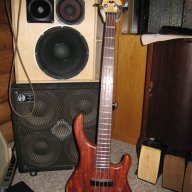
  • Pictures 054.jpg
    Pictures 054.jpg
    264.3 KB · Views: 63
I'm amazed at how few people have mentioned set-up here. Sure, string gauge will have an impact on your tone (though thinner strings will actually give you a brighter sound), and longer scale lengths increase the volume of harmonics relative to the fundamental (which results in a slightly brighter sound, hence why it helps lower-pitched strings), but if a bass is badly set-up then nothing can compensate for that. This is the same answer to those that complain about 'floppy' B-strings; you simply need to raise the B-string a bit, and move the saddle away from the nut a bit. That'll give you more clarity, more acoustic headroom, and a more even feel relative to the other strings.

Regarding your desire to have the 5th-fret B-string sound the same as an open-E, sorry - that's impossible. As Lo-E said, a 5th-fret E-string sounds different to an open-A, a 5th-fret A-string sounds different to an open-D, etc. If you change the length and gauge of a gauge (which is effectively what you're doing in these examples), you're going to alter the timbre. You're better off to embrace this change, by utilising the warmer sound when playing 4-string notes with the low-B string. Don't like such a warm sound when playing notes below the low-E? Tough. Those notes are very low, so if you cut the bass frequencies you've either got to boost the harmonics, or accept that you won't hear the fundamental.
 
Where are you getting this idea that the inner core is all that matters? The thickness of the inner core effects stiffness but it has no effect on tension until it breaks.
Edit: slight overstatement, the Inner core has mass so it does add to the mass and in turn tension at pitch, but most of the mass comes from the outer wrap.

In order for manufacturers to do equal string tension, they must alter the inner core gauge. And considering TENSION only (regardless of pitch) it comes solely from the inner core period, otherwise you couldn't get away with open core, or tapered strings. If we disregard pitch altogether, there's no difference from a plain string on guitar which is core only all the way. The (all) tension comes from the inner core only, period. Don't ever mix up tension for stiffness! Please show me any link that shows otherwise. At least 95-99 percent of it. Otherwise you could have a tunnel of air around the wrap and try to tune up and see what happens.

So, please get this into your head once and for all, this string which is open core, and has the same gauge when measured with the wrap on, tuned up to the same pitch:
IMG_3319s.jpg


has exactly the same tension as this one:

FPV_bridge_zpsd8d6fed5.jpg


Provided everything else is the same, tuned up to same pitch and total gauge is the same and inner core is the same gague, and of course, a hex core.
 
I bought my first 5-string in the mid-80's, when they were very much a novelty. It took me years of experimentation before I realized that I was working with a tuned system, and it was only as good as the weakest link.

The head I was using at the time had a "bass" control centered way up at 80Hz, and boosting the bass actually steepened and raised the LF cutoff. I eventually found a head that was flat below 30Hz, only to discover that my cabs couldn't keep up.

Even the best 15" cabs started rolling off at 55Hz or higher. Even today, most PA systems are voiced much the same way, moving huge amounts of air in the midbass, but sharply high-passed below 50 or 60Hz. Most 410s and fridges aren't much better.

Even worse, bass cab designers generally mask a high LF cutoff with a big bump in the low mids- it's the "vintage" sound that most people are used to.

Neither characteristic is helpful when you're trying to get a convincing low B. Pushing the low end with EQ just makes the system sound muddy, and lose headroom.

Exotic cabs helped, but needed more power, which led to yet another round of amp shopping.

Even after all that work, I still wasn't getting the same harmonics out of the low B, so in '93/'94 I got help with building a custom 35" singlecut. We threw everything but the kitchen sink at it- lockdown bridge, 35" scale, neck-through, chunky multi-lam neck, carbon fibre reinforcing rods, dense woods like bubinga, ebony and rock maple, active pickups...

Better, but still no cigar. Still, it was good enough that I stuck with that setup for nearly 20 years.

The final penny dropped after I bought a Dingwall in 2013. Interestingly, they are bolt-on and pretty light, and come with fairly light-gauge strings. It's not just about the 37" scale, either- the medium-scale D-Bird, Super P and Super J models also sound and feel very even, with great growl and definition on the bottom string, regardless of whether we're talking 4, 5 or 6.

But more than that, they stay bright and even much further up the fingerboard. There is clearly something going on with string tension and construction.

That was when I started taking a closer look at the major tension imbalances in normal packaged string sets. The D or G is generally the tightest, and most have somewhere between 10 to 20 pounds less tension on the low B.

Even my cheap 5-string P-bass now sounds much closer to the Dingwall, thanks to a balanced-tension string set that only has a 1.6 pound variation from string to string.

Unfortunately, with parallel frets, it takes a big B string to get that tension balance- 130 on a light-gauge set, or 145 on mediums. Those big gauges help the string-to-string balance on the lower frets, but actually harm the brightness and intonation as you travel up the neck.

Things are much easier than they used to be. AudioKinesis, Barefaced, Greenboy and others make great extended-range cabs, and most heads now have decent low-end extension. There are lots of ERB-friendly pedals that don't emasculate the low end. Basses are no longer a problem- Alembic, Dingwall, Fodera, F Bass, Ibanez, Modulus, Roscoe and others sound great if you string them right.

But putting all of this together, is there any wonder that so many people struggle to get a really great low B on stage?
 
In order for manufacturers to do equal string tension, they must alter the inner core gauge. And considering TENSION only (regardless of pitch) it comes solely from the inner core period, otherwise you couldn't get away with open core, or tapered strings. If we disregard pitch altogether, there's no difference from a plain string on guitar which is core only all the way. The (all) tension comes from the inner core only, period. Don't ever mix up tension for stiffness! Please show me any link that shows otherwise. At least 95-99 percent of it. Otherwise you could have a tunnel of air around the wrap and try to tune up and see what happens.

So, please get this into your head once and for all, this string which is open core, and has the same gauge when measured with the wrap on, tuned up to the same pitch:
IMG_3319s.jpg


has exactly the same tension as this one:

FPV_bridge_zpsd8d6fed5.jpg


Provided everything else is the same, tuned up to same pitch and total gauge is the same and inner core is the same gague, and of course, a hex core.
Just because a 1/4 of an inch (.7 %) of the vibrating length is unwound doesn't prove that the outer wrap has no effect , look at the d string of a guitar, it has a smaller or at most equal inner core compared to a plain G, which as you point out is all inner core, but if you tune it up to a G it likely won't make it before it snaps.
 
  • Like
Reactions: HaphAsSard
Just because a 1/4 of an inch (.7 %) of the vibrating length is unwound doesn't prove that the outer wrap has no effect , look at the d string of a guitar, it has a smaller or at most equal inner core compared to a plain G, which as you point out is all inner core, but if you tune it up to a G it likely won't make it before it snaps.

No effect on what? I have not even once discussed "tuned up to pitch". The inner core is still responsible for the tension, at least between 95 percent and 100. Please show me links to some site which provides other information. I am still discussing tension only. Of course the pitch isn't reached if you keep the same tension of an unwound string, compared to a plain one. The reason it snaps is because of the following:

Acoustic-Guitar-Strings.jpg


The hex core tugs into the wrap at certain nodes, and thus, provides a more prone to breaking point as the hex core "points" are used to stop the wrap from unraveling. Thus, it TUGS into the string and increases metal fatigue, and the strings elastic, plastic break point. Sure the mass increases, as well as stiffness, but please once again, don't ever mix those two things up with tension. Ever. On round core, THE TENSION is less, hence my notion of 95 percent, since the wrap doesn't brake or stop the inner core from being tensioned. Please, disregard anything to do with pitch and scale length. Still, TENSION ONLY comes ONLY from the inner core, just look at the ball end of the strings:

funkmaster_string.jpg


Why do you think the wraps doesn't ever go around the ball end? It's only and solely the inner core that makes that end point, and as such, are responsible for ALL tension. It's not responsible for pitch, or stiffness, or total mass alone. I've never ever said that.

Thus, if the inner core is of a thicker gauge, regardless of the total strings gauge, the tension is higher, and requires higher tension to be brought up to the same pitch. A thinner inner core, regardless of that the total gauge of the string is the same, requires less tension to be brought up to pitch, and as such, I've never ever read on a strings package of how the inner core is made, apart from that it is hex core and/or round core. Round core strings do have slightly less tension that hex core, if all else is equal, hence my statement of the 95 percentage of the inner core responsible for all tension.

Now, manufacturers doesn't dabble with "equal tension" by providing some strings, say D and G string with round cores, and A and E string with hex core, to bring some more equal tension to them. The resulting timbre, and feel, stiffness, and mass, will be too unbalanced (as per OPs definition) between the pair of strings. There is a significant difference in timbre and balance between hex core and round core strings in tone and EQ, so it's best used either in a complete set. Now, the only way for manufacturers to do "equal tension" string is to alter the inner cores gauge, and of course, different alloy and material. But different alloy and material can be picked up different magnetically, so I don't think they're using one alloy on E and A strings, and another one at D and G strings. The output will be too different, and again, unbalanced as per the OPS definition.

If you now happen to be of the notion that "tension isn't what it is all about, there's pitch, stiffness and mass too" why does manufacturers produces "equal tension" strings then? They don't take into account all the other factors, but just lists "tension" as the main selling point incentive. Of course it all ties together, and plays an important factor on the final feel, output and timbre of any string. Still, tension is solely (at least 95 percent) for all the drag and string pull there is. There are even strings that has open core up at the tuner headstock end, and you can wind them several turns on the tuning posts. So verdict, still: Tension comes solely from the inner core. Leave all the rest for now, pitch, mass, stiffness, scale. That a hex core will STOP or brake the tension, is due to the sluggishness it imposes on the inner core. Call it speed bumps if you like. Whatever tension there is to be needed to bring up a string to a certain pitch at a certain scale, it still comes SOLELY from the inner core. Period.
 
Some posts here are discussing the risk of putting on strings "twisted" that it screw around itself. It has some merit to it, in the end, and can be important for the string longevity and tone in the long run. But it mostly has to do with this (again), the hex core, and is elusive and you can't really tell, when push comes to shove:

hex-core-wire.gif


Think of that the hex core part of the inner core should reside on the bridge saddle witness point. Then the surface is the FLAT portion of the hexagon that is placed downwards and lets the string reside there. Then the pressure point should be spread out of a larger surface. Now, think of what happens if the hex core resides on one of the edges of the hexagon, and pressure is made on that "tangent" point instead? No wonder, metal fatigue, and breaking of the string will be more pronounced. This, we can't really tell when putting on strings since we can't really see the hex core of the inner core. It must be the same up the nut anyway, which part of the hex core is "faced downward" so to speak. Not to speak of when the string hits the frets ever so often.

I have yet to see anyone nail this, when putting on strings on any bass. It's a hit or miss.

Of course, on any round core string, these things doesn't matter as much. And as well, isn't prone to be "twisted" around itself, and "screws" its way along the string.
 
So why is a light gauge set on bass string has the exact D string gauge at - say - .55 as the heavy gauged sets G string at the same .55 ? It doesn't snap.

da_prod_exl180_main_2.jpg


da_prod_exl230_main_2.jpg
That's because tuned to D it isn't even close to failure and can still be tuned up to G with out reaching it's breaking point. It's the same exact string, no "inner core" magic. When you by single strings you don't have the option of to buy a .055 D string or a .055 G string they just don't do that. I used the example of a guitar because they are much closer to their failure point and thus illustrate the effect of the outer wraps better.

Also you can't have tension without mass and a pitch, otherwise you're comparing stiffness. It's simple physics.
image002.gif

T= Tension(lbs)
UW= Unit Weight (lbs)(The weight of an inch of the entire string including the wraps)
L= scale Length (inches)
F= Frequency (Hz)
 
  • Like
Reactions: HaphAsSard
Also you can't have tension without mass and a pitch, otherwise you're comparing stiffness. It's simple physics.
image002.gif

T= Tension(lbs)
UW= Unit Weight (lbs)(The weight of an inch of the entire string including the wraps)
L= scale Length (inches)
F= Frequency (Hz)

You're still mixing things up. Regardless of what the inner core is made of, and made like (hex or round core) or what gauge it is, it is the sole drag/pull of the string, no matter if the string is plain or wound. That it ends up in different pitch on different scale the tension is solely - again - only done by the inner core. Period. No matter that the hex core tugs and "hinders" the inner core a tiny bit, it's still only the inner core that drag/pulls the string. Oh BTW that equation is flawed. Tension is never ever measured in lbs, it's measured in Newton, as it should be. N. Unit weight I don't know abou though, (is it mass?) is measured in lbs.

Tension (physics) - Wikipedia

http://www.professorstring.com/string_FAQs.php#Q14b


How do you calculate the frequency of plain string?

There are three factors that determine the frequency of a plain steel string. They include the tension, length, and the mass per unit length of the string. The formula would look like the following:

Frequency_Formula.gif

Where:

L = length (meters)
T = tension (newtons)
m = mass (kg-sec2/m)

It is important to understand that this same equation does not apply to wound strings. Wound strings have a different mathematical expression for describing a string's mass and diameter.


How do you calculate the diameter of a plain string with respect to a desired frequency?

If we already know the desired frequency and tension, then the following equation will get it the diameter of a plain string.

Diameter_Formula.gif

Where:

T = Tension

F = Frequency

SL = Scale Length


How do you calculate the diameter of a wound string for a particular frequency?

The calculation is similar to a plain string, but there is a slight difference when deriving the mass per unit length. The wound string has two diameters that must be taken in consideration. The inner core string has a diameter (di) associated with it, and the outer wrapping has a diameter (do) associated with it. The ratio of these two diameters is approximately 0.9. This ratio is often represented by k.

K_Factor.gif

Where:

di = Core string diameter
do = Outer diameter of wrapping


If we take the reciprocal of k and multiply it times the diameter equation for a plain string, we will get the wound string diameter for a given frequency.

Diameter_Formula_Wound.gif

Where:

T = Tension

F = Frequency

SL = Scale Length

k = Winding compensation factor
 
That's because tuned to D it isn't even close to failure and can still be tuned up to G with out reaching it's breaking point. It's the same exact string, no "inner core" magic. When you by single strings you don't have the option of to buy a .055 D string or a .055 G string they just don't do that. I used the example of a guitar because they are much closer to their failure point and thus illustrate the effect of the outer wraps better.

So by your notion, is that if you could move the ball end of this string way further back into the body so that the wrapped/wound part of the string should reside over the bridge/saddle point, the tension would change? I e in order for it to reach the exact same pitch?

IMG_3319s.jpg
 
Oh BTW that equation is flawed. Tension is never ever measured in lbs, it's measured in Newton, as it should be. N. Unit weight I don't know abou though, (is it mass?) is measured in lbs.
It's only flawed in saying that it's wrong to measure
Volume in Gallons, or Cubic Feet compared to Litres. Newtons and Pounds are both measures of force, there is however one problem with the equation I posted, the one that D'Addario uses to calculate string tension (D'Addario : String Tension Guide), and that is that it uses lbs to measure the mass of something so if you go to outer space I suppose you might have some issue with calculating tension with it but here on earth it doesn't matter.

Using your equations only results in a theoretical string gauge and assumes that the core wire and wrap wire are the same material and only works for theoretical "steel" strings.
 
  • Like
Reactions: HaphAsSard

Latest posts