• TalkBass has been independent since 1998. Add your voice.
    Create a free account to reply to discussions, view embedded media, and browse with fewer display ads.
    Join freeLog in
    Want zero display ads or expanded classifieds tools? Compare plans.

is there such thing as too much power...

I played a great show last night at the Trocadero balcony in philadelphia, a small 50-100 people venue. I was using a Hartke 7000 and a 4'10 cabinet, the amp was running direct through the house system. the amp is 700 watts biamped 350 one cab. I had it at 3 the first song then the sound guy told me to turn it down it was at 1 most of the show I had trouble hearing it on stage but it was loud enough for everyone else. But yea, I just thought that it was funny.

Also the sound guy was checking my cab and he got zapped and he told me that my amp was not grounded. I was told not to touch the mics or i would get fried, I just dont understand this whole Gorunded thing if anyone can explain it to me.
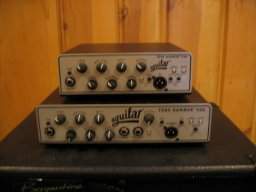
 
I don't think there is a concept of 'too much power' when considering bass amplification, but there surely is a concept of 'too much volume' caused by turning your amp up too loud in a small room when you have front of house support.

If the volume at 3 was too loud, that's why there is a '2' or '1' setting:smug:

In your situation, turning the amp toward the band from the side of the stage helps keep the volume from getting in the way of the mix, and also provides a nice monitor for you and the rest of the band. You can then probably turn up a touch so it sounds good to you on stage.

Not sure about the grounding issue.
 
Electricity will take the path of least resistance to get to where it's going. A "ground" is literally a connection to the ground:

800px-HomeEarthRodAustralia1.jpg


An ungrounded outlet lacks this. You can also lift (take out) the ground (using a "ground lift") if you're getting buzz from a grounded outlet, but this is a little dangerous for exactly the reason the sound guy said: Without a proper ground, the path of least resistance is your own body, and that's how people get electrocuted.

If you or your band is having trouble hearing the bass, that's a monitoring problem and you should bring this up to the soundguy. If the audience can't hear the bass, this is a FOH problem and also needs to be addressed by the soundguy - that's what he's there for. If he said you're too loud out front, listen to him, as he can hear out front better than you can from the stage.

Sometimes monitoring systems suck and you can't hear yourself. It's an unfortunate truth when playing smaller clubs without a decent budget for their PA or monitoring systems. If you use a solution like, e.g. the Bose L1 approach, you needn't worry about this, as you have complete control over your monitoring & FOH sound.

To answer your original question, no, you can't have too much power (as far as wattage). The more, the better, I say, as long as it's not too heavy or impractical to cart around. The more wattage you have, the more headroom you have, and that's a good thing. My mini-rig pushes 500 watts RMS @ 4 ohms and my regular rig pushes 2500 watts @ 4 ohms. Nothing wrong with that! Just make sure you're running your equipment safely and you'll be fine.
 
Another word of advice for too loud in the house.

Find a way to have the center of your cab aiming at your head.

So many musos seem to not grasp the concept that their knees don't have sufficient audio receptors. Your 4 x 10 is beaming like a Maglight adusted to spot mode.

You either have to be very far away to hear your mids and treble, or you have to aim it at your Head bone!!
 
Using a 3-to-2-prong adapter is not just a little dangerous, it's a lot dangerous. As the sound guy said, you can be killed. That safety ground guarantees that your chassis (and strings) are connected to ground. A short in the amp will blow a breaker rather than use your body to run to ground.

If you didn't lift the ground yourself, then perhaps the outlet is miswired. Buy a $7 outlet tester at Home Depot or your local hardware store. It's a 3-prong plug with LEDs that tell you all about the outlet: missing ground, reversed hot/neutral. If it shows anything wrong, try other outlets. If you can't find a good outlet, you may have to punt. Ask the club owner if his fire insurance covers incorrect wiring, or if his liability insurance covers electrocution deaths onstage. He'll fire you, but you'll be alive.