• TalkBass has been independent since 1998. Add your voice.
    Create a free account to reply to discussions, view embedded media, and browse with fewer display ads.
    Join freeLog in
    Want zero display ads or expanded classifieds tools? Compare plans.

Double Bass #$%@! Is this for real?!?!

Invalid Link Removed

That is one OLD hunk of wood.
I didn't think basses existed then...shows what I know, I guess.

Anyway, I'm sure it sounds freaking unbelievable.
The list of things I *wouldn't* give (body parts included) to have a crack at this bass is very, very short.
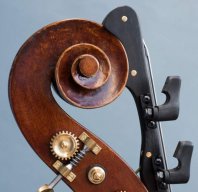
 
Well, one fact is that Thomas Martin is one of England's most respected luthiers and if he has a da Salo in his showroom I'd say its pretty likely to be authentic.
Look at the other basses he has there. I rather like the Heironymous Amati.

BTW da Salo made instruments with 3,4,5 even 6 strings.
 
The fact that it is a 4-string doesn't mean it was always a 4-string.

Tom Martin, although an American, was also principal of one of London's major orchestras. He also has made recordings of many Bottisini pieces. He used to post on the 2xbasslist and offered a lot of good advice.

A few years back, he sent some pictures around of Dragonetti's Gasparo da Salo that was kept in the basement of a museum in Venice.
 
Of course I never meant to imply that it was a fraud. Martin is of course a wonderful bassman in every way.

I was just blown away by that number...I mean, basses from the 1700's are rare enough. 1585 is Unbelievable! And wood cut in 1391! That's before the New World was discovered and everything, before any conception of "common practice" music or tonality or anything like that. It's just overwhelming to me to try to wrap my puny brain around that.

Just wanted to share, for whatever reason. :)
 
The fact that it is a 4-string doesn't mean it was always a 4-string.

Tom Martin, although an American, was also principal of one of London's major orchestras. He also has made recordings of many Bottisini pieces. He used to post on the 2xbasslist and offered a lot of good advice.

A few years back, he sent some pictures around of Dragonetti's Gasparo da Salo that was kept in the basement of a museum in Venice.

The 'Dragonetti' da Salo is in the basement of the Royal Ontario Museum in Toronto. There's a good photo and the Globe & Mail article at Joel Quarrington's site here: [Invalid or Expired Link Removed]

Its a three stringer with very much the same shape as the one at Martin's. Lovely! :)
 
That is one hell of a beautiful bass... However- dragging this old lady out on a gig? Riding a subway? Having it lay besides the car while you just hurry inside again because you forgot your rosin?

In other words, shouldn´t we leave these to the museums? Maybe to orchestras... Just my unsentimental 2 cents.

But for crying out loud, it´s nice!

Best

Sidecar
 
And wood cut in 1391! That's before the New World was discovered and everything, before any conception of "common practice" music or tonality or anything like that.

I know very little about basses, but do know something about dendrochronology. The way I read the 1391 date is that the bass contains wood that was living in 1391. That is the oldest tree ring on the bass, but he does not say what the youngest tree ring is for that bass, which would be an approximation of when the wood was cut, minus however many tree rings were trimmed when the wood was milled and crafted into the bass. The age of the bass would also have to consider however long the plank sat around before it was used to make the bass.

A few years ago I was handling some yellow cedar, freshly cut, that had tree rings dating back to about AD300 when the tree germinated. If the older wood from that tree had been used to make an instrument (sadly it was used for construction lumber), then we could say assuming loss of 20 tree rings during milling and planing and in the words of the Thomases website, "Dendrochronology put the oldest grain in the three piece front at AD320!", even though it was manufactured in, say, 2009.
 
So in other words, this fine old bass was constructed of wood that was in existence at the time of its' construction.

yes,it was constructed of wood that was in existence at the time of its' construction. ;)

As Harling clearly explains, those same materials are available today, identifying the build date is what's diffulcult.
flint arrowheads,pre-colombian pottery,69'chevelle ss ???