A B is a fourth higher than an F#, but an F# is a fifth lower than a B.
Wrong. F# is the fifth of the key of B, but it's a fourth lower.

TalkBass has been independent since 1998. Add your voice.
Create a free account to reply to discussions, view embedded media, and browse with fewer display ads.
Join free Log in
Want zero display ads or expanded classifieds tools? Compare plans.
A B is a fourth higher than an F#, but an F# is a fifth lower than a B.

In a nutshell, this is the strongest - and in my opinion most conclusive - argument against the low F# ever becoming mainstream. For one thing, it takes a trained and disciplined ear to clearly distinguish (and appreciate) frequencies in that range - and the vast majority of casual listeners (i.e. your audience) are simply not going to make the time or effort. There's only so far one can extend the range of frequencies one uses to make music. Eventually one bumps up against the limits of human hearing and sound comprehension.
Secondly, there simply is little musical imperative for the low F#. The vast majority of music communicates what it needs to communicate within the range of notes and frequencies commonly available already. Just because one can do it, technologically speaking, doesn't necessarily mean that one should...
Do more with the frequencies you've already got, I say. Music is about a lot more than just physics...
MM

In a nutshell, this is the strongest - and in my opinion most conclusive - argument against the low F# ever becoming mainstream. For one thing, it takes a trained and disciplined ear to clearly distinguish (and appreciate) frequencies in that range - and the vast majority of casual listeners (i.e. your audience) are simply not going to make the time or effort. There's only so far one can extend the range of frequencies one uses to make music. Eventually one bumps up against the limits of human hearing and sound comprehension.
Secondly, there simply is little musical imperative for the low F#. The vast majority of music communicates what it needs to communicate within the range of notes and frequencies commonly available already. Just because one can do it, technologically speaking, doesn't necessarily mean that one should...
Do more with the frequencies you've already got, I say. Music is about a lot more than just physics...
MM

I was at a recent Police concert at a big outdoor place. That sealed the deal. I don't go to these big shows anymore. The sound is always bad! Everytime Sting played near the low E everything shoke in a very weird fashion. Most soundguys play too loud and the bass always suffers.


For you who are using such low tunings, I salute you. But you may want to think twice or maybe thrice before you claim that your particular facility is "mainstream."
I have yet to hear any one who is utilizing the Low F# string claiming to be mainstream.
An F# string would be a challenge. It's hard enough to record a low E and have the presence you want
An F# string would be a challenge. It's hard enough to record a low E and have the presence you want...=sigh=
Not at all(and no I'm not being sarcastic).
As a tool I bet F# finds its place as the B-keyed pieces become common and F# is utilized in relation to B much as B is utilized now in relation to E.
What the hell do I know - I just build basses.
EDIT - and FWIW an F# can be strung up on any bass. A bass need not be built specifically to do it.
I doubt most listeners can tell the difference between a standard-tuned bass's low notes. Probably a lot of them are hazy even in the guitar's range. We bassists seem to do okay though. The perceptual issue is one of familiarity and I'm not talking about spending years learning to tell these notes apart. It's more a matter of weeks or a month for a person who already has some experience in another range. Many listeners are perfectly happy hearing no bass at all (because it doesn't even register). Should we quit playing because of them?In a nutshell, this is the strongest - and in my opinion most conclusive - argument against the low F# ever becoming mainstream. For one thing, it takes a trained and disciplined ear to clearly distinguish (and appreciate) frequencies in that range - and the vast majority of casual listeners (i.e. your audience) are simply not going to make the time or effort. There's only so far one can extend the range of frequencies one uses to make music. Eventually one bumps up against the limits of human hearing and sound comprehension.
Secondly, there simply is little musical imperative for the low F#. The vast majority of music communicates what it needs to communicate within the range of notes and frequencies commonly available already. Just because one can do it, technologically speaking, doesn't necessarily mean that one should...
Since when? I'm hardly ahead of the curve doing well with a low B. I guess it will all boil down to a can-do or can't-do attitude.

For one thing, it takes a trained and disciplined ear to clearly distinguish (and appreciate) frequencies in that range - and the vast majority of casual listeners (i.e. your audience) are simply not going to make the time or effort.
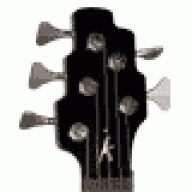
Swet, cuz now I feel like gettin some dark lords and stringing up my ibanez with an F#BEA setup. are ther any other string makers that make the f# string? i think its like .175 er somethin

I'm inclined to think that its value would not be great enough -- for the material that I play -- for me to go to the expense to try it.
 ) for the music they play. OTOH, some players feel the need to explore beyond their normal comfort range (not suggesting you don't, lp
  ) and reach out to things beyond the norm.

in a practical world, when I play it I hear it, my band hears it and the audience hears it .... that's all that really matters to me .......
this thread rules

this is simply not true. the harmonic content of the notes below the low b is unique, and as such is clearly distinguishable, even if the fundamental is not. anyone with ears can hear the notes on my low f# and register them as they should, especially live.