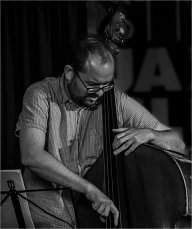
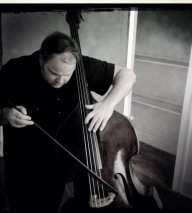
Jay Oliver – Wikipedia it's in German, but you can always google translate
That Wikipedia article pointed to a very heartfelt epitaph published 20. August 1993 in: "Die Zeit", written by Christian Bröcking (english with google translate) who, taking an outer perspective, describes in short words what Olivers ("the Berliner from Kansas City") life in Berlin may have felt like.
-->
When Jay Oliver first came to Berlin in December 1973, his brothers advised him on arrival to avoid the pubs with white curtains. And he stuck to it, black as he was. The bassist and composer, who had studied music and political science, later lived in Switzerland, in Sweden, and again and again in New York, Amsterdam and Paris. He knew the world.
In 1983 he moved to West Berlin forever. "Because it was my city," he said. It remained his city when West Berlin became Berlin again; even if he felt more and more as a stranger. If you wanted to know something about his music, then he philosophized about the color of the sounds.
Jay Oliver spoke German, annoyed with the cashier at the corner supermarket when she put the change in the plastic bowl instead of putting it in his hand.
His bed was in Kreuzberg, in a shared flat, in a private room he was proud of. In New York, he shared a room with his musician friend Frank Lowe and a bed. Oliver worked as a radio announcer at night and Lowe drove a taxi during the day.
In New York he was sometimes rags in a restaurant, where at noon up to 2000 people were fed. In the afternoon he went to the rehearsal, and it seemed quite normal that the musicians smelled of fish or lube oil. He recorded his composition In the dishroom with soprano saxophonist Steve Lacy.
In Berlin, Oliver worked as a bartender in a small Sudanese restaurant, Mondays and Tuesdays always. He paid the rent, and there he met people who did not know him as a musician. That helps him to stay on the ground, he said. Jay Oliver was proud of his work.
For almost eight years he played in Alexander von Schlippenbach's group, directed his own bands and toured with Keith Tippett, Peter Brötzmann or Rüdiger Carl. The musicians liked him. He remained an unknown to the large audience.
A year ago, it was quiet around him. Jazz musicians do not have a manager, but a telephone if you argue too much, the composition, the respect, or a decent pay, then it may happen that at some point no one calls you anymore.
A few weeks ago he learned that the New York jazz star Max Roach was interested in his compositions. Oliver believed in his chance - after all these years - and wrote his last composition: Pinball Machine.
"My doctors hate me," he said, feeling sick for a while in the heart and lungs. He drank, smoked and argued. "I'm not interested in dying healthy if you have to give up everything that's worth living for."
On Saturday he played with an Istanbul percussionist, a saxophonist from Los Angeles and a New York drummer together in the sold-out back room of a Kreuzberg music pub. Seventeen listeners. On Monday he served cappuccino and beer until three in the morning, as usual. Then he went to sleep.
And then he died.
In the morning, a friend who tried in vain to wake him noticed it. It was the 3rd of August. Six days later, the Berliner from Kansas City would have become fifty-one.
From him remained the bass, a stack of compositions, cassettes with recordings of his concerts, and on the wall of the room a framed poster of the joint tour with his friend Charles Tyler, the saxophonist who had died last year.
Jay Oliver owned a hundred marks, which were in his wallet. He did not have a bank account, no insurance. One hundred marks is the concert fee for a jazz musician in Berlin. That had repeatedly described Jay Oliver as unworthy.
The sister, two ex-wives and four children have come to Berlin from Switzerland, California and southern Germany, and he is buried in the cemetery in Kreuzberg's Bergmannstraße.
The American Embassy says she can not bear the funeral expenses; Two Turkish friends Olivers, owners of a jazz café in Kreuzberg, try to collect the 9000 mark. Donations Berlin jazz club owners as well as income from two small commemorative concerts add up to one thousand marks, while the Kultursenat has applied for the funeral expenses.
On September 30th, musicians in honor of Jay Oliver will play at the Berlin House of World Cultures. A benefit concert.