• TalkBass has been independent since 1998. Add your voice.
    Create a free account to reply to discussions, view embedded media, and browse with fewer display ads.
    Join freeLog in
    Want zero display ads or expanded classifieds tools? Compare plans.

JJ & PJ in one bass

IMG_3124.gif

hello everyone.
I asked questions about various electronics. after trying several options, I realized that the best solution for me is JJ and PJ.
They are similar and different at the same time.
I can't decide which one to choose.
However, I know that some P-pickups can have 4 wires (or you can cut the wire connecting the 2 halves), this allows you to use parallel/series for 2 different p-pickup sounds.
in theory, the 2 halves of the p-pickup sound like a regular single coil, of course not 100% due to the difference in the geometry of the pickups, but very close.
I'm only concerned about the volume difference between the bridge single coil and the screw p pickup in parallel mode.
I know that Dimarzio makes all their pickups with 4 wires, even single coils.
who have you tried, tell me how well PJ will sound like JJ?
 
Last edited:
It will not sound the same. To me the question is- will it sound good?

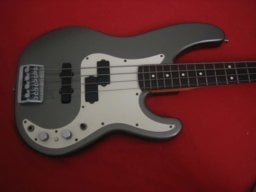
This looks like P/J with series parallel- something Fender offered in the early 90s (see avatar bass- the Precision plus). The Fender ones had Lace pickups. It sounds like a great idea, but in practice I pretty much only used parallel. It was usually one or the other.

Series caused a substantial volume drop and some scoop (which combined with my already scooped 90s GK was not ideal).

P pickups have more output even when series or paralleled than a J. There will likely always be a big volume difference. That is why in P/J sets the pickup matching matters. My fave P/J pickup set is the Wilde P/J pickup set- it does 4 wire, hum cancelling. Their set is complementary. It isn't perfect, the outputs are still very different, but sound good together. If you mess with pickup height and switching you can get great sounds from the Wilde pickups.

The best thing about the Precision plus was being able to quickly switch to P only or J only. J only gave you that burp sound if you liked. I don't really like the Lace pickups in that bass.

My bottom line- pickup position and type will matter more than a wiring scheme. And this particular wiring scheme has been done before and is not a miracle cure for having P and J sounds in a bass. I've given up on flexibility, and prefer having one amazing sound from a bass.
 
View attachment 7403387
hello everyone.
I asked questions about various electronics. after trying several options, I realized that the best solution for me is JJ and PJ.
They are similar and different at the same time.
I can't decide which one to choose.
However, I know that some P-pickups can have 4 wires (or you can cut the wire connecting the 2 halves), this allows you to use parallel/series for 2 different p-pickup sounds.
in theory, the 2 halves of the p-pickup sound like a regular single coil, of course not 100% due to the difference in the geometry of the pickups, but very close.
I'm only concerned about the volume difference between the bridge single coil and the screw p pickup in parallel mode.
I know that Dimarzio makes all their pickups with 4 wires, even single coils.
who have you tried, tell me how well PJ will sound like JJ?
 
I wired a PJ with Lace alumatones
With two push-pull so I could have all the options...
But it only realy sounds good to me with all three pickups in series.
Even added a boost module for the lower output options.
But only play it in the all series, no boost setting lol
 
  • Like
Reactions: erratick
I always wonder about the practice of grounding everything to a single pot, which carries some minimal risk of heat damage, versus collecting all grounds to a common point, the so called "star"grounding, and then a single ground wire to the output jack. What's the consensus on best practice for this? Is there one?
 
With the very low power, the risk of heat damage is nonexistent. Your fingers touching the pot knobs will heat them up more than any current flowing through them.

The main advantage of a common point ground is that if your common ground pot needs replacement, you don't have to unsolder the common ground wires from it and resolder them after replacing. Another advantage is that you can route all ground potential wires to the same location in the electronics cavity and they don't get in the way.

In short: If your bass came with a common ground to the pot, you don't have to resolder it to a separate common ground point. But if you're tinkering and thinking you might tweak a bit more, then by all means, use that opportunity to make a common ground point.
 
  • Like
Reactions: fig
I always wonder about the practice of grounding everything to a single pot, which carries some minimal risk of heat damage, versus collecting all grounds to a common point, the so called "star"grounding, and then a single ground wire to the output jack. What's the consensus on best practice for this? Is there one?

In a guitar or bass, it's so low voltage (and amperage), there is not enough power to generate meaningful heat. Also yes- star topology grounding is typically an easy way. It's easy to do, troubleshoot and is usually best practice.

There are other ways that are fine, but may not be as practical from a wiring standpoint in a bass or guitar.
 
  • Like
Reactions: fig
View attachment 7403387
hello everyone.
I asked questions about various electronics. after trying several options, I realized that the best solution for me is JJ and PJ.
They are similar and different at the same time.
I can't decide which one to choose.
However, I know that some P-pickups can have 4 wires (or you can cut the wire connecting the 2 halves), this allows you to use parallel/series for 2 different p-pickup sounds.
in theory, the 2 halves of the p-pickup sound like a regular single coil, of course not 100% due to the difference in the geometry of the pickups, but very close.
I'm only concerned about the volume difference between the bridge single coil and the screw p pickup in parallel mode.
I know that Dimarzio makes all their pickups with 4 wires, even single coils.
who have you tried, tell me how well PJ will sound like JJ?
I have a series/parallel Humbucker-equipped Les Paul. I would expect similar phenomenon with a Precision Bass pickup that has the wiring to achieve the series and parallel sounds.

Parallel is the default/normal wiring for a Precision Bass pickup. Series is the default/normal for guitar humbucker wiring.

My Les Paul with series/parallel:
Series: The full, normal tone with solid low end.
Parallel: Slightly less output, lows slightly attenuated, but... more crisp treble frequencies.

The idea was to give this Les Paul a bit more tonal versatility and a touch more "Fender-ish" quality when I wanted it.

For a Precision Bass application, if you're going to allow it to operate in series configuration, as with the Les Paul, it's going to be darker, with more lows, and slightly attenuated treble, and this is the important part.... it will play LESS well/balance LESS well with a J pickup in series mode because of increased output. I'm going to guess that is NOT what you want, and the PJ instrument where the Precision pickup is in series mode will not balance well with the Jazz pickup.

I'd say a BETTER way to achieve a little more of a two-pickup Jazz Bass sound on a PJ (and I have both a passive one and an active one, BTW), is to use the tone shaping of an active circuit to scoop the mids a bit with both pickups blended equally. Still not exactly a Jazz Bass with both pickups, but gets closer with the scooped tone from that active circuit. On my active PJ, there are days where I like that two-pickup slap tone every bit as much as the active two-pickup Jazz Bass slap tone. It is a great sound with that active circuit.
 
Yeah. My bad. Reversed it when I originally wrote it. Point still stands. It's a toggle, the volume substantially changes between them.
This will always be the case with series/parallel wiring. When you run pickups in parallel (or two halves of a P bass split coil), you get each pickup or coil producing a quarter the amount of output that they would alone. If you run them in series though, it just adds the value of each coil, so you get two pickups at full output level. That doesn't mean that it's going to sound four times louder, because volume doesn't increase in a linear manner, but it is noticeably louder.

Series wiring also attenuates some of the high end, like you've rolled the tone knob down a bit. You're doubling the length of the wire that the signal has to pass through, which increases the resistance.

This can be useful if you want to use your series/parallel switch to engage a sort of "turbo" mode - if you're using a tube amp or a preamp or some other overdrive effect that is sensitive to input volume, going to series will push the overdrive harder so you get more distortion. But the volume jump is just unavoidable.
 
I always wonder about the practice of grounding everything to a single pot, which carries some minimal risk of heat damage, versus collecting all grounds to a common point, the so called "star"grounding, and then a single ground wire to the output jack. What's the consensus on best practice for this? Is there one?
See turnaround's post #5 in particular but the whole thing is worth reading.
 
I have a series/parallel Humbucker-equipped Les Paul. I would expect similar phenomenon with a Precision Bass pickup that has the wiring to achieve the series and parallel sounds.

Parallel is the default/normal wiring for a Precision Bass pickup. Series is the default/normal for guitar humbucker wiring.

My Les Paul with series/parallel:
Series: The full, normal tone with solid low end.
Parallel: Slightly less output, lows slightly attenuated, but... more crisp treble frequencies.

The idea was to give this Les Paul a bit more tonal versatility and a touch more "Fender-ish" quality when I wanted it.

For a Precision Bass application, if you're going to allow it to operate in series configuration, as with the Les Paul, it's going to be darker, with more lows, and slightly attenuated treble, and this is the important part.... it will play LESS well/balance LESS well with a J pickup in series mode because of increased output. I'm going to guess that is NOT what you want, and the PJ instrument where the Precision pickup is in series mode will not balance well with the Jazz pickup.

I'd say a BETTER way to achieve a little more of a two-pickup Jazz Bass sound on a PJ (and I have both a passive one and an active one, BTW), is to use the tone shaping of an active circuit to scoop the mids a bit with both pickups blended equally. Still not exactly a Jazz Bass with both pickups, but gets closer with the scooped tone from that active circuit. On my active PJ, there are days where I like that two-pickup slap tone every bit as much as the active two-pickup Jazz Bass slap tone. It is a great sound with that active circuit.
hi.
you're wrong.
The standard halves of the P-pickup are connected in series.
parallel connection will make it quieter, thinner and brighter (in theory), I do not know how things will be with sweet frequencies, since the p-pickup is not a humbucker, it does not have 2 points for tracking each string, only one point, like a single coil.

I know it won't give me 200% of the Jazz Bass sound.

I love the Slap sound and clarity when playing chords on Jazz Bass. Overdriven sounds in the style of Geddy Lee.

I like PJ for its medium frequencies, but its clarity is worse than JJ's.

P is louder than J, I wonder if P will sound quieter than J in parallel mode?
I just want to get 2 modes PJ for playing with a pick in rock styles and JJ (well, his likeness) for everything else.
 
PJ can't and won't sound like a JJ. The location where the pickup senses the signal is different. This is the most important factor. P J's are great if you want two individual solo sounds, but it can't do the JJ thing.
Hi, I understand.
JJ is a clear sound, every note is distinguishable, a great slap.

P is much louder, middling and a little nasal, I would like to add variety to it somehow.
 
I saw a great video on the LowEndLobster channel where PP has serial/parallel connection switching for each sensor.

I asked the Lobster questions, but he ignored me, maybe he will give me the answer here)

 
Last edited:
hi.
you're wrong.
The standard halves of the P-pickup are connected in series.
parallel connection will make it quieter, thinner and brighter (in theory), I do not know how things will be with sweet frequencies, since the p-pickup is not a humbucker, it does not have 2 points for tracking each string, only one point, like a single coil.

I know it won't give me 200% of the Jazz Bass sound.

I love the Slap sound and clarity when playing chords on Jazz Bass. Overdriven sounds in the style of Geddy Lee.

I like PJ for its medium frequencies, but its clarity is worse than JJ's.

P is louder than J, I wonder if P will sound quieter than J in parallel mode?
I just want to get 2 modes PJ for playing with a pick in rock styles and JJ (well, his likeness) for everything else.
Yep, also guitar humbuckers like the PAF are typically wired in parallel.

We don't usually consider the split coil of a P bass a humbucker for the reasons you mentioned, though it does eliminate hum through the same mechanism that the two parallel coil pickups do. So it's sort of both.
 
I've modified many P-pickups for series-parallel coil switching. Combining the parallel P-pickup with a bridge J-pickup won't get you a 100% jazz bass tone, but it's a lot closer than a series P-pickup. The parallel P-pickup will be quieter with more highs and a thinner, clearer tone. Having separate volume controls for the pickups is a must to control the changes in volume discrepancy when you switch the P-pickup from series to parallel and lets you blend the 2 pickups to your liking.
A neck J-pickup typically lines up fairly close to the E-A coils of the P-pickup, so the D-G coils are closer to the bridge J-pickup - too close to get a similar interaction as a J-J between the 2 pickups. If you install the P-pickup coils reversed, with the D-G coils moved up closer to the neck, the D-G coils will be farther than a J-J, but the interaction between the pickups is more prominent and it'll sound closer to a J-J.
My typical wiring scheme for a PJ is to use 3 push-pull pots - one for P-pickup volume with switching for P-pickup series-parallel coils, the second for the J-pickup volume with switching for adding an inline capacitor on the bridge pickup (like a Rickenbacker), and the third for tone with switching for combining the 2 pickups in series-parallel. In order to have individual volume controls work in both series-parallel modes, the volume controls have to be wired shunt-style, which is a whole other topic that has been discussed in other threads. This gives me a lot more tonal options than standard PJ wiring.
Some folks on Talkbass use loading capacitors to alter the tone of pickups, so this would be another option to explore. There are several threads on this topic as well.
 
Hi, I understand.
JJ is a clear sound, every note is distinguishable, a great slap.

P is much louder, middling and a little nasal, I would like to add variety to it somehow.
Here is a more concrete observation about the difference. You are spot on about the clarity and slap tone.

There is this synergy between the pickups on a JJ bass, as if they were designed to sound a certain way together. PJ basses just don't have this tone. You notice this especially when playing slap style. The Jazz bass has a very powerful sounding G string. It has a ton of slice, and importantly, a ton of low end. Marcus Miller's sound is the best example of this. Of course, the Jazz bass wasn't designed with slap in mind, this is just something discovered later on.


With a PJ, the combination never quite seems better than its separate parts. When combined, the slap sound on the G string is very pingy, and lacks authority. It has a keyboard-bass quality to it. This is because of comb-filtering, and cannot be remedied from pickups, eq, etc.


You'll find these differences by exploring on your own and seeing what you like best. I have both, and I have some excellent P/J basses, but i never love the way they sound in the same way I like a J/J.