The two places on the internet I consulted got it wrong. Sorry.hi.
you're wrong.
The standard halves of the P-pickup are connected in series.

TalkBass has been independent since 1998. Add your voice.
Create a free account to reply to discussions, view embedded media, and browse with fewer display ads.
Join free Log in
Want zero display ads or expanded classifieds tools? Compare plans.
The two places on the internet I consulted got it wrong. Sorry.hi.
you're wrong.
The standard halves of the P-pickup are connected in series.
Always remember google searches repeat what has been said before by others. This includes falsehoods, popular rumors, fake news, misconceptionsThe two places on the internet I consulted got it wrong. Sorry.

I ran into this very problem last night, we discovered lice in my 6 year old's hair that morning and kept them home from school. The school gave us some lice treatment spray, when I got home I looked at the box and noticed that it was a homeopathic formula (i.e. not real medicine)Always remember google searches repeat what has been said before by others. This includes falsehoods, popular rumors, fake news, misconceptions
and opinions, however subjective and biased. Sometimes it contradicts itself in the same paragraph.
The luck of the draw. If those two sources had said differently, I would have continued trying to sort it out further in effort to clarify as well as relay my experience with two PJ Precisions, and series parallel wiring sound characteristics in general. Whether a Precision pickup is normally wired in series or parallel, I got that detail wrong, whereas otherwise regarding the nature of what series and parallel is, and what character is imparted to the sound from those distinct electrical characteristics, I got right.Always remember google searches repeat what has been said before by others. This includes falsehoods, popular rumors, fake news, misconceptions
and opinions, however subjective and biased. Sometimes it contradicts itself in the same paragraph.

Why not both in one package? Putting aside the "series/parallel switching" stuff, there are ways to have one bass that's capable of both. Not at the same time, mind you, but with a little elbow grease, one could rig up a J/J that could be turned to a P/J and back again at will. I did this mod to a Jazz bass years ago.I asked questions about various electronics. after trying several options, I realized that the best solution for me is JJ and PJ.
They are similar and different at the same time.
I can't decide which one to choose.
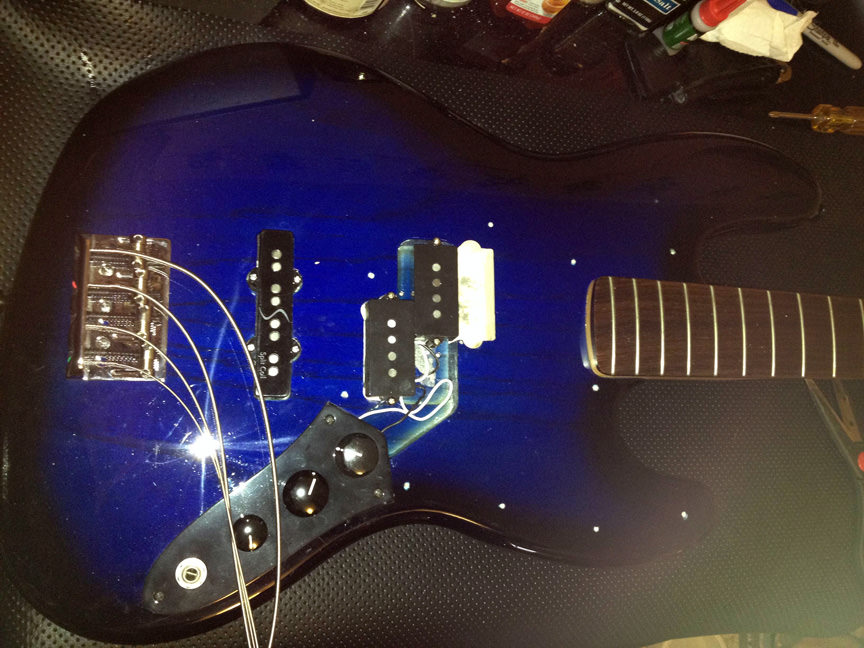
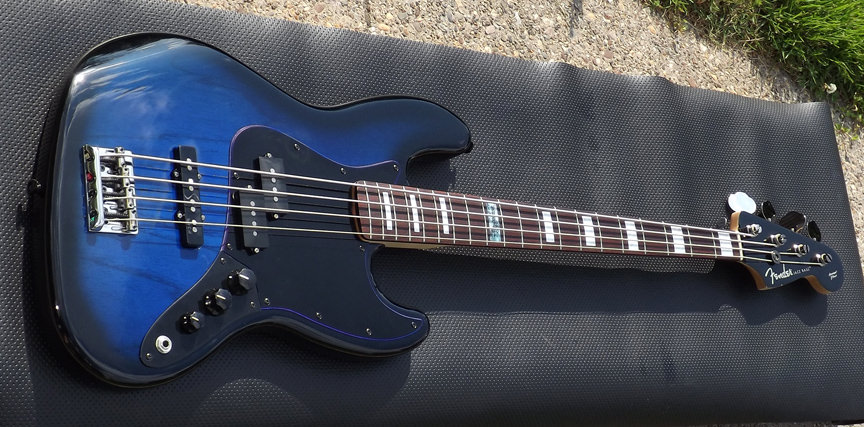
The Projekt Blue P/J pictured above now carries a DiMarzio Sixties P/J set and an Audere preamp. So far, I'm really diggin' the sound I'm getting out of it...thumpy and bold, but with plenty of clarity. To be fair, though, I've never ran them passively, but from many accounts, the preamp is very transparent, so I think it's fair to assume the flat EQ sounds really close to home. One thing for sure, if I were running them passively, I would definitely have a series/parallel switch as a part of the electronics suite.I know that Dimarzio makes all their pickups with 4 wires, even single coils.
who have you tried, tell me how well PJ will sound like JJ?
I don't want to use 2 picgards and switch from.Why not both in one package? Putting aside the "series/parallel switching" stuff, there are ways to have one bass that's capable of both. Not at the same time, mind you, but with a little elbow grease, one could rig up a J/J that could be turned to a P/J and back again at will. I did this mod to a Jazz bass years ago.
If I ever wanted to bring it back home, all I would need is to swap out the neck pickup and guard. Plus, if I did this frequently, it wouldn't take much to put together some kind of solderless, quick-connect between the pickup and pots. That, or simply use a solderless wiring harness. Just unhook the strings, remove the guard and pickup, drop in the new pup, make the connections, pop the guard on, retune the strings and set the pickup height.
The Projekt Blue P/J pictured above now carries a DiMarzio Sixties P/J set and an Audere preamp. So far, I'm really diggin' the sound I'm getting out of it...thumpy and bold, but with plenty of clarity. To be fair, though, I've never ran them passively, but from many accounts, the preamp is very transparent, so I think it's fair to assume the flat EQ sounds really close to home. One thing for sure, if I were running them passively, I would definitely have a series/parallel switch as a part of the electronics suite.
Given the Sixties are designed to work well together, either P/J or J/J, I doubt I'd run into any trouble switching up. (I've had issues with mismatched P/J pickups for years. Fortunately, these play nicely with each other.) Even the recommended pots are the same value, so that would eliminate one step in the transition.
Why not both in one package? Putting aside the "series/parallel switching" stuff, there are ways to have one bass that's capable of both. Not at the same time, mind you, but with a little elbow grease, one could rig up a J/J that could be turned to a P/J and back again at will. I did this mod to a Jazz bass years ago.
If I ever wanted to bring it back home, all I would need is to swap out the neck pickup and guard. Plus, if I did this frequently, it wouldn't take much to put together some kind of solderless, quick-connect between the pickup and pots. That, or simply use a solderless wiring harness. Just unhook the strings, remove the guard and pickup, drop in the new pup, make the connections, pop the guard on, retune the strings and set the pickup height.
The Projekt Blue P/J pictured above now carries a DiMarzio Sixties P/J set and an Audere preamp. So far, I'm really diggin' the sound I'm getting out of it...thumpy and bold, but with plenty of clarity. To be fair, though, I've never ran them passively, but from many accounts, the preamp is very transparent, so I think it's fair to assume the flat EQ sounds really close to home. One thing for sure, if I were running them passively, I would definitely have a series/parallel switch as a part of the electronics suite.
Given the Sixties are designed to work well together, either P/J or J/J, I doubt I'd run into any trouble switching up. (I've had issues with mismatched P/J pickups for years. Fortunately, these play nicely with each other.) Even the recommended pots are the same value, so that would eliminate one step in the transition.