• TalkBass has been independent since 1998. Add your voice.
    Create a free account to reply to discussions, view embedded media, and browse with fewer display ads.
    Join freeLog in
    Want zero display ads or expanded classifieds tools? Compare plans.

Double Bass K bass information

Hello!
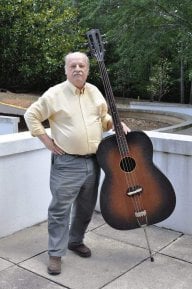
I'm contacting you because I recently found an old bass, and would like to find out more information about it. Like for example how it ended up in austria, if I should restore it and if it's worth something.
I will adding pictures, in hopes that you can tell me more. If not, do you have any recourses where I might find information?
Thank you in advance.
 

Attachments

  • 20210521_132555.jpg
    20210521_132555.jpg
    443.1 KB · Views: 210
  • 20210521_132638.jpg
    20210521_132638.jpg
    327.8 KB · Views: 182
  • 20210521_132617.jpg
    20210521_132617.jpg
    534 KB · Views: 200
  • 20210521_132840.jpg
    20210521_132840.jpg
    484.9 KB · Views: 177
  • 20210521_132730.jpg
    20210521_132730.jpg
    398.1 KB · Views: 170
I have found out that it's a historical instrument, and would now be most interested in finding out how it came to austria. I suspect it was used in the second world war, and came to europe with the us army. Is there anything i can find on bass, that would tell me what battailon it was part of? Thx
 
Kay is the maker. As the label indicates, this is the "M.?. Army model", so your assumption that it came to Europe with an American soldier is quite likely. I cannot imagine anyone kept records of which instruments travelled where in wartime, so the only way to find out would be to track down previous owners. @Steven Ayres seems to have quite a bit of knowledge on these.
 
It’s probably worth restoring, especially since it’s got a little historic value to it. It won’t be worth enormous amounts of money, but you could probably get a good return. It would be cool if you could do some research and pin it to a specific unit. I recently heard a show on public radio about Glen Miller, he joined the army and led a band, they ended up playing thousands of shows all over in all sorts of conditions. Either way, cool find! Here’s a reverb listing of a similar non-army bass. KAY Upright Bass – 1937 | Reverb
 
  • Like
Reactions: LaFaveBass
Back in the early nineties I was offered what I guess would have been a Kay C1B (no label or serial number) bass. The owner's story was that her grandfather was a military bandsman who bought the bass overseas and brought it home with him after the war. So yeah, it's not difficult to imagine Kays being found in Europe.
 
The 'Army' designation and 'KAY USA' stamp confirm this one was built for the US Army, less than 200 were labeled this way. While the company's contracts with the Army and Navy continued into the postwar period, Kay's use of these indicators ended well before the US entered the war. Like many of its type, this instrument was probably used at a domestic military base before it found its way to Europe postwar with Occupation forces or a USO tour, and later sold off as surplus. The company would have had no record of a specific unit assignment, and I have seen no evidence that the military ever tracked this kind of inventory by number. Basses also often left military service with their players.
 
If it ends up on the market, people will often pay more for the first year of production and a low-ish serial number. I think yours is a 4 digit number (a little hard to see on my device), so it wouldn't be from the very beginning. Early on, they were still working out their process, and some early Kay basses had European necks and tuners. Yours seems to have the Kluson tuners that became the norm for Kay. But your bass does have a fully carved scroll, wheras they soon went to glued-on applique "ears" for all but their most expensive models.

Nice find!
 
I think yours is a 4 digit number (a little hard to see on my device), ....

The number is 1726, from later in '37, but still first-year production.

your bass does have a fully carved scroll, whereas they soon went to glued-on applique "ears" for all but their most expensive models.

I'd like to see a more detailed close-in photo before we go with that. I've seen a few M-2s with carved scroll, but later and rarely, and none military-designated. Early filler work to blend in the applied volutes is often pretty good.

The M-2s fulfilled established contracts, so their price was likely fixed, and I suspect that the carved examples carry necks left over from discontinuation of several earlier, more expensive models as Kay worked out its cost balance for real-world pricing and late-Depression demand, particularly among institutions. The M-2 was a minor downgrade from the '37 M-1, therefore lower in cost, where the '39-on M-1s were cheaper still to build.

And if anyone happened to check out that link on the Gollihur site, no, the M-2 is not 1/2-scale. Kay market-tested the idea, but as far as I've seen never actually made a 1/2, only 1/4s. Other ideas in that link are long since superseded by the research as well.
 
  • Like
Reactions: Haans