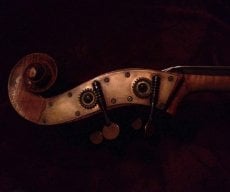
I’ve just received this old Knilling 3/4 bass. It has a solid top and solid sides, and what I think is a laminate back. The people I got it from said their grandfather played it over 50 years ago, so from that and the following info I surmise it is a prewar German bass? “Handmade in Germany” on the Knilling logo (it couldn’t be an east/west German bass from the 70s otherwise it’d say GDP right?), a small, mostly ripped sticker on the inside that is written in German, and has finish checking all over it that looks 50+ years old—along with the smell of an old instrument. Came with an old front zipping leather bass bag and a crappy Kay German bow. Ebony fingerboard/tailpiece, beautiful original varnish, real inlayed purfling, and a nice flame to the sides/back. Am I right in thinking it is an early 1940s shop bass? What is something like this worth? TIA


Enjoy the benefits of a premium membership!
Upgrade Account
-
TalkBass has been independent since 1998. Add your voice.
Create a free account to reply to discussions, view embedded media, and browse with fewer display ads.
Join free Log in
Want zero display ads or expanded classifieds tools? Compare plans.
You are using an out of date browser. It may not display this or other websites correctly.
You should upgrade or use an alternative browser.
You should upgrade or use an alternative browser.
Double Bass Karl Knilling Bass ID and Value help.
- Thread starter TheDellow
- Start date
More options
Who Replied?

Tune the strings down a half or whole tone, lay it on it's back (carefully), place your fingers through the strings and gently pull the top of the bridge back toward the tailpiece until the feet are sitting flat on the top and the bridge it 90-degrees from table. Then tune back up to pitch.
Good looking shop bass. I'm not great at IDs. Shops tended to produce basses that ended up with different labels. People like KFS ^^^ see the origin rather than the brand as the most revealing piece of information. You'd need to get it appraised for a value.
Good looking shop bass. I'm not great at IDs. Shops tended to produce basses that ended up with different labels. People like KFS ^^^ see the origin rather than the brand as the most revealing piece of information. You'd need to get it appraised for a value.

Tune the strings down a half or whole tone, lay it on it's back (carefully), place your fingers through the strings and gently pull the top of the bridge back toward the tailpiece until the feet are sitting flat on the top and the bridge it 90-degrees from table. Then tune back up to pitch.
Good looking shop bass. I'm not great at IDs. Shops tended to produce basses that ended up with different labels. People like KFS ^^^ see the origin rather than the brand as the most revealing piece of information. You'd need to get it appraised for a value.
In addition, it appears that the bridge needs to be moved northward.
Definitely a ply back, and it’s not that old. Looks like a Hofner.
If it's really pre-1945, it's a closet classic.
Aside: I've wondered at times whether the Germans kept making musical instruments during WW2. I would think that they were too busy killing people and fighting the Russians.
Last edited:
In addition, it appears that the bridge needs to be moved northward.
You're right. The middle of those feet should line up to the inside notches on the f-holes. Take it to a DB luthier for a setup and ask them about origin and value.
I assume that you are looking for this to be your bass, rather than something to flip. It appears to be a good, serviceable instrument for a student or local gigging musician.
It’s not pre-war, or even pre-Vietnam war. I’d say probably 1980 at the latest.
Because of the bifurcation between their military/the Nazis and civilian Germans, production absolutely could have continued until things got really ugly after Stalingrad. The US refusing to allow import of German or Czech basses is what created demand for Kay and HN White to fill.
Because of the bifurcation between their military/the Nazis and civilian Germans, production absolutely could have continued until things got really ugly after Stalingrad. The US refusing to allow import of German or Czech basses is what created demand for Kay and HN White to fill.
It’s not pre-war, or even pre-Vietnam war. I’d say probably 1980 at the latest.
Because of the bifurcation between their military/the Nazis and civilian Germans, production absolutely could have continued until things got really ugly after Stalingrad. The US refusing to allow import of German or Czech basses is what created demand for Kay and HN White to fill.
It’s hard to tell in the photos, but the finish is pretty heavily checked akin to other instruments I have of the 50+ y/o variety. My inclination, aside from it’s closer queen appearance, is that it’s older than that. I could be wrong, but it looks like a really clean, rarely used, old instrument.
Classic nitro finish weather checking. My first bass was identical except for being plywood and was labeled Anton Schroetter. Does yours have fake flame on the neck?
Classic nitro finish weather checking. My first bass was identical except for being plywood and was labeled Anton Schroetter. Does yours have fake flame on the neck?
No fake flames on the neck, although I did have a Roth that had the fake flames painted on (kind of trashy, IMO).
For what it’s worth, I’ve got a fully carved one in much worse condition that I suspect to be from the 50s because the last luthier signed and dated it. Same label as yours, just a little older.

They were made in the Hofner factory. In terms of value, I’m no authority but it seems like $6k would be a good high retail asking price given the condition. I’m asking $3750 for mine (repaired cracks and all) with no one rushing to put the cash in my hand. How does it play?
They were made in the Hofner factory. In terms of value, I’m no authority but it seems like $6k would be a good high retail asking price given the condition. I’m asking $3750 for mine (repaired cracks and all) with no one rushing to put the cash in my hand. How does it play?
For what it’s worth, I’ve got a fully carved one in much worse condition that I suspect to be from the 50s because the last luthier signed and dated it. Same label as yours, just a little older. View attachment 4486992
They were made in the Hofner factory. In terms of value, I’m no authority but it seems like $6k would be a good high retail asking price given the condition. I’m asking $3750 for mine (repaired cracks and all) with no one rushing to put the cash in my hand. How does it play?
It's an excellent bass, super punchy deep low end and it's surprisingly articulate under the bow for a hybrid bass (carved top, solid ribs, laminated back). I'm searching for any signs of a date on mine from the luthier too...where is yours signed/dated?

I'm searching for any signs of a date on mine from the luthier too...where is yours signed/dated?
On the bottom of the bridge. Says "Baker '63" and I assume it's not the original bridge, hence my "sometime in the 50's" estimation.... I agree they're great sounding/playing basses, particularly under the bow. I just can't hang with the skinny Kay-like neck. If I hold onto this bass, I'll probably end up putting a new super thick fingerboard on to beef it up a bit to make it feel more like my La Scala. It's just hard for me to justifiy doing it when it doesn't really need it other than to satisfy my personal preference.
Last edited:


