• TalkBass has been independent since 1998. Add your voice.
    Create a free account to reply to discussions, view embedded media, and browse with fewer display ads.
    Join freeLog in
    Want zero display ads or expanded classifieds tools? Compare plans.

Double Bass Kay bass repair surprise

I am an old classical player who recently discovered bluegrass. Just bought a c1 1949. Took neck (no crack or split) off and top off and found a 1" diameter wood rod someone glied in from near the end pin all the way up to right under the neck mortisse area - no screw or anything going into neck though. I can not see any structural reason why it would have been done though. Does anyone have any idea why or what this would be for? I feel like i should just remove it

Thanks for any insight.
 
here is a picture of the rod
 

Attachments

  • photo.jpg
    photo.jpg
    103.8 KB · Views: 303
actually it is glued in the bottom just like at the top - so they had the front of the bass off to do it. The neck mortis was loose and the action of course ended up being high - so maybe they thought wedging it in would lift the mortis angle up a bit and lift the fingerboard up? that's all i can figure.
 
Wow, that is odd. I would remove that neck block and re-glue it and remove that goofy thing. Your theory makes some sense... Kay's are notorious for having neck problems because of the poor neck to body fit.

Since you have the neck off, you should consider taking the time to correctly shim and fit the neck so it makes full contact at the bottom of the mortise.

I am in the middle of a bunch of work on a Kay as well... so far it has been quite rewarding. Good luck!
 
I am an old classical player who recently discovered bluegrass. Just bought a c1 1949. Took neck (no crack or split) off and top off and found a 1" diameter wood rod someone glied in from near the end pin all the way up to right under the neck mortisse area - no screw or anything going into neck though. I can not see any structural reason why it would have been done though. Does anyone have any idea why or what this would be for? I feel like i should just remove it

Thanks for any insight.

You've stumbled upon a well-kept secret, passed down from luthier father to luthier son for generations.

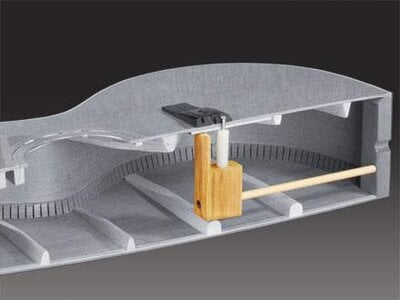
The Tone Rod, named for its discoverer 'Tone-y' Stradivari, is the long lost secret of the sound of the Cremonese master instruments. It lives on today as the Bridge Doctor, a sure-fire way to make your Tacoma Chief resonate like a pre-War Herringbone. :)
 

Attachments

  • JLD_Bridge_Doctor_sm.jpg
    JLD_Bridge_Doctor_sm.jpg
    12.4 KB · Views: 310
I will remove it, and rework the mortise this weekend. It actually sounded pretty good compared to my Chinese plywood bass, before i opened it up. much deeper and more sustained tone. maybe 'Tone-y' Stradivari, was on to somethin, or on somethin...

looking forward to hearing this baby's voice!
 
My theory. Someone took the top off and while they were doing repairs they put the dowel in to brace the bass, as recommended in the Traeger book for instance. Then maybe they didn't understand that you're supposed to take it out or maybe the bass got shuffled off to someone else who just glued it back together, not knowing why the dowel was in there.
 
You have probably taken it out already, but my thoughts on this one:
- it's a support bar to counteract the tension of the strings. The guy who installed it was probably of the opinion that the table / body was insufficiently strong to withstand the string tension. This was possibly so because he observed table sag / warpage, or because he moved from low tension gut to high tension steel strings.
- the problem with this contraption could be that the bar resonates at it's own specific frequency, thus potentially colouring the sound of the instrument. If you hear that is another matter.
- If you apparently did not know it was in there, and if it did not bother you, why take it out?
- Of course, if the instrument is properly shaped it should derive its strength from its shape, and the downward force of the bridge is counteracted by the longitudinal force on the table, as applied by the neck block. But there was an 'if', and ply may wobble (I believe these Kays were all ply? I don't think I've actually ever seen a Kay.)

Good luck, Koen.