
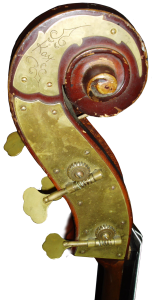
Here is an image of the only set I've ever seen, an extra pegbox / scroll stiffening plate on an old Kay that beefs up the area where they often break, circa 1952:

TalkBass has been independent since 1998. Add your voice.
Create a free account to reply to discussions, view embedded media, and browse with fewer display ads.
Join free Log in
Want zero display ads or expanded classifieds tools? Compare plans.


Here is an image of the only set I've ever seen, an extra pegbox / scroll stiffening plate on an old Kay that beefs up the area where they often break, circa 1952:


I think both the upper and lower plates would look better if they were inset so their top surface was in line with the top surface of the pegbox. It doesn't seem, however, that this is done on basses.
From a factory standpoint, there is no utility inlaying the tuning machines; they don't function any different and it adds another step to the manufacturing process that also requires other aspects like the proper alignment of the holes to be even more precise. The beancounters would instantly remove that step. If they didn't, the guys on the production floor would unofficially eliminate it when the beancounters started yelling at hem to increase production speed. ..
If my estimates are close the string shop was turning out 600 basses and cellos a week at peak production in the early '50s.



I remember Arnold Schnitzer writing that he didn't like the idea of weakening the pegbox area by removing wood to inlay. And I think he was referring to French style gears, not whole plates!

I think its got more to do with tuner replacement - but it would take an unbelievable amount of time to inlay the tuners into an instrument, so its just never done. I can't recall seeing any mandolin, banjo, guitar or bass tuners inlaid - even $35,000.00 classical guitars have the tuners surface mounted...Yes, absolutely.
It is, however, a little surprising that apparently not even high end makers inlay the plates. I agree it makes no functional difference, but it seems that it would look aesthetically more "finished".
I am not sure why I believe this, so now I'll have to think of examples where something similar is usually inlaid.
I think its got more to do with tuner replacement - but it would take an unbelievable amount of time to inlay the tuners into an instrument, so its just never done. I can't recall seeing any mandolin, banjo, guitar or bass tuners inlaid - even $35,000.00 classical guitars have the tuners surface mounted...


