I'm a moderately good sight reader, in that I know pick up sheet music and get a recognisable tune on first, slow, attempt and move up and down the fret board according to the piece. I ran into a basic problem today. Playing slowly I can get away with peeking at my left hand to make sure its in the correct place, but I decided to not peek. I was playing something in A major in the first position (? first 4 frets). Particularly when moving from G# on the E string (or C# on the A) to E on the D the stretch caught me out and I started losing track of where my fingers were. Placing my thumb carefully seemed to help, a bit, but only a bit. Is this just a practice thing or is there some trick or technique to it? And is this the correct forum?

Enjoy the benefits of a premium membership!
Upgrade Account
-
TalkBass has been independent since 1998. Add your voice.
Create a free account to reply to discussions, view embedded media, and browse with fewer display ads.
Join free Log in
Want zero display ads or expanded classifieds tools? Compare plans.
You are using an out of date browser. It may not display this or other websites correctly.
You should upgrade or use an alternative browser.
You should upgrade or use an alternative browser.
Keeping track of fretting hand while sight reading
- Thread starter R Flynn
- Start date
More options
Who Replied?Hi
yes, its a practice thing for muscle memory. "Locking in your thumb" to the position on the neck will help alot toward keeping position.
Its sounds like you need to focus on 'maintaining your position' which is all about being present in your hand while practicing your scales.
in two parts it would be 1) knowing your scale patterns (and how they 'link together') along with envisioning them in your mind as they lay across the neck. 2) All the while keeping a good hand grip/position —as to not 'lose your position'
It can seem daughting to think about all the possibilities for playing and reading but tackle each situation as it comes up.
For Example; playing in A major in 1st position—and you're losing position. Specifically reaching fret 4 to 2 on adjacent strings.
Good luck
yes, its a practice thing for muscle memory. "Locking in your thumb" to the position on the neck will help alot toward keeping position.
Its sounds like you need to focus on 'maintaining your position' which is all about being present in your hand while practicing your scales.
in two parts it would be 1) knowing your scale patterns (and how they 'link together') along with envisioning them in your mind as they lay across the neck. 2) All the while keeping a good hand grip/position —as to not 'lose your position'
It can seem daughting to think about all the possibilities for playing and reading but tackle each situation as it comes up.
For Example; playing in A major in 1st position—and you're losing position. Specifically reaching fret 4 to 2 on adjacent strings.
- Before sight-reading (or working on related material) Practice the A major scale in that position (Ascending and descending as wh, half, quarter and eight notes on the same metronome click, then with 'a pattern' at the various rhythmic values). This includes more than the frets you need to play but; is your fret-hand in the proper position?, with your thumb in the proper position?, using your fingertips?, reaching out for note with fingers and not collapsing the thumb?
- Now work on sight reading in that key for that position.
- Once confortable, can you play the Amajor scale in 2nd position, 4th position, 5th position etc?)
- work any new position and return to sight-reading materials in that key but from the NEW position. (and the cycle continues)
Good luck
Last edited:

One good suggestion I saw on SBL was rather than positioning your music stand or tablet directly in front of you, put it off center towards the neck side of your bass. That way you will be looking in the same general direction for both.
Get in the habit of not looking at the fingerboard. Practice slowly and listen to the pitch of the notes. Mistakes are good; they mean your are learning.

This sounds like you're making good progress, You can practice playing without looking, any time you're playing. So it's not a problem with sight reading per se. Also, the sight reading will get easier, and as you improve, you'll find that you can briefly glance away from the page without getting lost.
Thanks for the detailed response. Yeah I guess its one thing to know the variations of the scale(s), another to have some 'present in the hand' sense. Without being aware of it I probably do look at my hand as I run through a scale. Initially I thought the emoji wasHi
yes, its a practice thing for muscle memory. "Locking in your thumb" to the position on the neck will help alot toward keeping position.
Its sounds like you need to focus on 'maintaining your position' which is all about being present in your hand while practicing your scales.
in two parts it would be 1) knowing your scale patterns (and how they 'link together') along with envisioning them in your mind as they lay across the neck. 2) All the while keeping a good hand grip/position —as to not 'lose your position'
It can seem daughting to think about all the possibilities for playing and reading but tackle each situation as it comes up.
For Example; playing in A major in 1st position—and you're losing position. Specifically reaching fret 4 to 2 on adjacent strings.
These scale practice techniques are the ones that never get introduced or are skipped over but I've found them to be very helpful for "neck awareness", killing blind spots, as well as making your practice sessions alittle more engaging.
- Before sight-reading (or working on related material) Practice the A major scale in that position (Ascending and descending as wh, half, quarter and eight notes on the same metronome click, then with 'a pattern' at the various rhythmic values). This includes more than the frets you need to play but; is your fret-hand in the proper position?, with your thumb in the proper position?, using your fingertips?, reaching out for note with fingers and not collapsing the thumb?
- Now work on sight reading in that key for that position.
- Once confortable, can you play the Amajor scale in 2nd position, 4th position, 5th position etc?)
- work any new position and return to sight-reading materials in that key but from the NEW position. (and the cycle continues)
Good luck
 (eeek work).

One major problem people have with sight reading and maintaining tempo is knowing the fingerboard.
Practice two string scales. Say the note names out loud as you play. KEEP YOUR EYES OFF THE BOARD.
Make everything you can consistent: If you perform sitting, practice sitting. Wear a strap if you perform with a strap. If you play different basses, make sure they hang the same.
Know the fingerboard: Play notes around the circle of 4ths. (C-F-Bb-Eb-Ab-Db-Gb-B-E-A-D-G). Do them all on the same string. (yea, do the exercise 4 or 5 times). KEEP YOUR EYES OFF THE BOARD.
It's a process, not an event. All this takes time. The ultimate goal is to be able to perform with a group that already knows the music and you're seeing it for the first time.... no rehearsal. (yea, there are plenty of people that can do that)
Practice two string scales. Say the note names out loud as you play. KEEP YOUR EYES OFF THE BOARD.
Make everything you can consistent: If you perform sitting, practice sitting. Wear a strap if you perform with a strap. If you play different basses, make sure they hang the same.
Know the fingerboard: Play notes around the circle of 4ths. (C-F-Bb-Eb-Ab-Db-Gb-B-E-A-D-G). Do them all on the same string. (yea, do the exercise 4 or 5 times). KEEP YOUR EYES OFF THE BOARD.
It's a process, not an event. All this takes time. The ultimate goal is to be able to perform with a group that already knows the music and you're seeing it for the first time.... no rehearsal. (yea, there are plenty of people that can do that)
Is this just a practice thing or is there some trick or technique to it?
It's just practice and there are no tricks.
Like you, I only read well enough to learn material at slower than performance tempo. So I've gotten out my basic sight reading book and started shedding again. It starts with simple stuff like the same note in every bar but with different rhythmic combinations of notes and rests. Then it gets into multiple notes with rests, etc., etc. A page a day doesn't take a long time so it's easily slotted into your practice routine.


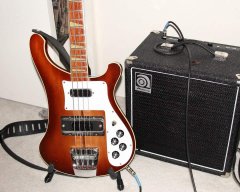
The construction of the bass is a factor. My first bass was a Ric 4001. The neck dimensions don't change as you move up and down the neck.
I remember demoing a Gibson Victory several times. The neck gets thicker as you play higher. I found this made it much easier to accurately shift up and down the neck without looking.
My current #1 is a Yamaha TRB6P. I don't have to look very often but it is necessary from time to time.
If you have to peek, you have to peek. Learn to read ahead and peek quickly. It gets easier with practice and experience.
I remember demoing a Gibson Victory several times. The neck gets thicker as you play higher. I found this made it much easier to accurately shift up and down the neck without looking.
My current #1 is a Yamaha TRB6P. I don't have to look very often but it is necessary from time to time.
If you have to peek, you have to peek. Learn to read ahead and peek quickly. It gets easier with practice and experience.

I've found it helpful to do my early read-throughs along with a recording of the music. Lately, I've been doing musical theater, so I listen in advance to the music and then play back the recording at a slower tempo to read through it. My ears do the rest to keep my hands in the right position.
I found that one finger per fret made positioning very easy with practice. For example, playing in G my second finger would be in the third fret and more than one octave of the scale can be played without moving the hand.
Scale of G. Notes of the next octave up in ( ) brackets.
Once learned you can move this anywhere on the fretboard and move up a string to change by a forth.
Scale of C. Notes of next octave down in ( ) brackets.
Once you get used to this you can stop thinking in terms of chord and note names. You'll find yourself thinking of chords I, IV, V, etc., and this means that once you know the root note you can transpose most of a piece without thinking - provided you're not relying on open strings for much of your playing.
Dots: o o||-----|-(1)-|-----|-(3)-|-(4)-|-- A B C||-----|--1--|-----|--3--|--4--|-- E F# G||-----|--1--|--2--|-----|--4--|-- B C D||-----|-----|--2--|-----|--4--|-- G AScale of G. Notes of the next octave up in ( ) brackets.
Once learned you can move this anywhere on the fretboard and move up a string to change by a forth.
Dots: o o||-----|--1--|-----|--3--|--4--|-- A B C||-----|--1--|--2--|-----|--4--|-- E F G||-----|-(1)-|--2--|-----|--4--|-- B C D||-----|-----|-(2)-|-----|-(4)-|-- G AScale of C. Notes of next octave down in ( ) brackets.
Once you get used to this you can stop thinking in terms of chord and note names. You'll find yourself thinking of chords I, IV, V, etc., and this means that once you know the root note you can transpose most of a piece without thinking - provided you're not relying on open strings for much of your playing.
Jazzdogg
Less barking, more wagging!
This thread reminds me of my days, back in the sixties, learning double bass using Simandl.
All of the practice developing ears, technique, and muscle memory, paid off handsomely when it came time to sight read.
Years later, I saw "The Karate Kid" movie, and easily saw correlations between Mr. Miyagi's "Wax on, wax off" method, and the Simandl bass method.
They're both about carefully and deliberately developing repeatable habits.
All of the practice developing ears, technique, and muscle memory, paid off handsomely when it came time to sight read.
Years later, I saw "The Karate Kid" movie, and easily saw correlations between Mr. Miyagi's "Wax on, wax off" method, and the Simandl bass method.
They're both about carefully and deliberately developing repeatable habits.

Agree with you on this, I play both DB and EB but lately more electric. With DB, you really have to develop muscle memory and learn to trust your hands (and your ears). For the OP, just keep after it and try not to look at your hands at all unless doing something like a big shift up the neck.This thread reminds me of my days, back in the sixties, learning double bass using Simandl.
All of the practice developing ears, technique, and muscle memory, paid off handsomely when it came time to sight read.
Years later, I saw "The Karate Kid" movie, and easily saw correlations between Mr. Miyagi's "Wax on, wax off" method, and the Simandl bass method.
They're both about carefully and deliberately developing repeatable habits.

Soon you will find that you can see a note and hear it in your mind.
This will lead to seeing two notes, hearing them both in your head, recognizing an interval and having your fingers on the notes without looking or thinking, thanks to muscle memory.
After about 47 million times, you go straight from seeing the note to hearing it.
The steps to get there go on auto pilot.
This will lead to seeing two notes, hearing them both in your head, recognizing an interval and having your fingers on the notes without looking or thinking, thanks to muscle memory.
After about 47 million times, you go straight from seeing the note to hearing it.
The steps to get there go on auto pilot.

I've been going through this myself, after switching to electric bass in a big band instead of upright. Everyone is right, it's a practice thing. After a while muscle memory takes over, and you will get better at glancing at the fretboard and not losing your place too. Just have to put in the hours.
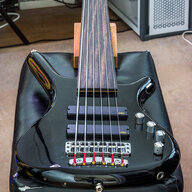
One thing that has seemed to speed up the process a little for me is practicing with a fretless bass. If you have one. It forces you to be more accurate in your shifts and fingering.
One thing that has seemed to speed up the process a little for me is practicing with a fretless bass. If you have one. It forces you to be more accurate in your shifts and fingering.

My violin teacher and orchestra director used to hit our hands with a wooden ruler or her bow if we ever looked away from our sheet music.
Maybe get someone to do that?
Or just practice. Ok I know that's a lame answer.
But if you can learn to play through basic scales without spying your hand you can learn to do the same while reading.
Don't get discouraged. It will come quicker than you think.
Maybe get someone to do that?
Or just practice. Ok I know that's a lame answer.
But if you can learn to play through basic scales without spying your hand you can learn to do the same while reading.
Don't get discouraged. It will come quicker than you think.

Practice your scales. Especially your shifts. Get to the point where you can shift without looking. This will help you to sight read without looking.
The less you look, the less you have to.
The less you look, the less you have to.


