• TalkBass has been independent since 1998. Add your voice.
    Create a free account to reply to discussions, view embedded media, and browse with fewer display ads.
    Join freeLog in
    Want zero display ads or expanded classifieds tools? Compare plans.

Double Bass KNA DB-1 weird intonation issue

I have a KNA DB-1 piezo pickup on my Shen SB-100. I recently got a Fishman preamp (https://www.talkbass.com/threads/fishman-platinum-pro-eq-di-analog-preamp-pedal.1650968/) on a recommendation from a (much better playing) friend as an alternative to plugging straight into an amplifier. Among other things, the Fishman has a built-in tuner.

I usually tune with either a D'addario clip-on or the TE tuner app (TonalEnergy, Inc.) both of which agree spot on. However, the Fishman, which tunes via the cable, said my A-string was flat. So I did some tests.

Here is the KNA DB-1 installed (on the treble side):
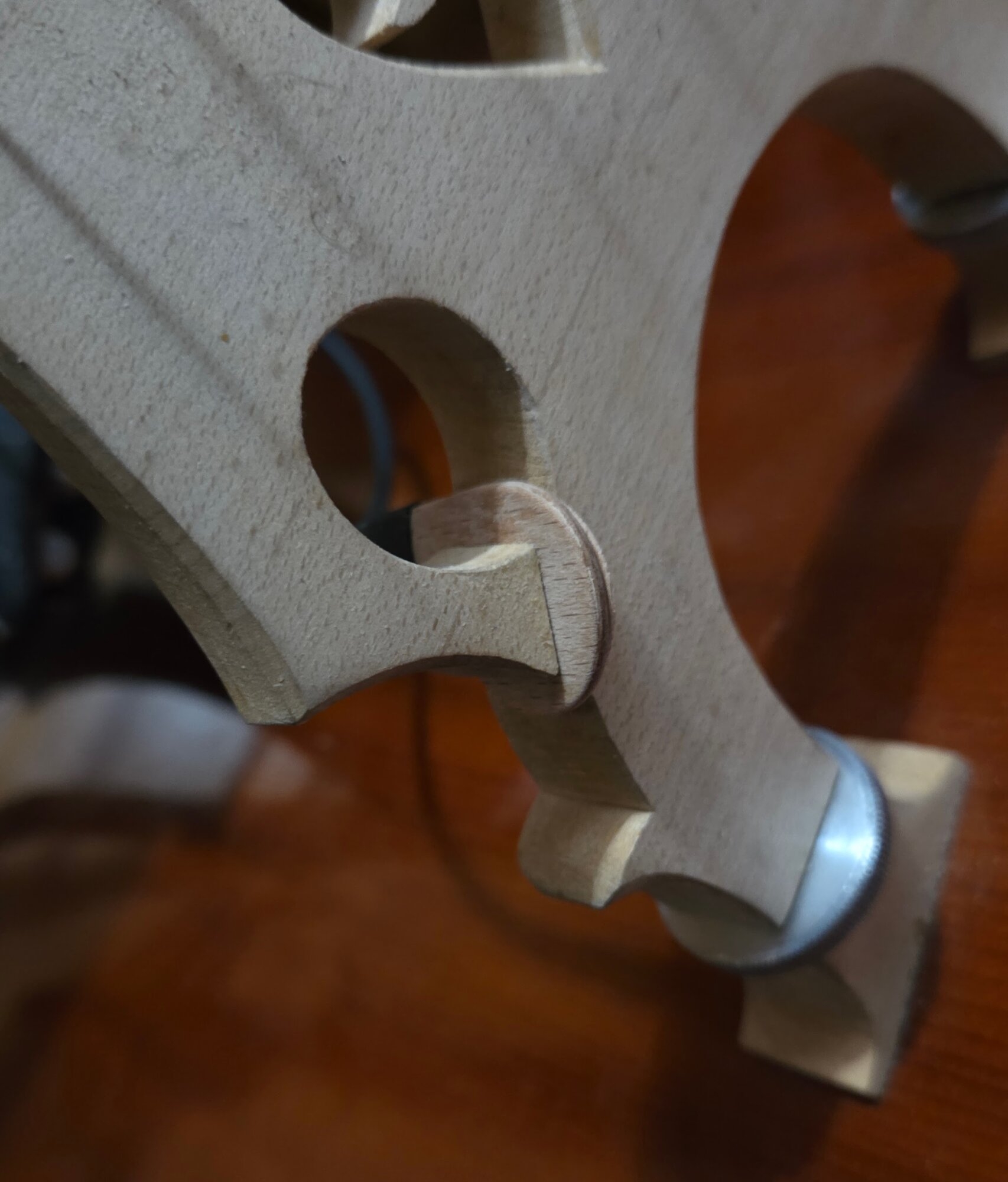
20251031_133458.jpg
20251031_133511.jpg


Here is a pic of both the Fishman and the TE app running simultaneously with the A string ringing (the issue I am describing happens only with the A-string):

20251031_133011.jpg


To check to see if there is an issue with the Fishman, I plugged in my electric P-bass. Had to take two pictures, one with the tuner on, and one with the tuner off so it sends the signal to an amp so the app can hear it:

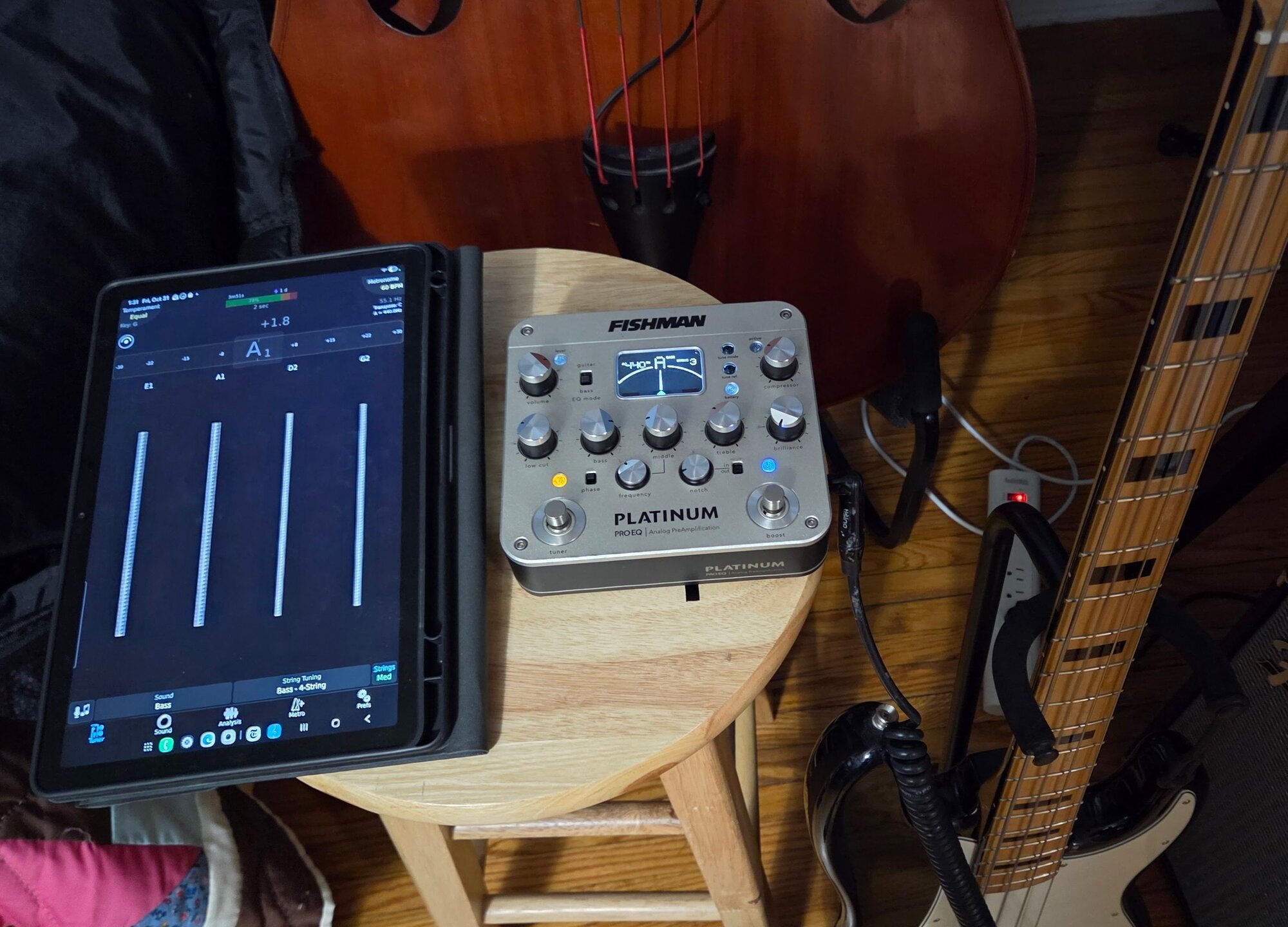
20251031_133332.jpg
20251031_133158.jpg


So the Fishman is working.

Question: Why is the KNA sending out a flat signal for (just) the A-string? I can just tune to the app or clip-on, but if it is a quiet gig and the unamplified sound is loud enough, then we are going to get some dissonance going on.

The dissonance isn't super noticeable to my ears, but it is there. And if I set the bass close enough to the amp I can get the E and the D string to feed back (increasing in volume) but this doesn't happen with the A string due to the slight change in pitch not reinforcing the vibration.

Anyone see anything like this before? Is there something wrong with my installation (I think I needed to add just one "tonewood" disk to get the tight fit on the bridge).
 
It's not the pickup; the pickup is a simple vibration/pressure to electronic signal device, it won't alter the "tuning" of a pitch. You might be dealing with some sort of irregularity from the bass, perhaps related to a minor wolf tone or similar, where the "tuning" of the acoustic body is interfering with/corrupting the harmonics (which is how most contact/plug in tuners analyze the pitch.)

More likely, though, I've occasionally heard rumblings that the tuner built into the Platinum Pro is less accurate/reliable than some of the better clip tuners, so it could very likely be that.
 
It's not the pickup; the pickup is a simple vibration/pressure to electronic signal device, it won't alter the "tuning" of a pitch. You might be dealing with some sort of irregularity from the bass, perhaps related to a minor wolf tone or similar, where the "tuning" of the acoustic body is interfering with/corrupting the harmonics (which is how most contact/plug in tuners analyze the pitch.)

More likely, though, I've occasionally heard rumblings that the tuner built into the Platinum Pro is less accurate/reliable than some of the better clip tuners, so it could very likely be that.
Hi Mark, I’ve been wondering about the accuracy of the Fishman Platinum ProEq tuner. I plugged the headphone
output of my Peterson StropoPlus HD
into the input of the Fishman. Through 4 octaves of the note A, the Fishman detects the note as dead on. I’m showing photos of octaves 1-3.
 

Attachments

  • IMG_3659.jpeg
    IMG_3659.jpeg
    1.1 MB · Views: 19
  • IMG_3661.jpeg
    IMG_3661.jpeg
    1.1 MB · Views: 16
  • IMG_3662.jpeg
    IMG_3662.jpeg
    1.1 MB · Views: 17
Hi Mark, I’ve been wondering about the accuracy of the Fishman Platinum ProEq tuner. I plugged the headphone
output of my Peterson StropoPlus HD
into the input of the Fishman. Through 4 octaves of the note A, the Fishman detects the note as dead on. I’m showing photos of octaves 1-3.
I think the tuner is useful for the weekend warrior, but they had to make it work across a wide range of instruments, since the Platinum pres are used for all sorts of acoustic instruments in different ranges. I'm more confident in a tuner that is designed for bass, it does a better job for me. I like the D'Addario Eclipse Clip on tuner for Cello/Bass; it works the best of any clip tuner I've tried (and we've had a lot of them over the years!)
 
Also, and I say this with all due respect, but the best tuners for double bass players are not to be found in electronic form. They come with us into this world as part of our bodies.

If we are to play our magnificent instrument in tune over the course of 3+ octaves, encompassing 36+ pitches in all, we should be able to tune four open strings using the same mechanism that we have to use to tune the other 32+ notes.

In addition to this, we are almost always tuning to another instrument, be it an oboe or a piano, which may not be perfectly in sync with any electronic tuner. If we can’t hear this well enough to tune the open strings, what hope do we have of playing the 32 + fingered notes in tune?
 
... we should be able to tune four open strings using the same mechanism ...
The double bass is unique in its extremely low range of notes, such that I can agree a lot with this, BUT...

In a number of genre worlds where there was never agreement about "being in tune" before, electronic tuners have made a huge difference. In a typical two to three hour bluegrass jam circle with 6 to 10 musicians, there could easily be 10 to 20 cumulative minutes of tuning in the days before electronic tuners. And I experienced the same decades ago when I assisted with college Jazz performance classes. Now, everyone has their electronic tuner and everyone privately tunes initially before the session and if necessary between songs. On a stage, it works the same way, even though most of us can tune by ear with someone else. As much as anything the near universal compliance serves to enforce that electronic tuners are the standard in those genre.

I can see tuning to a piano if one is in play, because for whatever reasons it may not be tuned to A440, and in an orchestra I can see tuning to the oboe or whatever is considered standard there, as much as anything for uniformity. But as someone who also plays a wind instrument, I personally know how widely variable intonation can be with these"fixed" instruments, so you really have to trust someone who blows a note, that they are going to be consistent throughout the session. And I've seen and heard that trust wasted.

So yes, learn to tune by ear and be prepared to do that when needed, but if everyone else is using electronic tuners, they're probably doing it for a valid and important reason.
 
Sooooo, I get my bass in perfect tuning while the &^%$#@ guitar player with a capo on 4 still calls it a G chord and is almost 50 cents out of tune on three strings.... :roflmao:

The built in Fishman tuners have issues with accuracy, plus they tend to break very fast. When I'm plugged in, I use a Turbo Tuner 300; fantastic accuracy and speed.
 
Last edited:
I’m not saying that tuners are evil, only that they are all flawed in some ways and that we should learn to tune by ear. I don’t have a tuner, although I have several on my phone. For jams with string instruments where everybody is tuning to 440, I don’t doubt that they help the collective ensemble sound better. And obviously, piano tuners use them, although their tuners are far more advanced than the little bugs most people carry around in their cases.

But here are two cases where they fail:

The most frustrating situation is one that I have witnessed hundreds of times: guitar player is in an ensemble that also has a piano player. The piano isn’t tuned to 440, but the guitar player tunes to the tuner and then doesn’t bother to notice that they are out of tune with the piano, and just plays out of tune until somebody, usually me, stops and makes them tune to the piano. 🤦‍♂️ Sadly, this is more the norm than the exception.

I recently did some recordings for an upcoming video on calibration in which I play exercises in all 12 keys along with a drone sounding the tonic of whatever key the exercise was in. I presented this topic at this year’s ISB convention and used these recordings as part of the presentation. God knows my intonation isn’t perfect - no one’s is - but there were some keys where the open strings were badly out of tune compared to the rest of the exercise (Open G in the key of Eb comes to mind) when they were perfectly in tune with their own pitch in relation to the drone. In a few cases I had to go back in in Logic and pitch correct the open strings just so the whole exercise didn’t sound terrible.

This happens on gigs all the time - you know that certain open notes are going to be out in certain keys. You can either use the open string or harmonic and shrug and say “cost of doing business”, or you can decide that they’ll sound better as a fingered note. My usual intuitive sense is that if the note is short or a passing note the open strings are usually fine, but if it’s a long sustained note that is exposed in the texture, it’s better to finger it manually.
 
Last edited:
I actually love playing with a good pianist... Our band's fiddle player carries degrees in both piano and violin performance and it is a total joy to play with her on keys. And yes, it's not unusual to find a piano that is not tuned to A440, so everyone else really does have to tune to it...

But, every once in a while we encounter in a gig a provided piano that is not in tune at all with itself. In those times, we plead to exclude the piano completely and play with our smaller, tunable stringed instruments. I understand the difficulty involved with tuning a raucous piano, but some pianos that are so deeply out of tune need to be mercifully put out of their misery -- just say "no".

Back on the tuners topic, in circles where electronic tuners are commonly used, I routinely use a Deuce1 bridge wing mounted D'Addario NS Micro Headstock tuner on my DB... It is accurate, it works very well for all strings (especially since moving to a aircraft cable tail gut) and it's easily available but discretely out of the way when not needed.
 
This is all great food for thought on tuning. I love to geek out on musical temperment, and understand the limitations. And of course, on anything other than open strings, my intonation abilities (i.e. lack thereof) overshadow any slight differences in how I tune the bass.

I believe Mark is right in that I am seeing a wolf tone. In response to Mark Lynch's question, it is just on the open A string. This is with pizzicato. The suggestion to test with the octave harmonic was insightful. The D'addario clipon is spot on with the Fishman at the harmonic (110 Hz), but the Fishman registers flat with the open string (55 Hz). This is additional strong evidence that it is a wolf tone.

I was mainly concerned about interferences between my natural and amplified sound since I won't be playing any large venues (but still need some amplification for the few double bass gigs I get). If this is just a near-55 Hz wolf tone, then it mostly won't be a problem. If I have a long whole note A, I will probably finger it on the E string.

And in regards to playing with a pianist, I know when someone comes over to my house and we play together piano + bass, I know enough to set my tuner to 438 first so that we match 😊. But that's because I know my piano.
 
I’m not saying that tuners are evil, only that they are all flawed in some ways and that we should learn to tune by ear. I don’t have a tuner, although I have several on my phone. For jams with string instruments where everybody is tuning to 440, I don’t doubt that they help the collective ensemble sound better. And obviously, piano tuners use them, although their tuners are far more advanced than the little bugs most people carry around in their cases.

But here are two cases where they fail:

The most frustrating situation is one that I have witnessed hundreds of times: guitar player is in an ensemble that also has a piano player. The piano isn’t tuned to 440, but the guitar player tunes to the tuner and then doesn’t bother to notice that they are out of tune with the piano, and just plays out of tune until somebody, usually me, stops and makes them tune to the piano. 🤦‍♂️ Sadly, this is more the norm than the exception.

I recently did some recordings for an upcoming video on calibration in which I play exercises in all 12 keys along with a drone sounding the tonic of whatever key the exercise was in. I presented this topic at this year’s ISB convention and used these recordings as part of the presentation. God knows my intonation isn’t perfect - no one’s is - but there were some keys where the open strings were badly out of tune compared to the rest of the exercise (Open G in the key of Eb comes to mind) when they were perfectly in tune with their own pitch in relation to the drone. In a few cases I had to go back in in Logic and pitch correct the open strings just so the whole exercise didn’t sound terrible.

This happens on gigs all the time - you know that certain open notes are going to be out in certain keys. You can either use the open string or harmonic and shrug and say “cost of doing business”, or you can decide that they’ll sound better as a fingered note. My usual intuitive sense is that if the note is short or a passing note the open strings are usually fine, but if it’s a long sustained note that is exposed in the texture, it’s better to finger it manually.
I do get the example about tuning to the (acoustic) piano if it is sharp or flat, and agree it makes sense.

Not sure I follow your logic on tuning by ear as a general practice. AFAIK a tuner is going to be equal temperament. AFAIK this means basically all tones are slightly and equally out of tune in order to facilitate playing in all keys.

If you tune the open strings by ear, AFAIK the bass will be tuned in just intervals. This will cause tuning errors that vary by key, and some keys will be far worse than others.

IME the tuning note given in a large ensemble like an orchestra is not a great opportunity to tune the bass. First IMHO you won't be able to hear well enough to tune with accuracy. Second, IME it takes longer to fully tune a double bass by ear than time allows. This creates a dilemma if the pitch given by the concert master/mistress is not where it is supposed to be.

With string and horn players, the pitch constantly shifts around. Strings typically go flat as they warm and horns typically go sharp. So there is always going to be tuning issues, even if everyone starts perfectly in tune.

A big part of my job was playing double bass in concert bands, big bands, and jazz trio. I found I was better in tune when I petuned the bass with a tuner. We typically used electronic keyboards that were set to A440. In concert band, the concert master/mistress's reference pitch was played with a tuner to validate the pitch. I don't really remember us tuning on stage with big bands unless the pitch got really squirrely. When we did tune, the reference pitch would likely be Bb which is not going to help the bass. For much of my career I ran my bass through a tuner with a mute to tune function, so I could check and adjust quickly between songs.

In the event the ensemble does not tune to A440, you simply adjust your tuner's calibration to whatever reference is used. IME most quality tuners allow this.

Tuning By Ear​
I don't really know my harmonics all that well, so hopefully I get this right:

Ref:

I was taught to tune using the open string, 2nd, 3rd, and 4th harmonics. On the A string, the 2nd harmonic is the mid-point of the string (octave). This harmonic is in-tune with the open string, but sounds an octave higher. The first step is to get the A in tune with the reference pitch.

In school string classes I remember being given a G for tuning, rather than an A.

The second step is to tune the E and D using 3rd and 4th harmonics. The 3rd harmonic on the A is E and the 4th harmonic on E is E (same octave). Also, the 3rd harmonic on A is D and the 4th harmonic on D is D (same octave).

The third step is to tune the G string to the D string, which is done in the same way.

Here's the problem, the 3rd harmonic is 2 cents sharp and the 4th harmonic is 2 cents flat. So if you get these harmonics in tune, the open strings are not in tune.

I am not saying a bassist should not know how to tune by ear. But IMHO using a tuner is better for most keys.

Maybe I am missing something :confused:.
 
Last edited:
And then there’s the problem of trying to hear yourself well enough to tune by ear while others in the band are also tuning, setting their EQ, warming up, practicing complex parts of tunes, general noodling, audience noise, venue PA playing background music, etc. I just got tired of asking people to turn down or cranking the volume on my amp so much that it overwhelms everything else and everyone asks ME to turn down! So I now use an electronic tuner and we’re all happy! It’s still up to my hands and ears to PLAY in tune!
 
Getting back to the original question, it would be informative if you could plug the pickup into another plug-in only tuner and see if you get the same indication of pitch as you do with the Fishman. If both plug-in tuners agree, then you have a strong indication that the signal from the pickup is the issue.