• TalkBass has been independent since 1998. Add your voice.
    Create a free account to reply to discussions, view embedded media, and browse with fewer display ads.
    Join freeLog in
    Want zero display ads or expanded classifieds tools? Compare plans.

Kubicki club, part 2

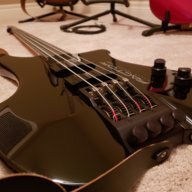
Hi, I was doing a search on Kubicki basses and came across this club. I was one of the first players to get a Kubicki Factor bass. I purchased one from the first batch. It was intended to be a silver color. I walked into the shop to pick it up but Phil didn't have it ready for me but had a green color bass, so I took that instead. This was late 1984? I was just about to go on tour with Charlie Sexton in 1985 and used the bass from 1985 onward for the duration of Charlies stint with MCA as a solo artist. The Kubicki made its TV debut when I played it on the 1985 MTV New Years Eve Special. I believe John Taylor got a black one from the first batch, too (a magazine mentioned Taylor and I as users -I forget the magazine name). So did Jammaladeen Tacuma, a yellow bass. During the first Sexton tour the sound guys (Shubert systems who did Toto and others) complained about the Kubicki first run of pickups and threatened to remove them and put in EMG's. I told Phil and he came up with an improved/different pickup and put it in my bass. I later toured the world with Sexton as an endorser of Kubicki basses and also did some press for them in Japan. When I came back from the first Japan tour Phil gave me a bass in appreciation, the first red flip flop color on the top. I continued to record and tour with Charlie using both basses until the late 80's. I eventually sold both basses. Phil was a super talent and a great guy. Between tours I would head up to Santa Barbara and hang with Phil while he went over my basses. He even had me dress my own frets as he watched and helped. Later, a funny and embarrassing thing happened...I was on tour in London and we played a one off at a famous punk club. It was a debacle! The punks were spitting on us, throwing stuff, and cussing us out. They hated us! Finally Charlie had enough threw his guitar down and left the stage so of course I threw my Kubicki down and damaged it. I got back to LA and took my bass in to Phil and told him that it had gotten damaged on stage and alluded that I didn't do it...Phil goes "Oh Really? a friend of mine in London told me you slammed the bass down on the stage and damaged it!" What a guy Phil was--lol. He let me slide on that and they fixed it. They loved seeing all the wear on my basses. We drank beer at his shop fixing and talking bass. Good times a hanging with him. Here's a later live video of Sexton's last single that was all over MTV back then. It shows the flip flop bass and the green one on a stand.


Thanks for posting this - it's nice getting 'on-the-ground' background on the early days of Phil's Factor. It confirmed something I wondered about related to the flip-flop finishes. As Fender also did them the early '90s on their Jazz+ and Precision+Deluxe's I wondered who started doing that finish first, Phil or Fender. Yours being mid '80s points to Phil using it first and Fender adapting it when the Custom Shop was making his Ex-Factors. Phil wasn't the first to use this finish though, I think Ibanez or another company used it earlier.

images-6.jpeg
Unknown-1.jpeg
images-4.jpeg
 
Japanese Headway factory (same factory that made Riverhead instruments) made it in the late 80's. Fixer was the original name of the model, this one was probably repainted

I wonder what they had under the hood? - Phil's pre was what made that bass sound unique. Also a really crude resolution to securing the strings at the hs - Phil's inset cups were elegantly simple and effective. I'm guessing they weren't approved by PK or were they? (like the Blaster) Funny name choices also - riffing off Factor, sorta'... you could blend those two and come up with Blixer and Faster. :D
 
  • Like
Reactions: zuma and saltydude
Now, if you had an Ex-Fixer, or an Ex-Blaster, I wonder if the more conventional bridge (at least at the saddles) would let you get a lower action than a true Ex-Factor. I try not to chase super low action these days but it's just a technical thing I wondered about once I saw these clones.

If I had such a clone, I'd get single-coils made for it and transform it into a "Super Jazz". I remember there was a TB guy who did these beautiful headless Jazz basses in a similar fashion. His headstock solution was way nicer though! I think he was in Indonesia. Anyone remember that guy?
 
Now, if you had an Ex-Fixer, or an Ex-Blaster, I wonder if the more conventional bridge (at least at the saddles) would let you get a lower action than a true Ex-Factor. I try not to chase super low action these days but it's just a technical thing I wondered about once I saw these clones.

If I had such a clone, I'd get single-coils made for it and transform it into a "Super Jazz". I remember there was a TB guy who did these beautiful headless Jazz basses in a similar fashion. His headstock solution was way nicer though! I think he was in Indonesia. Anyone remember that guy?

Never seen or heard of the guy but always interested in a good design solution.
 
I wonder what they had under the hood? - Phil's pre was what made that bass sound unique. Also a really crude resolution to securing the strings at the hs - Phil's inset cups were elegantly simple and effective. I'm guessing they weren't approved by PK or were they? (like the Blaster) Funny name choices also - riffing off Factor, sorta'... you could blend those two and come up with Blixer and Faster. :D
Per one of our TB friends Green Knight: "there were around 200 knockoffs made by a Japanese company who were trying to get officially licensed by Kubicki, like Hohner was by Steinberger. The instruments went to market anyway and were called the Blaster and the Fixer"

I agree with Green Knight they did try to market those knock-offs, and since I was a Kubicki artist, Phil had the 'Fixer' reps meet me while I was on tour in Japan in 1986. They came to my hotel and showed me a Fixer Bass. I didn't know exactly what I was supposed to say to those guys; I just said "cool" and left shortly. I wasn't going to start playing one of those basses. Sexton was huge in Japan at the time, and I was playing my Factor on many TV shows there, so maybe the Fixer guys were hoping to capitalize on that? Yamaha also brought me one of their BX-1 basses, too, but I said no thanks, and that I was there as a Kubicki artist. Phil was indeed initially in with those Fixer/Blaster guys, but nothing ever happened. There's a Fixer on ebay right now.
 
Last edited:
Per one of our TB friends Green Knight: "there were around 200 knockoffs made by a Japanese company who were trying to get officially licensed by Kubicki, like Hohner was by Steinberger. The instruments went to market anyway and were called the Blaster and the Fixer"

I agree with Green Knight they did try to market those knock-offs, and since I was a Kubicki artist, Phil had the 'Fixer' reps meet me while I was on tour in Japan in 1986. They came to my hotel and showed me a Fixer Bass. I didn't know exactly what I was supposed to say to those guys; I just said "cool" and left shortly. I wasn't going to start playing one of those basses. Sexton was huge in Japan at the time, and I was playing my Factor on many TV shows there, so maybe the Fixer guys were hoping to capitalize on that? Yamaha also brought me one of their BX-1 basses, too, but I said no thanks, and that I was there as a Kubicki artist. Phil was indeed initially in with those Fixer/Blaster guys, but nothing ever happened. There's a Fixer on ebay right now.

Thanks for the (historic) back-stories - :thumbsup: Phil Kubicki's Ex Factor bass is still unique today in the realm of a commercially produced product - no one has paralleled his drop-D capo concept since. I say 'historic' because so far there really hasn't been much written about this area of the development of electric bass. Hipshot has their version, Steinberger has theirs - but neither allow effortless non-transcribing playing mid-capo engagement. Maybe the advent of 5-string basses threw a wet towel on his concept - but I still think Phil has the drop-D concept nailed.
 
Thanks for the (historic) back-stories - :thumbsup: Phil Kubicki's Ex Factor bass is still unique today in the realm of a commercially produced product - no one has paralleled his drop-D capo concept since. I say 'historic' because so far there really hasn't been much written about this area of the development of electric bass. Hipshot has their version, Steinberger has theirs - but neither allow effortless non-transcribing playing mid-capo engagement. Maybe the advent of 5-string basses threw a wet towel on his concept - but I still think Phil has the drop-D concept nailed.
I'm with you. Phil was a hell of a designer and person.
 
No affiliation - just saw this '89 FCS Kubicki Ex Factor. One, I thought the FCS version wasn't made until '90, and this one has an 18v pre. (as in, I also thought all FCS Factors were the 9v pre) Anyone have any background on this? The first Ex Factor I owned was a very used black '86 and (similarly odd) it had the 9v pre. (can't recall if it had Fender printed on it - this was around '93-'94 so possibly the owner swapped pre's) I sent the bas to Phil and he installed the 18v unit in it shortly after I bought it.

Vtg 89 Kubicki Bass Guitar EX FACTOR 18v Black 4 Bass Guitar Fender Custom shop | eBay

UPDATE: I just looked it up and Phils brief FCS Kubicki was from '89-'90 according to The Fender Bass - An Illustrated History 2001.
 
Last edited:
As an eBay Associate, TalkBass may earn a commission from qualifying purchases.
  • Like
Reactions: JIO
I can understand that. I've never seen the guts in one, does anyone know what pre-amp was in them?

It's a fairly simple 9-Volt powered op-amp. I can't recall the actual chip offhand, but the preamp is a unique design (or at least a generic circuit that was repurposed).

The three pots are soldered directly to the board and offer (1) bass/treble boost or cut; (2) pickup volume selection; and (3) master volume.
 
Is it just me or did the value of a Kubicki fly through the roof?
There was one for sale on Reverb for $6K and it was gone in a day.

wow - wish Phil could have seen that. When I bought my first Ex-Factor used in '94 I called Phil to order a fretless neck for it. First off I thought I'd be taking to his secretary or front-person, but he answered the phone. We got talking and he asked how much I paid and I said $750. He said, "I would have bought it for that!"
 
It's a fairly simple 9-Volt powered op-amp. I can't recall the actual chip offhand, but the preamp is a unique design (or at least a generic circuit that was repurposed).

The three pots are soldered directly to the board and offer (1) bass/treble boost or cut; (2) pickup volume selection; and (3) master volume.

What I meant was if it was like a Kubicki (18v) or Fender/Kubicki (9v) pre, or something different? So by "a unique design" do you mean not like Phil's pre?
 
Last edited:

Latest posts