• TalkBass has been independent since 1998. Add your voice.
    Create a free account to reply to discussions, view embedded media, and browse with fewer display ads.
    Join freeLog in
    Want zero display ads or expanded classifieds tools? Compare plans.

Learning about graphite necks

Is a standard Moses neck hollow?
I've been wondering this myself as I've been mulling over making my own carbon fiber neck some day. I would think that if you ask they would tell you considering you're a potential customer. I'd like to know though how Moses, Modulus, Zon, etc, necks differ in construction and just what exactly is going on the inside of each. I've seen a lesser known acoustic manufacturer claim his necks are completely hollow, and I've seen a cross section of another's neck that has a sort of t-shaped support running down the middle that holds the truss rod, it is hollow on either side of the support. From what I can tell a hollow neck works fine, but when you incorporate a truss rod into the design it helps to have some kind of core.
 
I've been wondering this myself as I've been mulling over making my own carbon fiber neck some day. I would think that if you ask they would tell you considering you're a potential customer. I'd like to know though how Moses, Modulus, Zon, etc, necks differ in construction and just what exactly is going on the inside of each. I've seen a lesser known acoustic manufacturer claim his necks are completely hollow, and I've seen a cross section of another's neck that has a sort of t-shaped support running down the middle that holds the truss rod, it is hollow on either side of the support. From what I can tell a hollow neck works fine, but when you incorporate a truss rod into the design it helps to have some kind of core.

I have asked Moses and Modulus though they lack in the communications capabilities. The Moses website is also woeful. They are all engineers, it seems.

Moses needa to get some of the Warmoth marketing / communications people involved.
 
My Steinberger neck was made with something resembling fiberglass boat layup techniques. The mold was spray lined with a gelcoat material that forms the neck finish. Then alternating layers of chopped carbon fiber matt and resin are laid up in the mold, and cooked under pressure. The neck heel has a slight bevel that allowed it to pop out of the mold. Neck bolt inserts were cast in place. The frets were cut into the fingerboard surface later. The Modulus and Status necks seem to use either larger matt or a carbon cloth with a clear resin finish coat, so you see the carbon mesh as a decorative pattern thats kind of beautiful. In either case, they are nearly impervious to changes in temperature or humidity. The cons are weight, particularly with a traditional headstock, and special techniques to re-fret. I had a nasty ding in mine and repaired it almost seamlessly with black gelcoat patch. Mine has no trussrod, but in 30 years owning it, it hasn't warped or twisted at all, or at least its not measureable. I think this would be pretty tough to do as a home- brew, a lot of specialized materials and techniques required, but an interesting project I havent seen yet on TB.
 
Last edited:
My Steinberger neck was made with something resembling fiberglass boat layup techniques. The mold was spray lined with a gelcoat material that forms the neck finish. Then alternating layers of chopped carbon fiber matt and resin are laid up in the mold, and cooked under pressure. The neck heel has a slight bevel that allowed it to pop out of the mold. Neck bolt inserts were cast in place. The frets were cut into the fingerboard surface later. The Modulus and Status necks seem to use either larger matt or a carbon cloth with a clear resin finish coat, so you see the carbon mesh as a decorative pattern thats kind of beautiful. In either case, they are nearly impervious to changes in temperature or humidity. The cons are weight, particularly with a traditional headstock, and special techniques to re-fret. I had a nasty ding in mine and repaired it almost seamlessly with black gelcoat patch. Mine has no trussrod, but in 30 years owning it, it hasn't warped or twisted at all, or at least its not measureable. I think this would be pretty tough to do as a home- brew, a lot of specialized materials and techniques required, but an interesting project I havent seen yet on TB.
How is the weight a con? Shouldn't it be much lighter than a wooden neck? I thought that was one of the claims with most graphite necks.
 
How is the weight a con? Shouldn't it be much lighter than a wooden neck? I thought that was one of the claims with most graphite necks.
Most of the Fender style Modulus necks with a full headstock I've played were significantly heavier than stock wood necks, and therefore neck divers. The newer versions may be lighter, if so I haven't seen one yet. If you have a well balanced bass, it's not a problem, but Jazz basses in particular tend to be neck heavy already. I've never played a Status headless, I assume they are well balanced. With headless designs like a Steinberger, it's often the other way around, they are body-heavy, which is as annoying for seated practice as a neck diver.
 
Most of the Fender style Modulus necks with a full headstock I've played were significantly heavier than stock wood necks, and therefore neck divers. The newer versions may be lighter, if so I haven't seen one yet. If you have a well balanced bass, it's not a problem, but Jazz basses in particular tend to be neck heavy already. I've never played a Status headless, I assume they are well balanced. With headless designs like a Steinberger, it's often the other way around, they are body-heavy, which is as annoying for seated practice as a neck diver.
Interesting, makes me wonder what's going on with the Moses construction that much more, maybe they are nearly solid graphite or something.
 
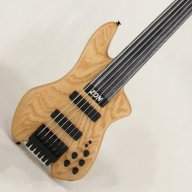
I have a pair of basses being built with Status necks - they seem to be pretty universally respected around here. I should get the first one finished within the next week or so.... :)

image2.JPG
 
  • Like
Reactions: Gilmourisgod
I have a pair of basses being built with Status necks - they seem to be pretty universally respected around here. I should get the first one finished within the next week or so.... :)

View attachment 707750
I love that "snakeskin" pattern on the Status necks, a fine example of maximizing the inherent beauty of a material. Do the status have trussrods? Looks like a nut-end adjustment on the one pictured?
 
  • Like
Reactions: mysteryclock