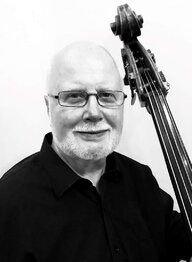
I can't address this specifically as regards the exact two instruments in question, but since the question has been sitting unanswered for a while, I thought I'd get the ball rolling:
First off, congratulations for having the willpower to study two new instruments as an adult! A question for you: what are your eventual goals for each of these instruments? Which do you hope to end up playing more, and in what kind of musical contexts?
As to the question of whether study on the one is transferable to the other, my answer would be both yes and no. Music is an art and a journey, and the instrument is the vehicle. Each vehicle has its own skill set involved in learning to operate it, and these skills sets are largely non transferable except where they overlap. The process of bowing and drawing a sound from the string, for instance, might overlap somewhat even though the physical posture an musculature involved are very different. I have a wonderful student at the university at the moment who was a great cellist before he came to school to study jazz on the bass. What he learned on the cello made his transition to the bass much easier, and in only a few short years he's playing extremely well. While he still has a ways to go in pulling a huge acoustic sound pizzicato, he can bow absolutely anything that comes his way on the bass, and bow it well (he's even placed as a runner up at an orchestral bass audition last semester).
Other things, like musical sensibility, awareness of articulation, melodic sense, and anything not directly technique related will certainly transfer from one instrument to the other with only technique to hinder the end result. I've played three different instruments professionally (four, if you count the bass guitar) in my life, but in a more or less sequential fashion. When going from one to the next, I've always felt that the music was always there waiting to come out, and that the only hindrance was my lack of technique on the instrument. By the time I got to the bass in my mid 30's, there was a large musical stockpile of information and ideas just waiting to come out that would start to flow as soon as the technique would allow.
Curiously and somewhat related, I recently resumed martial arts training after a 15-year hiatus. I am going to the lessons twice a week with my wife and son, and our interest was in the study of a defensive/grappling art, so that is what we all signed up for. But since the academy allows us to study all we want for a monthly fee, and since there is a gap between the child and adult classes and I would have to wait for the adult class anyway, I decided to go ahead and take the class that meets in between as well. Even though it's a very different art (a striking art), I notice that there are principles which overlap from one to the other, and which help each other: balance, awareness of distance, basic coordination, flexibility, core centering and strengthening, etc. I didn't really expect this to be the case, but it has been a pleasant surprise. i suspect you'll find much the same with your two instruments. Kudos to you for your hunger to study both, and enjoy the journey! Hopefully someone will be able to give you some more specific anecdotes/information to your situation in the thread.
Hi
my name is JO and I am UK based.
I am an adult learner of violin and double bass.
I started on violin 3 years ago and am at grade 5 (going by ABRSM standards), then I have taken up the double bass 8 months ago and my teacher would like me to take the grade 5 ABRSM exam soon.
I was surprised by how quickly I have learnt the double bass compared to the violin, is this because a lot of the skills are 'transferable' between the instruments? or is it because I am just 'better' at the double bass (by the way it's classical double bass I learn not jazz).
I have to say I don't practice regularly on the double bass, not because I don't like practicing but because the violin takes most of my time (I do 2 and a half hours a day on this).
what I would like teachers to discuss if possible please:
pros and cons of learning 2 different string instruments like violin and double bass.
If one learning one instrument does not practice much on the other, will they still progress on both as the skills are transferable/interchangeable? (sorry I hope I make myself understood)
I get the feeling I keep progressing the double bass because of all the practice I put into the violin (I practice bass about 3 to 4 times a week for 40 minutes or so vs violin daily for 2 and a half hours).
I find I have to play violin first followed by double bass if I practice both the same day as if I play on bass first then the violin feels so small I can't play it for the first half an hour!
Could learning these 2 instruments together cause any problems anywhere? (not sure what, just asking)
thank you in advance
Jo
First off, congratulations for having the willpower to study two new instruments as an adult! A question for you: what are your eventual goals for each of these instruments? Which do you hope to end up playing more, and in what kind of musical contexts?
As to the question of whether study on the one is transferable to the other, my answer would be both yes and no. Music is an art and a journey, and the instrument is the vehicle. Each vehicle has its own skill set involved in learning to operate it, and these skills sets are largely non transferable except where they overlap. The process of bowing and drawing a sound from the string, for instance, might overlap somewhat even though the physical posture an musculature involved are very different. I have a wonderful student at the university at the moment who was a great cellist before he came to school to study jazz on the bass. What he learned on the cello made his transition to the bass much easier, and in only a few short years he's playing extremely well. While he still has a ways to go in pulling a huge acoustic sound pizzicato, he can bow absolutely anything that comes his way on the bass, and bow it well (he's even placed as a runner up at an orchestral bass audition last semester).
Other things, like musical sensibility, awareness of articulation, melodic sense, and anything not directly technique related will certainly transfer from one instrument to the other with only technique to hinder the end result. I've played three different instruments professionally (four, if you count the bass guitar) in my life, but in a more or less sequential fashion. When going from one to the next, I've always felt that the music was always there waiting to come out, and that the only hindrance was my lack of technique on the instrument. By the time I got to the bass in my mid 30's, there was a large musical stockpile of information and ideas just waiting to come out that would start to flow as soon as the technique would allow.
Curiously and somewhat related, I recently resumed martial arts training after a 15-year hiatus. I am going to the lessons twice a week with my wife and son, and our interest was in the study of a defensive/grappling art, so that is what we all signed up for. But since the academy allows us to study all we want for a monthly fee, and since there is a gap between the child and adult classes and I would have to wait for the adult class anyway, I decided to go ahead and take the class that meets in between as well. Even though it's a very different art (a striking art), I notice that there are principles which overlap from one to the other, and which help each other: balance, awareness of distance, basic coordination, flexibility, core centering and strengthening, etc. I didn't really expect this to be the case, but it has been a pleasant surprise. i suspect you'll find much the same with your two instruments. Kudos to you for your hunger to study both, and enjoy the journey! Hopefully someone will be able to give you some more specific anecdotes/information to your situation in the thread.


 , to play at high standard both as a soloist and as an orchestral player