
• TalkBass has been independent since 1998. Add your voice.
    Create a free account to reply to discussions, view embedded media, and browse with fewer display ads.
    Join freeLog in
    Want zero display ads or expanded classifieds tools? Compare plans.

Left hand one finger technique.....

bullie76

Guest
Nov 19, 2014
41
17
72
Mississippi
Saw this video on Scotts Bass Lessons website. Basically Scott describes it as a method for muting with the left hand, but also one he used during a period when having health issues with the hand. He goes on to show the different tones he can get from the method.

My question........is this another way one could learn how to play the bass as a beginner? I can see some limitations, but just throwing the question out there. Looks like a good way to create some index finger problems if that is the only one being used. I'm not trying to short cut the learning process, but does look like a cool method. If this has already been discussed, mods pleas merge. Thanks.

Invalid Link Removed
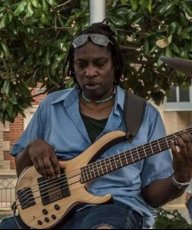
 
It's just a technique to get a certain sound, and like any other technique you can use it when you want. I don't think I'd recommend a beginner learning to play that way to the exclusion of using all the other fingers, but it's probably worth exploring. I don't see where it would cause any more problems than say, smashing the side of your thumb across the strings and crushing it into the fretboard as bassists love to do when they slap and thump...
 
Just looking at the video for the first time here is my take on what he is doing:

Yes you could use one finger to play the notes. Question still is what notes need playing. Answer - the notes of the current chord or the notes of the current scale. Does not matter how you go about playing (fretting) those notes as long as they sound good together.

Which brings us back to what notes are going to sound good with this song. I'd recommend you keep doing what you are doing and file this away as something that could be done, i.e. if you have four good fingers use them.

I like the sound of this bass line riff; |3 . 3 .|4 5 3 3| everything is on the same string. I can do this using three fingers or one. I choose to use three fingers. You may like to use one. I think that is what Scott is pointing out.

Major Scale Box.
G~~|---2---|-------|---3---|---4---| 1st string
D~~|---6---|-------|---7---|---8---|
A~~|---3---|---4---|-------|---5---|
E~~|-------|---R---|-------|---2---|4th string
 
Last edited:
Yes, I'm going to continue learning the traditional way. Two finger plucking and four finger fretting. I'm actually pleased with how it is coming along so far. Learning all the notes on the fretboard is a pain, but have found a couple of videos helping with that.

I'll file the above technique away. Plenty of basic stuff to work on at this point.
 
Yes, I'm going to continue learning the traditional way. Two finger plucking and four finger fretting. I'm actually pleased with how it is coming along so far. Learning all the notes on the fretboard is a pain, but have found a couple of videos helping with that.

I know the notes on the E and A string up to the 12th fret. Stuff on the D & G string and anything above the 12th fret I'm Jell-O. But it works out - IF you know where the root note of what you are wanting to play is located. Knowing the notes on the E and A string, up to the 12th fret, makes the following viable.

From the root.......
The 2 of the scale or chord tone will always be same string up two frets.
The 3 of the scale or chord tone will always be up a string and back one fret.
The 4 of the scale or chord tone will always be up a string same fret.
The 5 of the scale or chord tone will always be up a string and up two frets, over the 2, or down a string, same fret.
The 6 of the scale or chord tone will always be up two strings and back one fret, over the 3.
The 7 of the scale or chord tone will always be up two strings and up one fret.
The 8 of the scale or chord tone will always be up two strings and up two frets, over the 5.
A b (flat) note will always be back toward the nut one fret and a # (sharp) note will always be up toward the bridge one fret.

R-5-8-5 becomes a piece of cake. Course you have to think in 1, 2, 3's as well as A, B, C's. A, B, C's to place the root then 1, 2, 3's for the scale degrees you need.

It does help to know the "spelling" of what you will be using, i.e. a Cmaj7 chord's scale degrees are R-3-5-7. If you want C7 flat the 7 (R-3-5-b7). This will come in handy. http://www.smithfowler.org/music/Chord_Formulas.htm

This clicked for me. Help yourself.
 
Last edited:
  • Like
Reactions: bullie76