gotta learn the rules before you can break the rules

TalkBass has been independent since 1998. Add your voice.
Create a free account to reply to discussions, view embedded media, and browse with fewer display ads.
Join free Log in
Want zero display ads or expanded classifieds tools? Compare plans.

The point was I don’t find ANY of the positions you listed earlier as comfortable or natural. Quite the opposite.Thumb relative to the fingers, not which side of the neck. It is the same when I play cello. My thumb moves across the neck when I change strings.
Them’s fighting’ words!! (or click bait). Actually it should prevent strain over decades of playing.
I’ll use the ‘teachers way’ for 1/3rd of rock/pop gigs when doing tricky stuff.
I’ll use it 80% of the time on Fretless at gigs. It really helps with fretless intonation when moving around on stage, or when sight reading at a Jazz/ Big Band gig.

gotta learn the rules before you can break the rules



First and foremost, do whatever works for you. I personally believe that a wrapped thumb inhibits movement and inhibits your ability to spread the other four fingers outward so that you can also use the "one finger per fret" technique.All the bass teachers say keep the fingers perpendicular to the neck, position the thumb behind the second finger and, gasp, never let it protrude over the top .The problem is the only people who actually teach this are… the teachers. All the great players (with long careers) pretty much ignore it. Paul Macartney is a classic example but I was also watching Tommy Shannon just now - same thing. Fingers and thumb all over the place! The “teacher’s way” is just a sure fire path to injury IMO.

All the bass teachers say keep the fingers perpendicular to the neck, position the thumb behind the second finger and, gasp, never let it protrude over the top .The problem is the only people who actually teach this are… the teachers. All the great players (with long careers) pretty much ignore it. Paul Macartney is a classic example but I was also watching Tommy Shannon just now - same thing. Fingers and thumb all over the place! The “teacher’s way” is just a sure fire path to injury IMO.

I think you're conflating two very different issues here: How you position your thumb and fingers normally, versus whether it's "okay" to occasionally sneak your thumb over top of the neck.All the bass teachers say keep the fingers perpendicular to the neck, position the thumb behind the second finger and, gasp, never let it protrude over the top .The problem is the only people who actually teach this are… the teachers. All the great players (with long careers) pretty much ignore it. Paul Macartney is a classic example but I was also watching Tommy Shannon just now - same thing. Fingers and thumb all over the place! The “teacher’s way” is just a sure fire path to injury IMO.

Those who can't do....If it works for you then fine. But can you play Teentown or other advanced stuff with that technique? Teachers teach it for a reason.

All the bass teachers say keep the fingers perpendicular to the neck, position the thumb behind the second finger and, gasp, never let it protrude over the top .The problem is the only people who actually teach this are… the teachers. All the great players (with long careers) pretty much ignore it. Paul Macartney is a classic example but I was also watching Tommy Shannon just now - same thing. Fingers and thumb all over the place! The “teacher’s way” is just a sure fire path to injury IMO.

It is important to moisten the finger before using it in some particular positions.
@Geepers - please tell us more about your bass technique & habits.
Did you have a straight fretting wrist?
A slightly bent wrist? or
a full bent/ flexed wrist when you played?
How many hours per week would you play bass (on average)?
How flexible are you normally?
Did you do regular stretches and warm ups when playing bass?
Also, please tell us what work & other hobbies you do.
I’ll almost guarantee these other factors had a much bigger influence on you developing CTS than playing bass.
A few people have asked what I actually do technique-wise now to avoid Carpal Tunnel problems so rather than answer individually I thought I’d post a bit of a summary here.
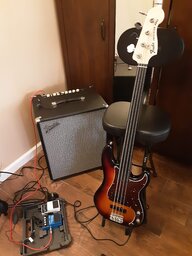
1. I switched to a custom, short scale (31”) fretless bass with very low action (it’s unlined and no side dots so that I HAVE to play by ears, not eyes)
2. I now play with an ultra light touch (800w amp turned up high to compensate); bonus here is that I love the tone this produces
3. I switched to a “floating thumb” technique on my right hand (Gary Willis)
4. I now occasionally use three finger plucking (Willis) instead of exclusively two (reduces stretching/strain at times)
5. I switched to the Carol Kaye left hand technique (thumb always points towards the nut, not the ceiling; fingers move as a unit, pivoting off the thumb)
6. I now play with super flat wrists 90% of the time; this means playing with the very tips of curled left hand fingers and it means extending my right elbow away from my body (it also meant I had to do a LOT of experimentation with bass height/position/angles … I’ve got it bang on now)
7. I had to solve neck dive. My custom bass is pretty good in this respect but still had a tiny amount of dive. I wanted zero so that my hands could barely touch the instrument. I’ve come up with a simple restraining system that holds the bass in the perfect position even if I let it go and walk around.
I barely touch the strings with both left and right fingers now and let the amp do all the work. It lets me play completely stress-free and I can now go for hours a day, every day without a problem. I know some of you can already do this with more conventional techniques but for me this is amazing as I wondered if I’d ever be able to play again at all, let alone play this much.
The final piece of the technique has nothing to do with hands or bass: it’s breath. I have learned to focus on breath only while I play - ie play on auto pilot, no thought about what I’m actually doing (the big learning here came from Kenny Werner’s “Effortless Mastery” and the follow up “Becoming The Instrument”). This has been huge. It prevents tension creeping in and allows me to execute fast/tricky passages way more easily. You can get to the point of simply observing your hands playing with no conscious control over them at all.
There’s quite a bit more I could talk about (eg left hand damping technique, why the unlined fretless is such an important part of this …and lots of other things) but this gives you the gist. I hope it helps someone. This has not been an easy transition but I love playing bass so much I pushed through and have overcome. So will you if you want it as much as I do. Good luck!
All (mostly) good stuff - I don't understand the diversion in your first post about hooking thumbs over the top and posting McCartney videos etc. as examples of good technique. What was that all about?
Also interested in how the unlined fingerboard helps? I play unlined all the time but probably for different reasons, so genuinely interested in taking that conversation further on how it might contribute to an ergonomic method. Right now I see no direct correlation other than having to develop good handshape and posture, but that is also true for lined 'boards, IMHO.