
Enjoy the benefits of a premium membership!
Upgrade Account
-
TalkBass has been independent since 1998. Add your voice.
Create a free account to reply to discussions, view embedded media, and browse with fewer display ads.
Join free Log in
Want zero display ads or expanded classifieds tools? Compare plans.
You are using an out of date browser. It may not display this or other websites correctly.
You should upgrade or use an alternative browser.
You should upgrade or use an alternative browser.
Double Bass Left thumb pain
- Thread starter bramvdhoeven
- Start date
More options
Who Replied?

turf3,
I believe you and some of the
Well, I'm going to be the one that points out the nature of the emperor's suit.
The use of the term "arm weight" is bogus for the majority of bass players who play bass in a near-vertical position. In that position, gravity pulls your arm and hand down toward the FLOOR, not back against the fingerboard. As near as I can tell, what's actually meant is "pull back against the fingerboard with the big muscles in your upper back." OK, that's fine; but I don't know how "weight" got into it. The terms "weight" and "gravity" have actual meanings and "a force exerted by the muscles of the upper back more or less parallel to the surface of the earth" ain't it.
Now let's talk about pulling back with the muscles of the upper back. In lower positions (physically higher up, further from the floor), this ain't gonna happen either. Why? Well, because if you pull back against the fingerboard at the top of the neck, one of two things will happen, maybe both at the same time. 1) Because the bass is only constrained in the middle where it presses against your belly, and at the floor where the end pin (rubber foot, usually) sits on the floor, the thing's gonna wave all over the place in the breeze. 2) Because you're pulling backward at the top of the neck, the end pin is going to be pushing forward against the floor (anyone ever hear of Newton's Laws of Motion - equal and opposite forces?) and if it's not a new real sticky rubber foot, it's going to slide out from under the bass. So what really has to happen in low positions is that you're going to have to exert force with your thumb to - at least partially, or mostly - counteract the forces applied by your fingers. Yeah, you can put a little force on your fingers from the upper back, reducing the force exerted by the thumb, but get too excessive here and the bass is going to wave all over the place.
What really happens, in my opinion, is that experienced bass players apply considerable force with their thumb on the back of the neck but they've built up the necessary muscles (the thumb is very strong in that direction) and they don't put any more force than required. So they're playing efficiently; but the gravitational force of the earth is not involved to any meaningful extent.
Now in the higher positions, the vertical distance between where your belly touches the bass and where your hand is, is much reduced so the resulting reaction force at the end pin is correspondingly much reduced; and then you really can get the muscles of the upper back into play. And if you play sitting with the bass fully constrained and more nearly horizontal, then the gravitational force of the earth can assist in stopping the strings. But for normal near-vertical playing and in low positions, I respectfully submit that "arm weight" is a gross misnomer.
I would dearly love to put a force transducer under the thumbs of some expert players who claim they play without thumb force and see the actual measurements, playing let's say a bunch of half position stuff in the key of F or Eb. I bet you'd find that if it takes 15 lbs to stop the string, they're applying 1 lb with the muscles of the upper back, 14.001 lb with the thumb, and not an ounce more than needed.
others replying here don't quite understand what's involved with the minimum thumb concept. Pulling back against the neck is not it at all. The idea, as best I can describe it, involves using the weight of your arm to hold your finger(s) against the string. It's an idea that takes a little thought and practice to get comfortable with, but once you get the feel for it you see that it makes sense. Your left arm does not "pull" back, it "hangs" on the neck from your fingers at roughly a 45 degree angle to the neck. Your arm is more or less straight from the elbow. Your shoulder and back muscles supply the energy to your arm and fingers, they don't actively pull back. If you need some support from your thumb, you apply as much as necessary but never with the idea of squeezing.If you have a properly adjusted nut and comfortable string height this is as fatigue-free as your technique allows. This assumes of course that other aspects of your technique are efficient and correct. I've been playing the bass professionally for over 55 years with no serious arm or hand issues so I know this concept works if properly applied. I've played mostly standing with a straight endpin. It's very much a mental thing as well as physical IMO.[/QUOTE
This reads like any one of us at a certain juncture in our playing. These terms don’t seem to add up, even being impossible to implement. That may be true, ON THEIR OWN. But in tandem they also ring particularly true. I will say that the area where I use the most thumb pressure is half position and that force diminishes as soon as I move into the upper positions. You make a good observation that how you hold the bass is very important. Can you balance the bass without holding it in any way? That is one of the first things I show a new student because when we hold the bass with our left hand or squeeze with our thumb we make shifting difficult. Can you play WITHOUT your thumb at all from the fourth position (on up to the higher positions) across the strings chromatically? I’m not saying play well I just mean produce clear notes just using your balance point with the bass against your body? How about thumb position below the octave? I often dip down on thumb a whole step or more below the octave. Again, no thumb to support. Arm weight in the lower positions is a real thing. It’s counterintuitive perhaps but it does come into play. I truly don’t squeeze with my thumb behind the neck very much at all. I suppose if I’m hold down a double stop in the lower positions. But I notice that I’m constantly change my positions, balance, weighting, muscles etc even if I’m playing a simple repetitive part. I never squeeze the neck for very long or very hard. In a sort of abstract sounding way, I try to almost not touch the bass at all in the service of letting it resonate…just the minimums I need to get the note and keep the note. Every player has to find these relationships for themselves. It’s personal to each player. These “experts” are just trying to convey concepts because no one can be in your body to show you what it feels like to play with total relaxation. It’s an endless quest to get out of the way of the bass to let it sing.


Ah, but you're assuming that the thumb and fingers ARE a clamp and I don't think that's the case. I do agree that that's how a clamp works, though.Anytime the Thumb and Finger(s) are simultaneously engaged on the neck, the Thumb is 50% of the total force - that is my understanding of how a "clamp" works. I would need to see Actual Proof to be convinced otherwise.
Yes....and... the neck of the bass (which acts as a LEVER below TP), is no longer involved - the Arm & Arm weight is being ACTIVELY pushed into the fingerboard in TP, and the body (corpus?) of the bass is stabilized (whether you are sitting or standing), and one can transfer that Arm weight into the string in TP. There is no "pulling" involved, only Active "pushing" into the string.
My approach is to have the student understand from day 1, that the Thumb is a critical component of sound production, AND and Huge factor when one begins to Shift.
I would never encourage a student to waste any time going "thumbless".
IMFO, of course, as always.
Thanks, Tom.
As to the rest, there's more than one way to skin a cat and you've been "skinning" for a long time so I'm sure your "cats" are getting something good!

It is not possible to "squeeze with our thumb" - it is akin to clapping with one hand.(Maybe you meant squeeze our Hand? Both the thumb and fingers.)squeeze with our thumb
Let's not conflate "squeezing" with "excessive squeezing" - there can be a correct and minimal amount of "squeeze", as well as too much. Finding the optimal amount should be the goal.
Thanks, Jason.
Last edited:

Well, I'm going to be the one that points out the nature of the emperor's suit.
The use of the term "arm weight" is bogus for the majority of bass players who play bass in a near-vertical position. In that position, gravity pulls your arm and hand down toward the FLOOR, not back against the fingerboard. As near as I can tell, what's actually meant is "pull back against the fingerboard with the big muscles in your upper back." OK, that's fine; but I don't know how "weight" got into it. The terms "weight" and "gravity" have actual meanings and "a force exerted by the muscles of the upper back more or less parallel to the surface of the earth" ain't it.
Now let's talk about pulling back with the muscles of the upper back. In lower positions (physically higher up, further from the floor), this ain't gonna happen either. Why? Well, because if you pull back against the fingerboard at the top of the neck, one of two things will happen, maybe both at the same time. 1) Because the bass is only constrained in the middle where it presses against your belly, and at the floor where the end pin (rubber foot, usually) sits on the floor, the thing's gonna wave all over the place in the breeze. 2) Because you're pulling backward at the top of the neck, the end pin is going to be pushing forward against the floor (anyone ever hear of Newton's Laws of Motion - equal and opposite forces?) and if it's not a new real sticky rubber foot, it's going to slide out from under the bass. So what really has to happen in low positions is that you're going to have to exert force with your thumb to - at least partially, or mostly - counteract the forces applied by your fingers. Yeah, you can put a little force on your fingers from the upper back, reducing the force exerted by the thumb, but get too excessive here and the bass is going to wave all over the place.
What really happens, in my opinion, is that experienced bass players apply considerable force with their thumb on the back of the neck but they've built up the necessary muscles (the thumb is very strong in that direction) and they don't put any more force than required. So they're playing efficiently; but the gravitational force of the earth is not involved to any meaningful extent.
Now in the higher positions, the vertical distance between where your belly touches the bass and where your hand is, is much reduced so the resulting reaction force at the end pin is correspondingly much reduced; and then you really can get the muscles of the upper back into play. And if you play sitting with the bass fully constrained and more nearly horizontal, then the gravitational force of the earth can assist in stopping the strings. But for normal near-vertical playing and in low positions, I respectfully submit that "arm weight" is a gross misnomer.
I would dearly love to put a force transducer under the thumbs of some expert players who claim they play without thumb force and see the actual measurements, playing let's say a bunch of half position stuff in the key of F or Eb. I bet you'd find that if it takes 15 lbs to stop the string, they're applying 1 lb with the muscles of the upper back, 14.001 lb with the thumb, and not an ounce more than needed.
Having the bass lean back at an angle definitely helps with using arm weight...and this has already been addressed...lean the bass back.
Let's keep in mind that even if the bass is vertical, the neck is not.
While arm weight is less effective when the bass is more vertical, IMHO it's still relevant.
Gravity pulls down on your arm which is hinged at the shoulder. This cause rotational torgue that exerts a force through the finger tips.
If you are applying 14lbs of force with your thumb, you are doing it wrong. On top of being physically taxing, it also makes it more difficult to shift.
Last edited:
This just in -
Clamps are Adjustable.
Stop ClampShaming!
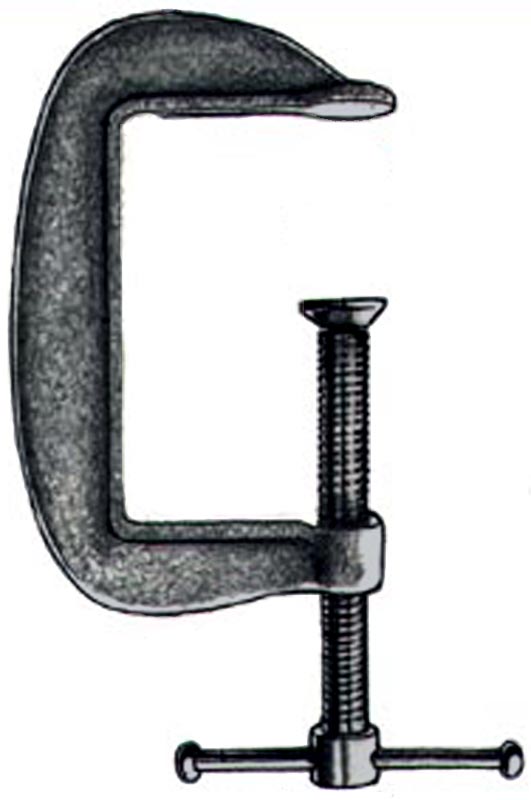
Clamps are Adjustable.
Stop ClampShaming!
I will add one more comment and then sit on my hands. Many of the players whose approach I've studied - watched intensely - like Lynn Seaton, Rufus Reid, Chris Fitzgerald, etc, do lean the bass back and keep it more parallel to their bodies and that's the model that I follow too. But, another of my favorite players, John Goldsby, doesn't do that; his bass is pretty perpendicular to the floor and his playing is about as effortless as it comes. So I wondered what he's doing and why it works for him. I don't want to speak for him, and hopefully he'll correct me if I misspeak, but it looks to me that what he's doing is pulling the neck toward his shoulder with his fingers, so, John's "clamp" is his fingertips and shoulder. My "clamp" is my fingertips and the weight of my arm. I want to personally thank Gravity for the fine job it's doing. Hasn't failed me yet!
Gravity!!!!then sit on my hands.
So the screw actually applied the pressure (like a thumb might) while the fingers merely counter that pressure. And this clamping would limit this apparatus from movement.This just in -
Clamps are Adjustable.
Stop ClampShaming!
When I play a note I curl my fingers into a near verticals position. This takes musculature to hold this position of the fingers but any counter musculature would come from the thumb bulb. Of course, for me at least, that is a minimal amount and I have never had any tiring in that region. Perhaps I’m going to have to make a video of this tomorrow.It is not possible to "squeeze with our thumb" - it is akin to clapping with one hand.(Maybe you meant squeeze our Hand? Both the thumb and fingers.)
Let's not conflate "squeezing" with "excessive squeezing" - there can be a correct and minimal amount of "squeeze", as well as too much. Finding the optimal amount should be the goal.
Thanks, Jason.
I believe the measurable pressure would be equally split between the screw side and stationary side of the c clamp. The Hand generates pressure from both the Thumb and Fingers, IME.So the screw actually applied the pressure (like a thumb might) while the fingers merely counter that pressure. And this clamping would limit this apparatus from movement.
I could be wrong...but I don't think I am!
Thanks, Jason.
Last edited:

I do think setup and playing styles and the size of the double bass in question are important parts of this OP's discussion, and they really haven't been hashed out. Just because the OP is doing jazz walks and has a teacher doesn't necessarily mean that all these things are correct for him; I know from personal experience that some teachers focus on other things.
Maybe we're assuming too much here? How tall is the OP, and what size double bass is he playing? How is the OP holding the neck with his left hand? How is his double bass setup? These all could make a huge difference in a possible solution for the OP.
Maybe we're assuming too much here? How tall is the OP, and what size double bass is he playing? How is the OP holding the neck with his left hand? How is his double bass setup? These all could make a huge difference in a possible solution for the OP.
Just ribbing Don, taking a snap of him writing "I may be wrong". Especially when I know he is! Kidding! Don takes as good as he gives.Explain?
This reads like any one of us at a certain juncture in our playing. These terms don’t seem to add up, even being impossible to implement. That may be true, ON THEIR OWN. But in tandem they also ring particularly true. I will say that the area where I use the most thumb pressure is half position and that force diminishes as soon as I move into the upper positions. You make a good observation that how you hold the bass is very important. Can you balance the bass without holding it in any way? That is one of the first things I show a new student because when we hold the bass with our left hand or squeeze with our thumb we make shifting difficult. Can you play WITHOUT your thumb at all from the fourth position (on up to the higher positions) across the strings chromatically? I’m not saying play well I just mean produce clear notes just using your balance point with the bass against your body? How about thumb position below the octave? I often dip down on thumb a whole step or more below the octave. Again, no thumb to support. Arm weight in the lower positions is a real thing. It’s counterintuitive perhaps but it does come into play. I truly don’t squeeze with my thumb behind the neck very much at all. I suppose if I’m hold down a double stop in the lower positions. But I notice that I’m constantly change my positions, balance, weighting, muscles etc even if I’m playing a simple repetitive part. I never squeeze the neck for very long or very hard. In a sort of abstract sounding way, I try to almost not touch the bass at all in the service of letting it resonate…just the minimums I need to get the note and keep the note. Every player has to find these relationships for themselves. It’s personal to each player. These “experts” are just trying to convey concepts because no one can be in your body to show you what it feels like to play with total relaxation. It’s an endless quest to get out of the way of the bass to let it sing.
Can you really balance the bass in a playing position without holding it?
I too was shown this my first week of bass lessons long ago. I have heard it repeated over and over and uh, I've never seen anyone actually do it. I think in Chris F's video about holding the bass several famous bass players proceed to try and demonstrate balancing the bass without holding it and fail

Rabbath, Bent-end pin people, and people who sit yes, but I don't believe it can be done standing otherwise. I've never really thought much about this particularly thing. I've never had the left hand squeeze problem... (Now my bow hand took a long long time.) My particular way of standing involves a bend end pin -- the bass feels like it's falling into my hands a little bit. When I really dig in, I can feel my body resist the bass but I am definitely not squeezing anything.
A good way to “loosen up” with the left (and the rest of the body) was to start using vibrato and more dynamics in general, helping the notes to sing and project. The beast is better handled with empathy and kindness instead of forceful wrangling.
Like so many things, the phrase "you should be able to balance the bass without holding it" is incomplete. No, you're not going to be able to just stand there indefinitely with the bass just resting against one spot on your belly; it's going to fall one way or the other. But the intention is that you're not holding the thing up (or to the left or right) with your left hand. So if it'll stand there for a few seconds before you have to reach to stop it from falling, that means it's balanced, and thus that residual force on your left hand wont' be big enough to affect left hand technique. Then when you cup your hand around the neck and start playing, your hand will lightly touch the neck and keep the bass upright.Can you really balance the bass in a playing position without holding it?
I too was shown this my first week of bass lessons long ago. I have heard it repeated over and over and uh, I've never seen anyone actually do it. I think in Chris F's video about holding the bass several famous bass players proceed to try and demonstrate balancing the bass without holding it and fail
Rabbath, Bent-end pin people, and people who sit yes, but I don't believe it can be done standing otherwise. I've never really thought much about this particularly thing. I've never had the left hand squeeze problem... (Now my bow hand took a long long time.) My particular way of standing involves a bend end pin -- the bass feels like it's falling into my hands a little bit. When I really dig in, I can feel my body resist the bass but I am definitely not squeezing anything.

Jason's assessments of thumb use and arm mechanics resonate with my experience even though I'm coming from a seated posture. Whether we call it weight or leverage, the source of the force in my experience comes from the core, where it can be felt in the chest and back; the rest of the arm is just a big extension of that core.
Regarding the thumb, I would use the analogy of walking up or down a staircase and using the railing. The hand that's on the railing isn't squeezing or pulling you up or down the staircase. It's just guiding you and keeping you on the straight and narrow and your legs and hips do the actual work. The only time we grab or squeeze the railing is when we stumble, and we release it again once we regain our balance. To this point, I do sometimes practice things slowly without the thumb as a balance exercise, but in actual performance I'm always touching the stair rail as lightly as I can.
Regarding the thumb, I would use the analogy of walking up or down a staircase and using the railing. The hand that's on the railing isn't squeezing or pulling you up or down the staircase. It's just guiding you and keeping you on the straight and narrow and your legs and hips do the actual work. The only time we grab or squeeze the railing is when we stumble, and we release it again once we regain our balance. To this point, I do sometimes practice things slowly without the thumb as a balance exercise, but in actual performance I'm always touching the stair rail as lightly as I can.
The OP's question wasn't really well served by my intervention.I do think setup and playing styles and the size of the double bass in question are important parts of this OP's discussion, and they really haven't been hashed out. Just because the OP is doing jazz walks and has a teacher doesn't necessarily mean that all these things are correct for him; I know from personal experience that some teachers focus on other things.
Maybe we're assuming too much here? How tall is the OP, and what size double bass is he playing? How is the OP holding the neck with his left hand? How is his double bass setup? These all could make a huge difference in a possible solution for the OP.
I'd suggest that the target be:
1) As near to zero left hand force be used to hold the basss upright as possible - see "balance without left hand".
2) Use only enough finger force on strings to stop the string; excess force is a problem and often identified as "tension". I think a better definition of "tension" would be "any extra force not needed to do the operation in question". This comes up with every musical instrument.
3) To the extent possible, supplement the clamping force of the thumb against the fingers by engaging the large muscles of the upper back and upper arm to pull the hand back against the fingerboard, both by directly pulling back and by slightly rotating the arm downward about the shoulder to interact with the small but real angle of the fingerboarrd to the vertical. In "low" positions (further away from the floor) this supplemental force is necessarily limited, because tugging on the top of the bass too hard will make it bob and weave. In higher (closer to the floor) positions, more upper body force can be used.
4) Check the alignment of the thumb against the other fingers. There's a tendency to make sweeping statements like "the thumb should be across from the middle finger". Well, I have broad palms and short fingers; for me to position my thumb across from my middle finger around a bass neck means I have to collapse my thumb joint down toward my little finger and I lose much strength in the clamping action of my thumb. For me, on a bass neck my middle finger is almost exactly across from my index finger. This is where it's strongest. The thumb is immensely strong. Its opposability is what allowed our boreal ancestors to swing from branch to branch. I think I've demonstrated that thumb strength is a factor in playing the double-bass in lower positions; so make sure your hand shape while playing is so as to maximize that strength.
I can hold my bass without the left hand, indefinitely (if there’s no wind). But when I play it I’m not balancing it vertically and it just stays there. We are in total agreement. I teach people to stand with it to, yep you guessed it, understand balance. It is the beginning of understanding one extreme of the variety of positions available, the beginning of relating your body to this instrument. Usually people are handed a bass and are terrified that it’s going to fall, the very beginning of thinking you have to grip this thing. When I get home (coffee) I’ll take a photo and postLike so many things, the phrase "you should be able to balance the bass without holding it" is incomplete. No, you're not going to be able to just stand there indefinitely with the bass just resting against one spot on your belly; it's going to fall one way or the other. But the intention is that you're not holding the thing up (or to the left or right) with your left hand. So if it'll stand there for a few seconds before you have to reach to stop it from falling, that means it's balanced, and thus that residual force on your left hand wont' be big enough to affect left hand technique. Then when you cup your hand around the neck and start playing, your hand will lightly touch the neck and keep the bass upright.
Last edited:


