• TalkBass has been independent since 1998. Add your voice.
    Create a free account to reply to discussions, view embedded media, and browse with fewer display ads.
    Join freeLog in
    Want zero display ads or expanded classifieds tools? Compare plans.

Leo maybe didn't know he got it right.

darwin-bass

Supporting Member
Mar 29, 2013
5,438
9,113
Salem OR
We've heard it 1000 times - Leo got it right the first time when he built the Precision bass. But I'm thinking he didn't really know it.

Some of the features / decisions seem to either be off-target or made for reasons not related to performance:
  • String mutes - Apparently this new creation it had too much sustain and clarity so he needed some low-cost way to fix that.
  • Tug bar - We're supposed to play this thing with our thumb even though an upright is plucked with fingers? Hmmm.
  • 34" scale - Chosen because it was easy to build. Extend a 25.5" guitar scale by 5 frets and you're at 34". Makes it easy to modify your existing gang saws to cut bass fretboards.
As a kid we had a neighborhood snowball war. I threw at this kid who was like 30 yards away. My shot went too high and way too far to the right. But as the snowball was traveling, my target moved. A lot. He ended up walking right under my wayward snowball and got hit right on the head. I got credit with a perfect shot even though it was really down to luck.

I feel like this happened to Leo as well. He built a bass with too much sustain and too bright a sound. Then music changed. Rock & roll grew up. Round wound string became a thing and full range long sustain bass guitar sounds became the expectation. The music landscape shifted and suddenly his off-target creation was the perfect solution.
 
In concept, Leo got it right the first time; in execution, not so much. All of his "flaws" are debatable, including those you posted and others I and others could add. But his goal was to create an affordable, viable, more portable alternative to the string bass. It was far too early in the game for him or anybody else to niggle over the fine details (like weight or dead spots).
 
Saying that Leo did it right the first time is like saying Edison did it right the first time. They were merely “good ideas” with decent execution using the technology that was available at the time. Countless others have improved on the design of both basses and lightbulbs since.
 
We've heard it 1000 times - Leo got it right the first time when he built the Precision bass. But I'm thinking he didn't really know it.

Some of the features / decisions seem to either be off-target or made for reasons not related to performance:
  • String mutes - Apparently this new creation it had too much sustain and clarity so he needed some low-cost way to fix that.
  • Tug bar - We're supposed to play this thing with our thumb even though an upright is plucked with fingers? Hmmm.
  • 34" scale - Chosen because it was easy to build. Extend a 25.5" guitar scale by 5 frets and you're at 34". Makes it easy to modify your existing gang saws to cut bass fretboards.
As a kid we had a neighborhood snowball war. I threw at this kid who was like 30 yards away. My shot went too high and way too far to the right. But as the snowball was traveling, my target moved. A lot. He ended up walking right under my wayward snowball and got hit right on the head. I got credit with a perfect shot even though it was really down to luck.

I feel like this happened to Leo as well. He built a bass with too much sustain and too bright a sound. Then music changed. Rock & roll grew up. Round wound string became a thing and full range long sustain bass guitar sounds became the expectation. The music landscape shifted and suddenly his off-target creation was the perfect solution.
I think that goes without saying, but it's not that he "didn't get it right".

Leo was an innovator. He liked to tinker and create new things for the heck of it, and he fostered that mentality during his time at Fender. Sometimes that new thing ended up taking off, sometimes it didn't.

Personally I think a lot of players get too caught up in being "right" and not concerned enough with what can be.
 
We've heard it 1000 times - Leo got it right the first time when he built the Precision bass. But I'm thinking he didn't really know it.

Some of the features / decisions seem to either be off-target or made for reasons not related to performance:
  • String mutes - Apparently this new creation it had too much sustain and clarity so he needed some low-cost way to fix that.
  • Tug bar - We're supposed to play this thing with our thumb even though an upright is plucked with fingers? Hmmm.
  • 34" scale - Chosen because it was easy to build. Extend a 25.5" guitar scale by 5 frets and you're at 34". Makes it easy to modify your existing gang saws to cut bass fretboards.
As a kid we had a neighborhood snowball war. I threw at this kid who was like 30 yards away. My shot went too high and way too far to the right. But as the snowball was traveling, my target moved. A lot. He ended up walking right under my wayward snowball and got hit right on the head. I got credit with a perfect shot even though it was really down to luck.

I feel like this happened to Leo as well. He built a bass with too much sustain and too bright a sound. Then music changed. Rock & roll grew up. Round wound string became a thing and full range long sustain bass guitar sounds became the expectation. The music landscape shifted and suddenly his off-target creation was the perfect solution.

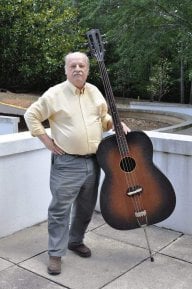
It actually wasn't that he did OR didn't get it right:

The Tug bar wasn't his idea. It was Monk Montgomery who asked for it.
Same with the string mutes. He didn't come up with that alone. Early bass guitar players wanted to be able to emulate the attack and decay of a bass viol. The cheapest way to do that was to put a piece of foam or felt either under or over the strings. The scale length was debated while the bass was passed around to early electric bass pioneers. Some wanted it longer, some wanted it shorter. 34" was a marketable compromise.

The first bass amp Leo designed frequently blew speakers with his own bass guitar invention. Someone else had to convince him to experiment with offset pole pieces.

If Leo had insisted on having his way, the Fender bass would have had virtually no contours. Don't believe me? Look at the early slab Stingrays. After the P bass evolved to have contours, and the J-Bass was developed with added contours from the get go (not his body design at all) - he went right back to the slab (lack of) ergonomics as soon as he got design autonomy at Music Man. It was only later at Music Man and at G&L that he finally relented that curves and rounder cutaways were ergonomically useful. By then body and neck design were being handled by virtually everyone but Leo at Fender, Music Man, and G&L.. He was great at applying RCA electronics and designs, though.
 
the tug bar is an interesting microcosm of the question.

many bass guitarists use the pickup as a tug bar (fwiw I do not I maintain a free right hand). so fender was right to acknowledge the issue of how a player might support right hand action. I think it's irrelevant whether the tug bar was originally *correct* - for somebody out there i'm sure it is. but the entire fender ethos was having a quality, affordable, modular electrical musical instrument. to me the tug bar is almost quintessential to how fender was leading his audience and clientele to approach his instruments as something to be personalized.

it's interesting that his mute designs never really got past beta but I think that has more to do with the fact that the mute is really more an artifact of the string than the body of the instrument. but again: fender was totally right about exploring the mute as a critical factor in shaping tone. it really can be. I actually think there's a lot of space in the market for a mute solution that isn't wood-backed foam. the string manufacturers should probably offer it.

interesting convo
 
  • Like
Reactions: Hawk620
I feel like this happened to Leo as well. He built a bass with too much sustain and too bright a sound. Then music changed. Rock & roll grew up. Round wound string became a thing and full range long sustain bass guitar sounds became the expectation. The music landscape shifted and suddenly his off-target creation was the perfect solution.
Don’t know about this point… I feel like music went there because electric guitars and basses enabled it. But that’s a common story - what sellers think they’re selling is often not the same thing buyers think they’re buying. Tools tend to get repurposed, new uses are found, and the whole landscape evolves.
 
Paul Tutmarc got it right too, on bass, steel, amps, marketing, but not on timing, especially the bass, nobody knew what to do with it in 1935 and speakers were poor. by the time Gibson and Fender got in the game nobody had yet figured out quite how to play it, with thumbs and tugbars being prioritized and speakers still lagging. but all that soon evolved as Fullerton basses changed the music world and their original designs still command respect. we'll never know what exactly was going on in Leo's head as he took on the bass c1950, but his small team combined a type of conceptual design genius which took on aspects of race cars and the jet age to create timeless beauties that looked and sounded fantastic. no matter how they're cloned, if you stick to Leo's basics you can't lose.
Thundermother bassist Mona 'DeMona' Lindgren
1747455836891.png
 
P-Basses seem like a near fetish-worship object on TB, with lots of Hyperbole about how many great songs it's featured on. True enough, but if some other company had come up with the first commercially viable, mass produced bass guitar, it's tone and features would have become the "Sound of Rock & Roll" of the 50's and 60's, and THAT would have become the fetish object. People used what they could afford to buy, and that got "baked in". Leo himself obviously didn't consider it the apogee of bass design, as he almost immediately surpassed it (IMO) with the Jazz bass, and later the G&L L2k, which is a vastly more sophisticated and versatile instrument. If a P is really "all you need", a phrase I've read ad-nauseum on TB, then we'd all just own P's, but of course...it isn't. That's like saying the 57' Chevy can't be improved on, which, despite looking cool, was a fairly dangerous gas-guzzler. Stuff gets better, not a knock on obsolete designs, but personally I prefer almost any newer 2 pickup bass to a P.
 
I saw a b&w Muddy Waters clip today and the bass player was keeping the beat with his thumb pick on the E string just like a blues guitarist does it. It was call-and-response and he and the drummer and guitarist and pianist responded in song to Muddy's call, old style blues, the electric bass guitar player using his thumb pick like a guitar player does it. Not at all like a double bass is usually played. Maybe he was a converted guitar player.
 
but if some other company had come up with the first commercially viable, mass produced bass guitar, it's tone and features would have become the "Sound of Rock & Roll" of the 50's and 60's,
But no one else did or at least not as successfully as Fender. The same could be said about the Telecaster and C/W music and the Stratocaster with rock and roll. Leo, with help from many created mass produced affordable instruments that could easily be adapted to the popular musical genre of the day.

But Leo was never one to rest on his laurels. That was never in him until the day he died. He was always looking for ways to create something new or improve upon an earlier design and thank God for that. As music migrated toward different genre Leo created instruments and amps that were more suitable for it.

I don't personally subscribe to a "PBass is all ya' need" ethos but if it was all that was available as was once the case it wouldn't be difficult to find ways for it to fit most any purpose one would have for a bass. Players, engineers, and producers have been doing just that since the '50s much like has been done with a Telecaster.
 
  • Like
Reactions: Ric Vice
P-Basses seem like a near fetish-worship object on TB, with lots of Hyperbole about how many great songs it's featured on. True enough, but if some other company had come up with the first commercially viable, mass produced bass guitar, it's tone and features would have become the "Sound of Rock & Roll" of the 50's and 60's, and THAT would have become the fetish object. People used what they could afford to buy, and that got "baked in". Leo himself obviously didn't consider it the apogee of bass design, as he almost immediately surpassed it (IMO) with the Jazz bass, and later the G&L L2k, which is a vastly more sophisticated and versatile instrument. If a P is really "all you need", a phrase I've read ad-nauseum on TB, then we'd all just own P's, but of course...it isn't. That's like saying the 57' Chevy can't be improved on, which, despite looking cool, was a fairly dangerous gas-guzzler. Stuff gets better, not a knock on obsolete designs, but personally I prefer almost any newer 2 pickup bass to a P.
Spot-on.
 
the tug bar is an interesting microcosm of the question.

many bass guitarists use the pickup as a tug bar (fwiw I do not I maintain a free right hand). so fender was right to acknowledge the issue of how a player might support right hand action. I think it's irrelevant whether the tug bar was originally *correct* - for somebody out there i'm sure it is. but the entire fender ethos was having a quality, affordable, modular electrical musical instrument. to me the tug bar is almost quintessential to how fender was leading his audience and clientele to approach his instruments as something to be personalized.

it's interesting that his mute designs never really got past beta but I think that has more to do with the fact that the mute is really more an artifact of the string than the body of the instrument. but again: fender was totally right about exploring the mute as a critical factor in shaping tone. it really can be. I actually think there's a lot of space in the market for a mute solution that isn't wood-backed foam. the string manufacturers should probably offer it.

interesting convo
He put a good deal more focus into mute design for the Mustang and even later the MM Stingray, even though one could argue that the interest in having a muted bass sound was probably a quite less popular idea or want as time progressed. What I take from that is that Leo may have been focused on something that he knew could be improved upon even though the market wasn’t particularly strong for it.
 
Saying that Leo did it right the first time is like saying Edison did it right the first time. They were merely “good ideas” with decent execution using the technology that was available at the time. Countless others have improved on the design of both basses and lightbulbs since.
As you mentioned, Edison didn’t design the Lightbulb all by his lonesome. Louis Lattimer contributed significantly to the carbonized filament that kept the lightbulb from flaming out. So. It’s a team effort. I own a 1959 Precision Bass. I gig with a Lakland 55-94.
 
I wonder what a Freudian analyst would make of a TB's supercilious and presumptuous commentary on CLF's acheivements
it's oedipal. ;) and here's an easy one: is it homo or hetero erotic?! 🤣 a tougher one: how to explain the desire for a powerful, but loving father figure that needs to be destroyed to have mommy all to oneself?! 😂 🤣


🤔


:wideyed:


We've heard it 1000 times - Leo got it right the first time when he built the Precision bass. But I'm thinking he didn't really know it.
big2 fan boy.png
 
Last edited:

Latest posts