• TalkBass has been independent since 1998. Add your voice.
    Create a free account to reply to discussions, view embedded media, and browse with fewer display ads.
    Join freeLog in
    Want zero display ads or expanded classifieds tools? Compare plans.

Leo maybe didn't know he got it right.

After the P bass evolved to have contours, and the J-Bass was developed with added contours from the get go (not his body design at all) - he went right back to the slab (lack of) ergonomics as soon as he got design autonomy at Music Man.
The last Fender Bass that Leo was involved with was the Mustang Bass… which were slabs as well for the first years.

original.jpg


If a P is really "all you need", a phrase I've read ad-nauseum on TB, then we'd all just own P's, but of course...it isn't. That's like saying the 57' Chevy can't be improved on, which, despite looking cool, was a fairly dangerous gas-guzzler. Stuff gets better, not a knock on obsolete designs, but personally I prefer almost any newer 2 pickup bass to a P.
With that difference that the Precision Bass as we know it is still relatively unchanged compared to 1957. It’s still the exact basic shape, with at the heart a splitcoil pickup, and generally a more substantial neck than a Jazz Bass. There were attempts to deviate from it (P Bass Special and Elite with active electronics (and a second splitcoil), the Lyte with its contoured horn and 22 fret neck, the 1990’s “Boners” with a 22 fret neck and a modified body, the futuristic looking JP90…) but they all stayed relatively close to the proven recipe of 1957. And almost all attempts to update the design were shelved after a relatively short period.

I’m not that well versed in American cars, but I think that the 57 Chevelle and its 2025 counterpart have very little, if anything in common.

Is the Precision the ultimate bass? Most certainly not, but given it remains in production for 68 years, virtually unchanged, it must mean that at least something about the simple passive P-bass is making it very popular and well liked.
 
Last edited:
I got it right wirth my second wife. Then I got it right with my 3rd wife! And happy with my 17 bass arsenal.
After 48 years I can definitely say, I got it right with my first wife. She's not so sure why she hung around for so long, but I'm glad she did.

I read that Leo was a collaborator. If you had an idea, you could go to him and if you convinced him it was a good one, it could be adopted.
 
P-Basses seem like a near fetish-worship object on TB, with lots of Hyperbole about how many great songs it's featured on. True enough, but if some other company had come up with the first commercially viable, mass produced bass guitar, it's tone and features would have become the "Sound of Rock & Roll" of the 50's and 60's, and THAT would have become the fetish object. People used what they could afford to buy, and that got "baked in". Leo himself obviously didn't consider it the apogee of bass design, as he almost immediately surpassed it (IMO) with the Jazz bass, and later the G&L L2k, which is a vastly more sophisticated and versatile instrument. If a P is really "all you need", a phrase I've read ad-nauseum on TB, then we'd all just own P's, but of course...it isn't. That's like saying the 57' Chevy can't be improved on, which, despite looking cool, was a fairly dangerous gas-guzzler. Stuff gets better, not a knock on obsolete designs, but personally I prefer almost any newer 2 pickup bass to a P.
I think you are conflating "All you need" with "All you want"
 
String mutes - Apparently this new creation it had too much sustain and clarity so he needed some low-cost way to fix that.

this is a thing often misunderstood:

Leo Fender wanted the bass to sound bright and with sustain, and the first strings on the Precision bass were roundwound. the first flatwound set dates back to 1954 with LaBella, and Fender didn't start to produce them until 1959.
also, the string mutes were not present on the original Precision project, and added years later when the first modification arrived (contours, offset poles, metal saddles).

every successive project signed by Leo Fender went in that direction:

- the Jazz Bass with bright and scooped sound
- the Stingray with bright sound and active electronic
- the G&L with bright and powerful pickups and a preamp that boosts the highs

also his guitars were bright and "twangy" compared to what was on the market at that time.

what influenced the modifications was the music of the era: the bass was still supposed to sound "thumpy" like a double bass, with more attack than sustain, the sound needed from the bass was more oriented to bass and mid frequencies, what we call the "vintage" sound.

talking about the string length, he came up with the 34" scale after tests: the objective was to find the right measure to have a comfortable instrument to be played like a guitar but also having clear notes down to the low E string.

when talking to a luthier friend, he explained me how the various scales were studied during the evolution of the guitar (settling on the 25,5" as an overall standard in classical music, in acoustic guitars and on the Fender Telecaster and Stratocaster), with small differences (24,75" for Gibson, 24" for "short scale guitars" and the J45 by Gibson), to have the right string tension and clarity.

Rickenbacker tried the 33.5" scale, Gibson have used the 34.5" for the long scale (until 2008) and still uses 30.5" for shorts, which have small differences compared to the 30" and 34" scales used by Fender.

during the 60's the 30" scale was the most used, and 34" was marketed as the "Fender scale".

the other things were just what usually an "inventor" has to deal with, the actual use of the project, "fine tuning" on the road.
 
As others have eluded to in thread already, I'm in the camp of "Leo got the foundation right". Any engineer, designer, or inventor typically never rests or settles and is always looking for constant improvement in both aesthetics and performance, depending on the goals of said engineer/designer/inventor. Sometimes the improvements are subtle, while other are more groundbreaking.
 
I will always feel comfortable playing a Precision bass. When I got my first bass (1978-9?) There were already many other basses available to me. Our local music store had a bunch of basses for sale and I tried them all and bought the Precision they had. It played the best, sounded the best and felt the most ergonomic.

All these 45+ years later and although I've owned so many other basses of all kinds of designs (including my own) I still like having one in my hands, even while having others available to play. I'm sure there is a subconscious reason for it, but Precisions seem to hold up to my needs/wants.

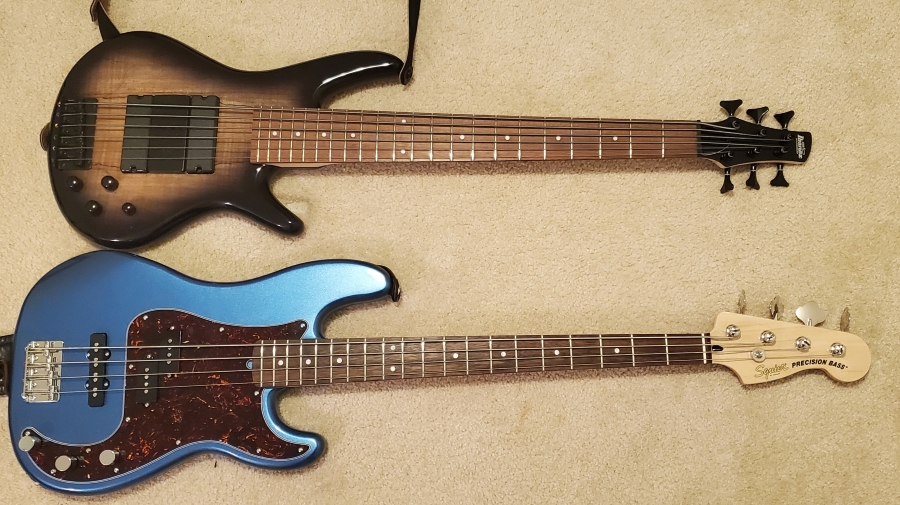
Did Leo get it right? In my case, I'd say yes he did, but so did many others that followed. I love my current Precision but I'm no Fender snob or purist. As you can see mine also has a Jazz bridge pickup, but otherwise is no different than the one I owned over 45 years ago (along with many other P-Basses I've had)...

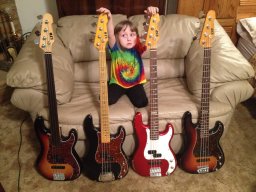
2-basses.jpg


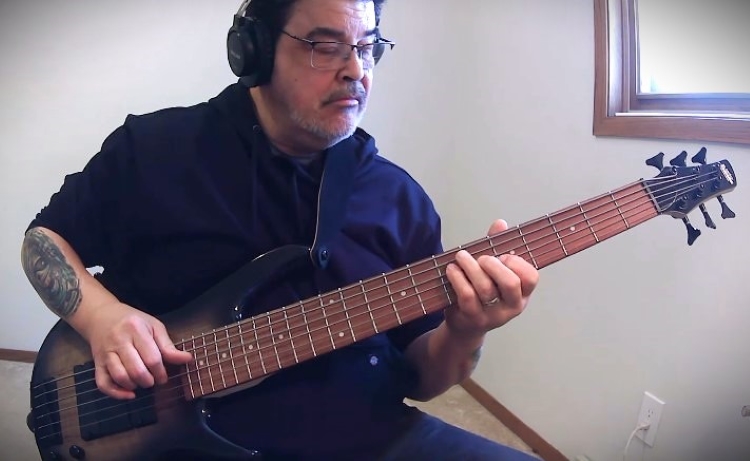
SR206-Mark2.jpg


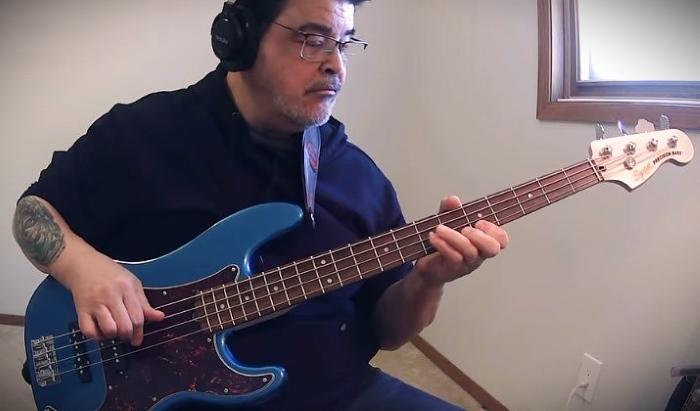
Precision-PJ2.jpg
 
Paul Tutmarc got it right too, on bass, steel, amps, marketing, but not on timing, especially the bass, nobody knew what to do with it in 1935 and speakers were poor. by the time Gibson and Fender got in the game nobody had yet figured out quite how to play it, with thumbs and tugbars being prioritized and speakers still lagging. but all that soon evolved as Fullerton basses changed the music world and their original designs still command respect. we'll never know what exactly was going on in Leo's head as he took on the bass c1950, but his small team combined a type of conceptual design genius which took on aspects of race cars and the jet age to create timeless beauties that looked and sounded fantastic. no matter how they're cloned, if you stick to Leo's basics you can't lose.
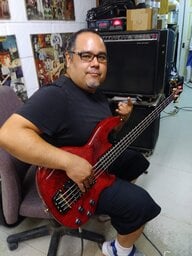
Thundermother bassist Mona 'DeMona' Lindgren
View attachment 7228993
Sandberg is a great example of standing on Leo’s shoulders yet changing with the market demands . I’ve liked every Sandberg I’ve played. Would love to own one.
 
Last edited:
Leo didn't believe he "got it right the first time". He completely revised the precision bass within just a few years, then he introduced other guitars and basses, and continued to come up with new things as long as he was working.
 
P-Basses seem like a near fetish-worship object on TB, with lots of Hyperbole about how many great songs it's featured on. True enough, but if some other company had come up with the first commercially viable, mass produced bass guitar, it's tone and features would have become the "Sound of Rock & Roll" of the 50's and 60's, and THAT would have become the fetish object. People used what they could afford to buy, and that got "baked in". Leo himself obviously didn't consider it the apogee of bass design, as he almost immediately surpassed it (IMO) with the Jazz bass, and later the G&L L2k, which is a vastly more sophisticated and versatile instrument. If a P is really "all you need", a phrase I've read ad-nauseum on TB, then we'd all just own P's, but of course...it isn't. That's like saying the 57' Chevy can't be improved on, which, despite looking cool, was a fairly dangerous gas-guzzler. Stuff gets better, not a knock on obsolete designs, but personally I prefer almost any newer 2 pickup bass to a P.
Preach it! I like my P Bass, but it’s not the be all end all of bass guitars as so many say it is on TB. Different basses work for different things.
Leo didn't believe he "got it right the first time". He completely revised the precision bass within just a few years, then he introduced other guitars and basses, and continued to come up with new things as long as he was working.
This is why he created the G&L L-1000 in 1980. It was supposed to be the ultimate iteration of the P Bass. By creating the L-1000, Leo Fender admitted that he didn’t get it right the first time.

End of story. Drop the mic!
 
Last edited:
We've heard it 1000 times - Leo got it right the first time when he built the Precision bass. But I'm thinking he didn't really know it.

Some of the features / decisions seem to either be off-target or made for reasons not related to performance:
  • String mutes - Apparently this new creation it had too much sustain and clarity so he needed some low-cost way to fix that.
  • Tug bar - We're supposed to play this thing with our thumb even though an upright is plucked with fingers? Hmmm.
  • 34" scale - Chosen because it was easy to build. Extend a 25.5" guitar scale by 5 frets and you're at 34". Makes it easy to modify your existing gang saws to cut bass fretboards.
As a kid we had a neighborhood snowball war. I threw at this kid who was like 30 yards away. My shot went too high and way too far to the right. But as the snowball was traveling, my target moved. A lot. He ended up walking right under my wayward snowball and got hit right on the head. I got credit with a perfect shot even though it was really down to luck.

I feel like this happened to Leo as well. He built a bass with too much sustain and too bright a sound. Then music changed. Rock & roll grew up. Round wound string became a thing and full range long sustain bass guitar sounds became the expectation. The music landscape shifted and suddenly his off-target creation was the perfect solution.
The Tug Bar in use
 
If Leo had insisted on having his way, the Fender bass would have had virtually no contours. Don't believe me? Look at the early slab Stingrays. After the P bass evolved to have contours, and the J-Bass was developed with added contours from the get go (not his body design at all) - he went right back to the slab (lack of) ergonomics as soon as he got design autonomy at Music Man. It was only later at Music Man and at G&L that he finally relented that curves and rounder cutaways were ergonomically useful. By then body and neck design were being handled by virtually everyone but Leo at Fender, Music Man, and G&L.. He was great at applying RCA electronics and designs, though.

Um no.
The Leo era StingRay had very rounded body edge all the way around. While yes it was a slab, it was no way at all slab like the 1st gen P.
When EB did the Classic, they very much missed out on how rounded the preEB Rays really were.

Also* I think you forgot the Sabre came out in 1978, and it has contours. So Leo had his deluxe model.
And then the L2000 seemed to have taken alot of the details ques from the Sabre: the pickup positions, body shape is very close, and claw style bridge.
 
Last edited: