• TalkBass has been independent since 1998. Add your voice.
    Create a free account to reply to discussions, view embedded media, and browse with fewer display ads.
    Join freeLog in
    Want zero display ads or expanded classifieds tools? Compare plans.

Let’s talk about thumbs and anchors

CaptainRuss

Supporting Member
Feb 21, 2024
188
949
So, I am back to bass after around 30 years of on/off guitar in bands, was the lead in my current band. I switched because we have a hard time keeping bassists and my hands have passed their peak mobility period now that I’m in my mid 50s and have arthritis. I wasn’t on bass for long back when I did play it previously. Back then I was young and in punk and rock bands so technical issues were low on my priority list.

Now that I am back I am paying attention to the details in my own playing. The thing I keep coming across is the moving thumb anchor. I don’t find that I need to keep moving from the edge of the pick up to the E string because of two reasons:
- My thumbs are a bit stubby
-My thumb does the weird backward hook thing
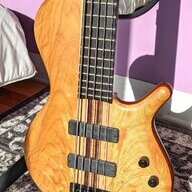
IMG_6420.jpeg


This “special feature” allows my thumb and hand to already be half a fingertip closer to the pick up and E string. I do not find myself stretching to hit the higher strings. Usually just bowing my wrist out a bit is enough. I’m practicing moving my anchor point but it is really cumbersome for me and my playing suffers.


I often read that fixed anchor is not the preferred method and there are few notable players using it. What do you think, keep practicing the moveable anchor or embrace my mutant hand physique and use it to. Y advantage?

Anybody else similarly equipped?
 
  • Like
Reactions: Dabndug
There are two primary reasons for using a moveable anchor (or something comparable -- see below): First, the thumb is used to mute the string(s) below the one being plucked -- which is a much bigger issue on bass than on guitar -- and second, your hand is always in exactly the same position, and your plucking motion and angle are exactly the same, no matter which string you're playing. Note that neither of these reasons has anything to do with the size or shape of your thumb.

I personally prefer the "floating thumb" technique over the moveable anchor, which serves the same two purposes. In the "floating thumb" your thumb is never anchored; it just lies across the lower, unplayed strings while your hand moves up and down to pluck different strings. Some years ago I experimented with both techniques for a month or two before deciding I preferred the floating thumb. This isn't to say that it's "better," but I personally enjoy the feeling of not having my thumb anchored on anything: My whole hand feels super-relaxed as my hand "floats" and the thumb just glides across the strings. Also, I've discovered that (at least for me) a third advantage of this technique is that it encourages me to pluck with a very gentle touch; I turn up the amp and let it do the work.

Here's a short but clear demonstration of the floating thumb if you want to check it out:

 
Keep practicing the moveable anchor and begin to explore the floating thumb technique. Because in reality, you will end up using all three techniques in your everyday playing. It all really depends on what you are playing as to whether you have a fixed, moveable or floating anchor. It is much better to become proficient in all three and employ them as needed. And if you do not continue to practice each of them, you will never learn how to use them.
 
Last edited:
Was a confirmed moveable anchor guy for a long time when I played just 4-bangers. When I finally found some fivers I could actually play with my small hands, I really had to transition to floating thumb to handle the additional muting needed. Being part of the overall fiver on-boarding, I grew comfortable with it over a reasonably short time. Even so, I do still find myself using moveable anchor from to time... old habits die hard, I reckon. :D
 
  • Like
Reactions: CaptainRuss
There are two primary reasons for using a moveable anchor (or something comparable -- see below): First, the thumb is used to mute the string(s) below the one being plucked -- which is a much bigger issue on bass than on guitar -- and second, your hand is always in exactly the same position, and your plucking motion and angle are exactly the same, no matter which string you're playing. Note that neither of these reasons has anything to do with the size or shape of your thumb.

I personally prefer the "floating thumb" technique over the moveable anchor, which serves the same two purposes. In the "floating thumb" your thumb is never anchored; it just lies across the lower, unplayed strings while your hand moves up and down to pluck different strings. Some years ago I experimented with both techniques for a month or two before deciding I preferred the floating thumb. This isn't to say that it's "better," but I personally enjoy the feeling of not having my thumb anchored on anything: My whole hand feels super-relaxed as my hand "floats" and the thumb just glides across the strings. Also, I've discovered that (at least for me) a third advantage of this technique is that it encourages me to pluck with a very gentle touch; I turn up the amp and let it do the work.

Here's a short but clear demonstration of the floating thumb if you want to check it out:


All good info from you up on the North Shore, (I’m representing the South Shore).

I will reply that one of the things I am able to do with my thumb in my configuration is mute the E when not in use.

Maybe what is not hindering me is the beveled edge of the p/u on my Ray34. I can just roll the edge of my thumb back and forth in there. My Fender FSR PJ doesn’t offer such a luxury, nor offer much of an edge to work with. Fortunately since I got the SBMM I fell in love with the sound and pretty much don’t want to touch the PJ anymore. Tried the PJ again yesterday after several weeks of ignoring it to make sure I wasn’t missing anything. Nope, up on craigslist it went locally.

Despite all that nonsense, I will keep trying the moveable anchor. Seriously. I know it is better technique.

Thanks for everyone’s good responses.
 
  • Like
Reactions: Nuttybeanie
I started out on lead guitar back before most of you were born. I learned to mute unplayed strings with a combination of the side of my right hand and the fingers of my left hand. When I moved to bass, I kept using a pick and did so for the next 15 years, so I stayed with the same muting technique. I took a break from bands in the mid ‘80s to focus on my career, night school, and investing, and used what spare time I had to learn fingerstyle. I anchored my thumb at the edge of my PB’s pickup and learned to use my left hand to do all the muting. It worked (and still works) really well. I can keep unplayed strings dead quiet with just my left hand. Don’t ask me how—it just happens and I guess I learned it instinctively. (Around the turn of the century I moved my thumb anchor point “south” a bit by gluing a small rubber foot to the pickguard. But that wasn’t related to string muting; it was because I liked the tone better.)
 
  • Like
Reactions: SDBassed
I don’t consider myself worthy to give advice regarding technique, but one of the most liberating discoveries in playing bass has been the floating thumb. I can do anything my other digits will permit without being tied to a fixed point. Doesn’t mean I can’t use a pickup to anchor my right thumb, but it is not my necessary foundational starting point.
 
Here's a short but clear demonstration of the floating thumb if you want to check it out

That just looks awful. Spose I shouldn't knock it till I try it. But sheesh it looks awkward. Seems like a bunch more work to move your whole arm to go string to string, and maybe not so great on the ol' shoulder. But "floating arm technique" probably isn't as good a pitch. And I'm not sure why it's desirable to pluck each string using an identical right hand position as opposed to using the range of motion our wrist and fingers have have been endowed with. At any rate I'm going to keep anchoring on the pickup. I am sure this is different for everyone.
 
When, as a drummer, I decided to take up bass I thought I’d better at least have one lesson to set me on the right path. I’m very thankful that the guy I chose (pretty much at random) taught me floating thumb technique right off the bat. “It will feel weird but stick with it” he said, “you will be very thankful later that you did.” He was right. Thankyou random bass dude whoever you were.
 
  • Like
Reactions: Al Rivera
Here's a short but clear demonstration of the floating thumb if you want to check it out

That just looks awful. Spose I shouldn't knock it till I try it. But sheesh it looks awkward. Seems like a bunch more work to move your whole arm to go string to string, and maybe not so great on the ol' shoulder. But "floating arm technique" probably isn't as good a pitch. And I'm not sure why it's desirable to pluck each string using an identical right hand position as opposed to using the range of motion our wrist and fingers have have been endowed with. At any rate I'm going to keep anchoring on the pickup. I am sure this is different for everyone.
I use the floating thumb technique and have NO IDEA what you are talking about here...:eyebrow:
 
I predominately use thumb and Index finger, sometimes throwing in the ring finger. Thumb is usually anchored on the E string unless I have to move it up for faster runs or muting, etc. I have no idea what "technique" it is. ?
 
My technique is strictly mine - I have never seen anyone else do this. I rest my thumbnail on the pickup. Not the thumb - no meat involved, no skin involved. Just the nail. Yeah, weird, I know, but it works for me (some 50+ years). Just use whatever you feel comfortable doing.
 
...
And I'm not sure why it's desirable to pluck each string using an identical right hand position as opposed to using the range of motion our wrist and fingers have have been endowed with.
...
I'm going to keep anchoring on the pickup.
...

As a 'time-served' floating thumb player (almost 40 years and decades before even learning of Gary Willis who is often credited with 'inventing' the technique) I can say categorically that floating the thumb does not restrict or enforce the same right hand position any more or less than any other technique does. It might simplify the achievement of such consistency if that is what is needed, but that is not the objective or purpose. In fact, because there is no fixed fulcrum, one might easily argue from the perspective of simple mechanics that even more variety of right hand positions and motions are available. Just because the thumb is free to mute mutliple strings at the same time does not mean it is dogmatically enslaved to that purpose at all times. IME playing with a fixed anchor renders much of that flexibility available. YMMV
 

Latest posts