

Enjoy the benefits of a premium membership!
Upgrade Account
-
TalkBass has been independent since 1998. Add your voice.
Create a free account to reply to discussions, view embedded media, and browse with fewer display ads.
Join free Log in
Want zero display ads or expanded classifieds tools? Compare plans.
You are using an out of date browser. It may not display this or other websites correctly.
You should upgrade or use an alternative browser.
You should upgrade or use an alternative browser.
Lets see your nice cables.
- Thread starter Red Planet
- Start date
More options
Who Replied?
So where is rbonner's rig? He has the nicest cable setup out there.
Bob only shows up if there is Free Beer involved.

OK, just got back from Star Trek movie at midnight central... Beer? I had to shrink down a panel shot of the amp rear with the panel off the back so you can see the wiring. Just got it done.
Link Removed
OK well in the rear in the top is a blower fan sucking air out of the rack. The one on the bottom pushes air in.
The next thing down is the DTR-1000 Korg Tuner. Yes I will need to walk behind the rig to tune. I do not have it in my signal chain, it is off the tuner out in the head, goes live in mute.
Then the radial JD-7 injector which spreads my signal around to the six amps.
The horizontal wires are the speaker wires, they go to the output panels with speakons for each output on the back of the 4PRO's. They are bundled, but they are also clamped to the rack walls that keeps inputs and outputs separately spaced.
There's a Channel A, a Channel B, and in the middle of each a MONO connector. The +1 +2 wiring is done on the connector in each head rear, so the rear panels are all wired +1 -1. This allows the rack to use all the same cables.
Out to the rear panel is also the DI both wet and dry, plus both foot switches.
The vertical bundled cables are each output lead off each channel on the JD-7 headed to their respective Amplifier's PA INPUT.
The power wiring is not visible, but it's there. It's behind that outlet strip on the left all neatly bundled just like the speaker outs. Since there is a lot of AC power going on here the power is spaced away from both the outs and inputs to make sure we don't introduce any hum. The amp is almost perfectly silent.
All the power leads come from their own channel off the Furman Power Distro unit. That thing sequences the power on and off. The terminal strip goes active with the first amp and powers all the fans, JD-7, tuner and anything else we put in there.
Thanks for the complement on the rig.
I will tell you this guys, when you have this much wire it is IMPERATIVE to bundle it up like this. It is also easier to bundle it up nicely compared to a much simplier rack. My little guy looks no different than any of your racks. We're all in the same boat there.
BOB
Link Removed
OK well in the rear in the top is a blower fan sucking air out of the rack. The one on the bottom pushes air in.
The next thing down is the DTR-1000 Korg Tuner. Yes I will need to walk behind the rig to tune. I do not have it in my signal chain, it is off the tuner out in the head, goes live in mute.
Then the radial JD-7 injector which spreads my signal around to the six amps.
The horizontal wires are the speaker wires, they go to the output panels with speakons for each output on the back of the 4PRO's. They are bundled, but they are also clamped to the rack walls that keeps inputs and outputs separately spaced.
There's a Channel A, a Channel B, and in the middle of each a MONO connector. The +1 +2 wiring is done on the connector in each head rear, so the rear panels are all wired +1 -1. This allows the rack to use all the same cables.
Out to the rear panel is also the DI both wet and dry, plus both foot switches.
The vertical bundled cables are each output lead off each channel on the JD-7 headed to their respective Amplifier's PA INPUT.
The power wiring is not visible, but it's there. It's behind that outlet strip on the left all neatly bundled just like the speaker outs. Since there is a lot of AC power going on here the power is spaced away from both the outs and inputs to make sure we don't introduce any hum. The amp is almost perfectly silent.
All the power leads come from their own channel off the Furman Power Distro unit. That thing sequences the power on and off. The terminal strip goes active with the first amp and powers all the fans, JD-7, tuner and anything else we put in there.
Thanks for the complement on the rig.
I will tell you this guys, when you have this much wire it is IMPERATIVE to bundle it up like this. It is also easier to bundle it up nicely compared to a much simplier rack. My little guy looks no different than any of your racks. We're all in the same boat there.
BOB
This be the Back of your Rack/Head and Cable Thread.
.......
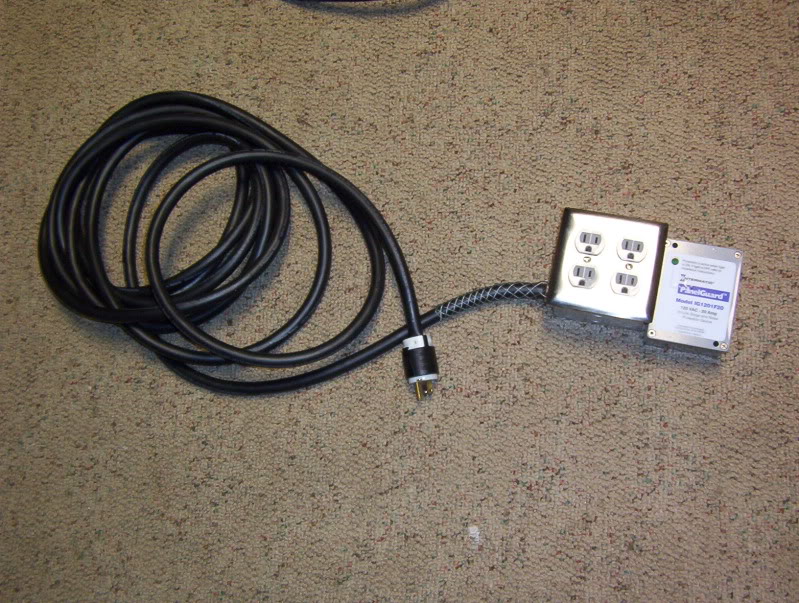
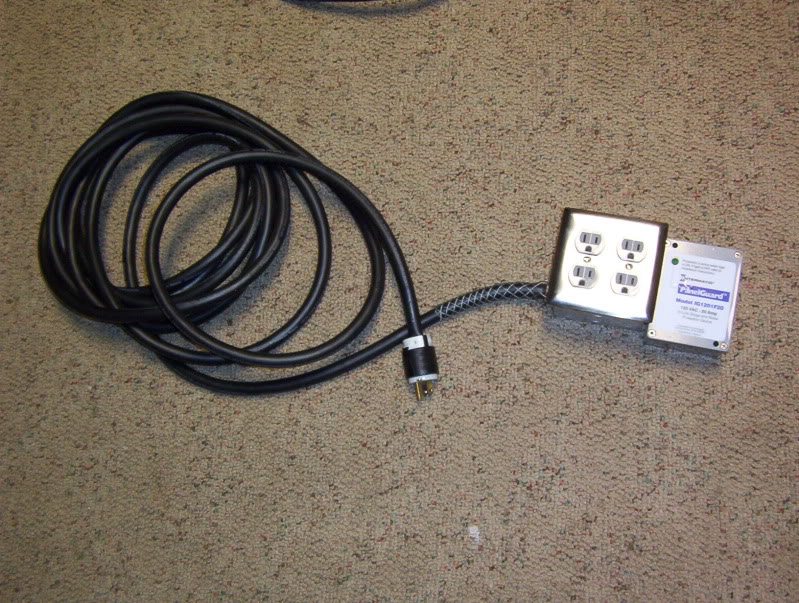
For those times when I need more length to my power cord or am plugged into questionable dirty power I made a 20 foot 10 gage SO Cable that runs into a 4 gang box with an indutrial grade Surge Supressor with built in RFI EMI filtration. The Surge unit will take up to a 32,000 VA surge and still protect my gear.
can you give a little more info/closer pic of your surge suppressor please?


Bob Lee (QSC)
In case you missed it, I work for QSC Audio!
- Jul 3, 2001
- 12,668
- 2,036
- 67
- Disclosures
- Former Technical Communications Developer, QSC Audio
Unfortunately, I never got paid a grand a piece for my mic cables. The general idea is that a cable should be made as if it was worth a thousand dollars since the signal chain is only as strong as it's weakest link. If it's pro audio, studio, or bass guitar the cable is just as important as any other piece in the chain.
Okay, I can very much agree with that. In a high-profile, mission-critical situation like that, it's worthwhile to check the cable before the show, and of course have good spares on hand.
I thought perhaps you meant you had to pay a thousand dollars to get a mic cable you could rely on, and that seemed absurd.

Btw Bob, every QSC piece I've had always sounded great and was tough as nails.
That's what they're supposed to do! I'm glad they've served you well.
can you give a little more info/closer pic of your surge suppressor please?
Be glad to but they do not make them anymore.
Here is what I now use.
[Invalid or Expired Link Removed]
I pretty much install a Surge unit into a 4 outlet box and add the cord, plug, and strain realief. I prefer this setup over having a rack unit. My Power Protector is in the floor instead of in my rack.
Oh and the comment about the Beer was a joke in case anyone missed it. I knew Bob could not miss this thread.
Sorry to Monday-Morning-Quarterback such a nice cabling job, but I note that the IECs are taking the weight of the power cable+connector. If you use a cord to tie up your power cable when it's coiled, having that at the 'amp' end & tying it to a cover latch would take the weight.
Extremely nice job!!
Extremely nice job!!
Not sure I foillow you about when it is coiled. There is hardly any weight on the cable. When I move my rack I untwist the twistlock and remove the bulk of the cable to put it in my gig bag.
I tie cord around one end of most of my power/mic/speaker cables. When I coil them I use the cord to tie up the coil. Cables get tossed into a case. Tying up the coiled cables greatly reduces them "mating" & snarling together.
If not a problem, no need to solve it; pardon my paranoia.
Nice ideas there! I'm likely to steal a few.
If not a problem, no need to solve it; pardon my paranoia.
Nice ideas there! I'm likely to steal a few.
Sorry to Monday-Morning-Quarterback such a nice cabling job, but I note that the IECs are taking the weight of the power cable+connector. If you use a cord to tie up your power cable when it's coiled, having that at the 'amp' end & tying it to a cover latch would take the weight.
Extremely nice job!!
I think you are refering to my project... IEC? Industrial Electronic Connector? The power cable feeding this is quite heavy and comes up from the floor and hits the twist lock.
The power inlet is only about a foot from the floor and it isn't very much of a load on the connector. I do put a positive twist on the cable to keep it twisted in the correct direction as a 6ga power cable is stout and will UNTWIST LOCK the connector.
When being moved etc the cable is not on the amp. Is that what you are talking about?
I have two things that do bother me about the construction of this amp. First is the WALL WART power supply for the JD-7 that is plugged into the terminal strip. You can see it with the light guage red wire coiled up and tie wrapped. Since it is JUST PLUGGED into the strip I feel transportation bumps might dislodge this from the outlet. SO I will be adding a couple small eyehooks and ties across the wart to secure it into the outlet.
The second is the 4PRO's are only supported by their front panels. They are brutes but I feel some extra support would be a good thing. I need to design a rear mount to secure the six amps to the rear of the rack and still allow cooling air to get by.
The next incarnation includes 6 sub woofers and possibly horns. This will result in a double wide rack instead of this single wide. If I do that I will be making further changes to the inlet power as that rig will need at least a 100 AMP 240 Volt power service.
Those levels of power use pin and sleeve connectors and are huge. It's a completely different ball game.
Lets call this the learner rig.
BOB
Lets call this the learner rig.
Dang. With a learner rig of this size, I'm drooling with anticipation of the "advanced" rig.
It was OP's I was referring to. For me at least, IEC = thingie like my computers power plug.
Your rig's a bit outside of my experience, except for the wall wart. I'd ty-wrap it to the buss bar.
I see your point on 40 pound amps hung from the front. I don't think I'd have any ideas you haven't already thought of.
& man, that's a beautiful rack!!!
Your rig's a bit outside of my experience, except for the wall wart. I'd ty-wrap it to the buss bar.
I see your point on 40 pound amps hung from the front. I don't think I'd have any ideas you haven't already thought of.
& man, that's a beautiful rack!!!

I have two things that do bother me about the construction of this amp. First is the WALL WART power supply for the JD-7 that is plugged into the terminal strip. You can see it with the light guage red wire coiled up and tie wrapped. Since it is JUST PLUGGED into the strip I feel transportation bumps might dislodge this from the outlet. SO I will be adding a couple small eyehooks and ties across the wart to secure it into the outlet.
Couple of cable ties should do it.
Personally I think Ampeg should have a rear rack mount for the 4PRO to screw in where the rear feet go.
There's 4 nice screw nuts back there. I'm thinking either a deal that screws to them and then bolts to the rear rack rail, or an L tray that screws to the front rail and rear rail and the amp sits on it.
Or a rail that runs vertical to the back of each side of the amp and secures top an bottom to the rack. I just need air to be able to pass through.
Yes 40# is too much to have wiggling around in there. Well, make that 240# wiggling around on two little rack rails.
BOB
There's 4 nice screw nuts back there. I'm thinking either a deal that screws to them and then bolts to the rear rack rail, or an L tray that screws to the front rail and rear rail and the amp sits on it.
Or a rail that runs vertical to the back of each side of the amp and secures top an bottom to the rack. I just need air to be able to pass through.
Yes 40# is too much to have wiggling around in there. Well, make that 240# wiggling around on two little rack rails.
BOB
Personally I think Ampeg should have a rear rack mount for the 4PRO to screw in where the rear feet go.
+999.
The 'feet' on the back are tempting, but I don't know how solid the back would be there. I'd be inclined to work from the bottom back rubber feet screws. Another rack rail down each side would make an easy tie point for an L bracket on those feet locations.
Or use the top & bottom of the rack; 'shim' between the bottom amp & the 'floor', between each amp, & between the top amp & the rack top. But for the shockmount rack, I might use hardish rubber as part of the shim.
MAN, WHAT a rack!! Must weigh twice what I do. I'm imagining the next one will have a power mast & utility meter on it

You are like the "Twist Loc" Master dude! I have the same short run cables in my rig, I think George Ls or some other special plug maker. They work great. And I see the made up NL4XLs with probably 12 g copper. Very nice.This be the Back of your Rack/Head and Cable Thread.
I'm a heavy duty cable nut and like to make everything nice and neat as well.
Here are some things I've done to hook up my Rig - Speaker Cables, Audio Cables, Instrument Cables, Tuner Cables, etc......
What are you guys doing?
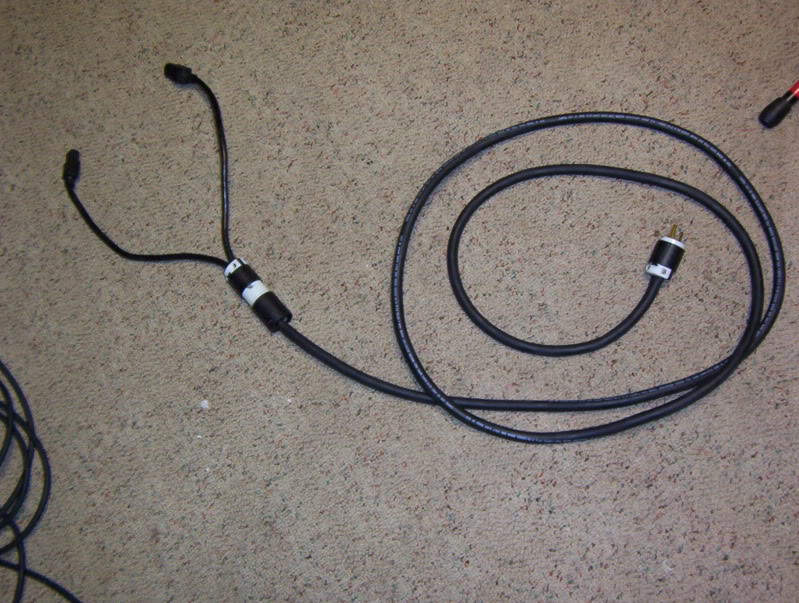
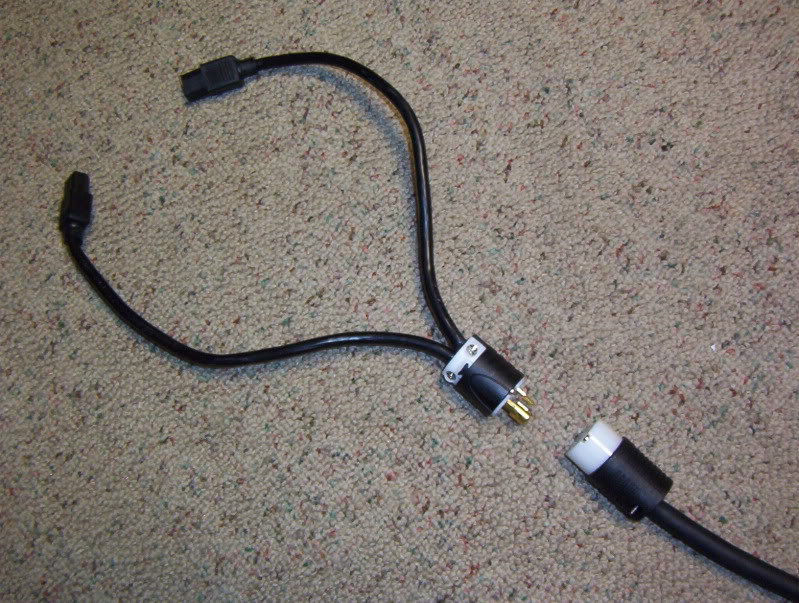
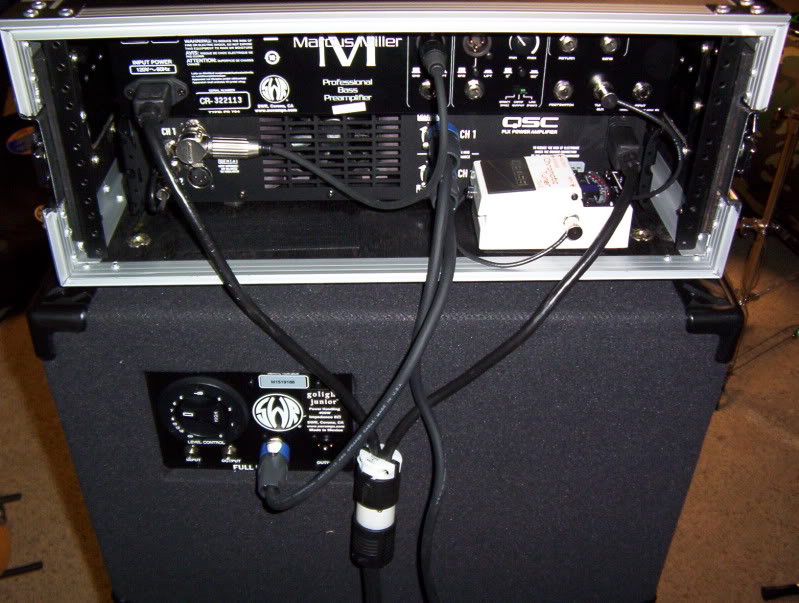
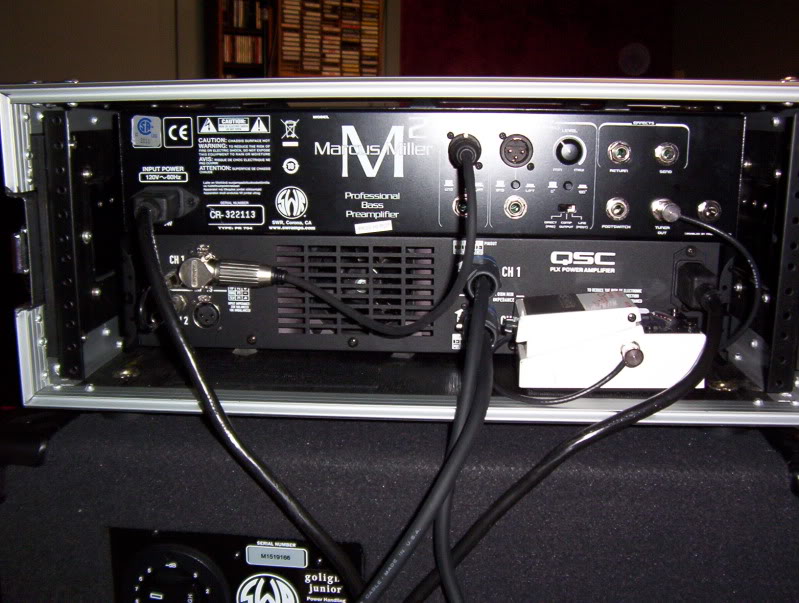
Lets see for Power I made a 10 foot 12 gage SO Cable that goes to my two rack units. The 12 gage cable runs into a twistlock female plug then from a male twistlock out to two 14 gage IEC cables to my Preamp and Poweramp. I use the little Boss TU-2 Tuner powered by one of those Ultralife 9 volt batteries and just unplug slightly the input to it when not in use. The Tuner is held down with good ol velcro.
For those times when I need more length to my power cord or am plugged into questionable dirty power I made a 20 foot 10 gage SO Cable that runs into a 4 gang box with an indutrial grade Surge Supressor with built in RFI EMI filtration. The Surge unit will take up to a 32,000 VA surge and still protect my gear.
For Audio from my Preamp to my Poweramp, I made a short XLR Cable. The XLR goes into one Channel on my Poweramp then I jump over from the TRS 1/4" jack of that channel to the other channel of the Amp. This cable is made up of some foil shield Beldon and has Switchcraft ends on it.
For my Bass I use a $150.00 heavy duty Instrument Cable, not for it's esoteric Audio but just because it is sturdy.
For Speaker Cables I used 12 gage speaker wire with Neutrick 4's on each end. I made these just a little longer than the exact length.
Now I know some of my stuff here is overkill and I am not advocating any special Tones to my Cables or anything, I just enjoy making heavy dity cables. I did not need/want a strip in my rack and was tired of using two cables going to the same place, hence the crazy Y cable I made. I put in the twistlocks so it would not pull apart and was a nice clean way to make the Y connection to the two IEC's.
Also I like to look at pics so here are mine, lets see your's.
Cable connoiseurs. A new TB low.
How is that a "low"?
What is wrong with having nice, clean cabling with a rack rig? Not much different from clean cabling on a pedal board.
Does TB stand for trivializing bass?
How is that a "low"?
What is wrong with having nice, clean cabling with a rack rig? Not much different from clean cabling on a pedal board.


