• TalkBass has been independent since 1998. Add your voice.
    Create a free account to reply to discussions, view embedded media, and browse with fewer display ads.
    Join freeLog in
    Want zero display ads or expanded classifieds tools? Compare plans.

Lets talk about finger board woods...

Could someone explain to me how the wood changes the way the magnets of the pickups and the vibrations of the strings are impacted? I could definitely understand the wear of the fingerboard, and the potential for chipping when refretting with some wood types. But when you're talking the wood of the body, or for that matter the wood on the fretboard, I just can't fathom how it would impact the electrical characteristics of a non acoustic guitar/bass.

The theory is that It's not that the woods change the magnetic circuit, but rather how the woods resonate with the strings vibrations from the nut and bridge, attenuating some parts of the spectrum differently than other woods. So the strings vibrations are changed, the pickups field doesn't change, but what it senses does.
 
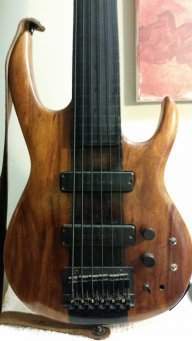
My new American made G&L JB has a Chechen fingerboard. Presumably rosewood from Chechnya. Looks a little different with a light and dark mottled appearance. Feels good and the bass sounds great. With the Empress body this bass is light and has a punchy aggressive sound.

G&L JB2.jpg
 
I think
My new American made G&L JB has a Chechen fingerboard. Presumably rosewood from Chechnya. Looks a little different with a light and dark mottled appearance. Feels good and the bass sounds great. With the Empress body this bass is light and has a punchy aggressive sound.

View attachment 3102604
I think Chechen is from Mexico.
 
  • Like
Reactions: Thir13teen
Oh yeah - fretboards! Got off the track. People always claim that: maple is brighter than rosewood, ebony is bright but emphasizes different frequencies , etc!!
I wonder if much of that is imagined? Bill Lawrence said that all fretboard woods sounded about the same - since they are all usually very hard wood. He thought string gauge was more important - that every instrument has a string gauge that makes it resonate at it's best.
 
Wood resonates. Pickups not only sense strings in the magnetic field, they also "pickup", sense, the vibrations around it. If I drop a pickup that is wired to a cable, then to an amp, onto a wood floor? It pops. The impacts vibrations are sensed. Drop it on a hollow floor, vs a solid one, the sound changes. So? It isn't just magnetically sensing string a pickup does. More evidence, for me... If only pickups were a factor, two identically equipped basses, with identical construction materials, would sound identical. This isn't the case, either. I use passive pickups exclusively. For this reason. They sense the vibrations around them more freely. To my ears. Tho active pickups may sense the vibrations, the manufacturers idea of tone is imparted in the preamp design, so that lessens the effect. Take the strings off yer bass and plug it in. Shake it. Hard. Sound will eminate from the guitar. Tap the body. The pickups will sense the tap. No magnetism involved. And lastly, I have played a bazillion basses in my life. Over the years, woods commonly used have been on a bazillion different designs. But I can hear evidence of commonalities in wood's contribution to tone. Bright Ebony. Aggressive Wenge. I'm not sure that woods themselves have a tone. But wood's hardness and density affect it's ability to reflect or absorb vibration. If a wood reflects more, absorbs less, it's brighter, more lively. Tighter grained woods tend to reflect more. In my experience. But EACH bass, identically constructed and equipped, sounds different. Having to do with all the parameters folk mention. Whether they be of wood faith or not. Heh. I am. I can hear it. I can't predict it. But I can hear a difference between Wenge, Ebony, Rosewood and Maple. Pau Ferro is an EXcellent fingerboard wood. It isn't called Ironwood fer nothin. We all perceive things differently. Our perception is reality. And reality to me is when a Master Builder such as Smith, Thompson, Tobias, Spector, describe tonewoods, and use their perception of the tonal qualities to build tones into basses? Who am I, the lowly player, to refute them.
 
Do you think how the wood feels (we don't believe there is a substitute for the sponginess of rosewood) and looks might be more important to the player than the difference in tone?

All the ingredients count in a submarine sando right???....same for guitars.
 
  • Like
Reactions: Swamp_Ronin
Okay then....time for me to chime in again....I never asked how the fret wood made a bass sound per say, but what could happen if the traditional woods like Rosewood or even Ebony were no longer being used and different ones were needed to be swapped out. I should have given an example like for instance what if your favorite bass always used Rosewood and it was switched to a different type, one that wasn't mainstream, would it really make much if any difference besides looks? Would the durability suffer? Would you still buy said bass again if this happened?

I'm seeing some good answers here from folks who got the question I was asking, but of course some didn't. I hope this clarifies what I meant a little bit better.
 
Could someone explain to me how the wood changes the way the magnets of the pickups and the vibrations of the strings are impacted? I could definitely understand the wear of the fingerboard, and the potential for chipping when refretting with some wood types. But when you're talking the wood of the body, or for that matter the wood on the fretboard, I just can't fathom how it would impact the electrical characteristics of a non acoustic guitar/bass.
Same way that gunk on the strings impacts tone: by absorbing more or less energy from the vibrating string at various frequencies.
 
Okay then....time for me to chime in again....I never asked how the fret wood made a bass sound per say, but what could happen if the traditional woods like Rosewood or even Ebony were no longer being used and different ones were needed to be swapped out.

I use old floorboards for my fretboards and I also make them a structural part of the neck. The second requirement, plus a desire to reuse/recycle, means I've moved away from "traditional" fretboard material.

Some of my thoughts on this. The basic requirement of a fretboard is that it is hard enough to cope with strings (so pine is is not a great choice), it is dimensionally stable (the frets need to stay in the right place), and that it works pretty well (setting frets requires a lot of fairly fine cuts). Ebony and rosewood both meet those requirements, plus they look good, which means they have been the go-to woods for European luthiers for centuries. But there are lots of other woods that meet those three requirements. Jotoba is just one of many. I really like using jarrah, a local Oz wood, and also merbau. For my designs, these woods work pretty well, I think. They look nice and feel nice to play and they are stable in Sydney's climate (huge heat and humidity swings).

Basically, as more and more poaching of rosewood happens (thank you Chinese middle class aspirations), luthiers are going to have to go to non-traditional woods. Ibanez is simply, to their credit IMO, ahead of the curve.

Hope this helps.
 
Could someone explain to me how the wood changes the way the magnets of the pickups and the vibrations of the strings are impacted? I could definitely understand the wear of the fingerboard, and the potential for chipping when refretting with some wood types. But when you're talking the wood of the body, or for that matter the wood on the fretboard, I just can't fathom how it would impact the electrical characteristics of a non acoustic guitar/bass.

This topic generates endless conjecture and debate. Full stop - there is no definitive answer, just a lot of opinions. Mine is that pu's have to be attached to something and wood is a logical choice because of stringed instrument tradition and it's high craft through woodworking skills. Other people will have a myriad of other opinions on the matter. So the short answer is; whatever you choose to believe based on your own honest assessment is a good enough reason and don't get into endless arguments trying to convince skeptics that your insight is the only truth. There's nothing to be gained by always being 'right', and always leaving someone 'wrong'. In this example anyway - as long as the player who believes what he wants to believe is happy believing that.., does it really matter who's right or 'not right'? ;)
 
The tonal effect of fingerboard wood is as big as that of pickguard color.

Considering the fingerboard is attached to the neck, I'll uncynically disagree as the necks contribution to the sound of a stringed instrument is next in line following the pu/electronics and strings. And that's not only my assessment - Phil Kubicki was the first person I heard say it and I'll tend to listen to a master luthier of his caliber.
 
Could someone explain to me how the wood changes the way the magnets of the pickups and the vibrations of the strings are impacted?

I'll have a crack. Hooray! :-)

The magnets? Nope. The wood has no impacts, unless there are buried nails or other magnetic material lurking, but even then the induced currents go nowhere, so you might as well call it zero impact.

The vibrations? Now that is a different story. But you get that, right? Alloy necks, super-high mass bodies (like concrete), the bridge mounting, the way the neck is joined to the body, the same for the tuners. And then there is the nut. Physics-wise, a string is a simple spring and, for instrument purposes, will follow Hooke's Law, where the amount of vibration is proportional to the force of your pluck. All of those little things mentioned, like the neck join, will cause the oscillations to decay, as will energy losses from the string material (and air resistance and so on). That's sustain. The stiffer the structure, the longer the sustain. The more mass in the string, the longer the sustain. And the quality of vibrations is also impacted. Some materials will dampen some of the frequencies more than others.

So it is basically a complex system where all these small parts impact how the string wobbles, and thus what the magnets can get to work with. Not as complex as resonant wooden boxes, but also not completely straight forward. And all that doesn't mean you can't make a workable bass from a plastic fretboard attatched to a metal pole with some pickups attached. You can. But IMO it won't be very nice to play or look at...