
It's also the standard wood for Spector US custom shop builds. I think more people are noticing it now because Fender is using it so more of them are out there.Pau Ferro is not new. I remember it in the specs for fingerboards on some basses back in the mid 90s. I believe I recall EBMM using it on some models.

Enjoy the benefits of a premium membership!
Upgrade Account
-
TalkBass has been independent since 1998. Add your voice.
Create a free account to reply to discussions, view embedded media, and browse with fewer display ads.
Join free Log in
Want zero display ads or expanded classifieds tools? Compare plans.
You are using an out of date browser. It may not display this or other websites correctly.
You should upgrade or use an alternative browser.
You should upgrade or use an alternative browser.
Lets talk about finger board woods...
- Thread starter dragon2knight
- Start date
-
- Tags
- useability wood
More options
Who Replied?I couldn't care less about how wood "sounds" on an electric bass, because it doesn't "sound" like anything. The pickups have a magnetic field. The strings are ferris metal. The sound is made by the metal strings vibrating within and fluctuating the magnetic field, which generates a current through the coil,....which is then sent to the amp to be amplified and the reverse happens with the coil in the speaker. Which vibrates the cone, the air and sends sound waves to your ears. At no point are you listening to wood, or is the wood generating sound, or is the pickup sensing vibrations through the wood. It doesn't work anything like a violin or acoustic guitar.
I start with wood that I know is structurally desirable to build the frame that holds the strings. Hardness, flexibility, strength:weight, grain orientation, movement in service, etc. Once I know that the wood is structurally up to the task, I worry about looks. If the frame is flexible, it will flex when the strings are vibrating and it will rob energy from the string, making it sound softer, or "muddy". If the frame is rigid, it won't rob as much energy from the string and they will sound brighter/clearer. No need to get any further into detail than that. If you do, it's likely you're taking a wild guess, or trying to sound like the smartest guy in the room by debating things on a microscopic level that have no practical value.
If you attached bass strings to a steel I-beam with a pickup, it wouldn't sound like steel. It would sound like bass strings attached to a very rigid frame.
If you attached bass strings to a blank of willow with a pickup, it wouldn't sound like willow. It would sound like bass strings attached to a soft, flexible frame.
Maple doesn't have a sound. Ebony doesn't have a sound (Unless it's the thin top of an acoustic instrument and it literally is what is making the sound, but that is a compLETELy different set of circumstances than a solid bodied electric instrument). Rigidity is a property of the frame. The frame is something to mount the strings and electronics to. The strings vibrate. That vibration is transduced into an electrical signal. That's the sound. The strings vibrating in a magnetic field. I can build a bass out of poplar and build it in a way that it would be just as rigid as a bass made from maple. And all else being equal, you wouldn't hear a difference if you didn't already know which was which. Would you hear a difference between an acoustic with a poplar top and one with a maple top? Most definitely.
There's plenty of anecdote, plenty of theories, plenty of imagining how it all works and plenty of hairs to split amongst the theoretical physicists, but I like to bypass all that and look at it in the simplest terms. Because that's all that's actually useful.
Knowing how pickups work, what to look for in a piece of lumber and how to navigate construction methods to achieve a good frame is all you need to build a good electric instrument.
Once you know how to build a good frame and put that aside, 90% of your sound is your pickup design/placement, controls in the signal chain and the rest is what strings you have, their condition and your playing.
Not going any further than that helps me avoid analysis paralysis and also from getting ripped off if I were in the market as a buyer.
If you think I'm full of it and think there's a relationship between the type of wood your bass is made of and the pickups, or that the pickups are sensing vibrations through the wood,......string your bass up with nylon strings and let me know how it sounds at the speaker.
If,.....and that's a big IF, you hear a difference between a maple FB and an ebony FB on 2 otherwise identical fretted basses,...it's because one board made the neck stiffer than the other. It has nothing to do with vibrations traveling through the wood, being colored by it and then getting soaked in through the pickups, through the wood.
That's why the guy in that vid that keeps getting posted, was able to get 2 different guitars to eventually sound identical and then attached the strings to 2 work benches and it still sounded exactly like the same guitar.
Wood doesn't affect sound at all? How is it that 2 of my current basses strung up with the same strings, same body shape and hardware (Spector Euro) sound slightly different when played UNPLUGGED? One seems to emphasize higher frequencies, the other sounds fuller, rounder.
Last edited:

Ok, well thanks for clearing that up.That's not what I said.
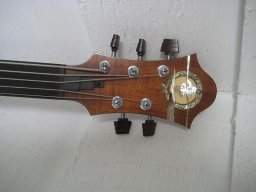
My ‘88 fretless Stingray has a pau ferro board so it’s been pretty commonly used for at least 34 years. I remember reading about it on spec sheets in the late ‘80s so I think it was already considered an ‘acceptable’ choice by then. To be honest, I never found that pau ferro board to be considerably different than rosewood in feel and I’m not going to speculate about tone - there are far too many other factors at play for me to try to assign a tone to a specific fingerboard wood. I have my suspicions but I can’t verify them.Pau Ferro is not new. I remember it in the specs for fingerboards on some basses back in the mid 90s. I believe I recall EBMM using it on some models.


I've read where one luthier had said that he thought the wood used for the fretboard affected tone more than body wood. This has been my experience with 70's Fenders (rosewood vs maple & ash vs alder)and wondered if others felt the same way.
What was your experience?I've read where one luthier had said that he thought the wood used for the fretboard affected tone more than body wood. This has been my experience with 70's Fenders (rosewood vs maple & ash vs alder)and wondered if others felt the same way.
I found that alder and ash would often times sound more alike than different and really couldn't name those subtle differences. Perhaps ash was a little bit clearer in tone.What was your experience?
Maple was brighter than rosewood and would also get more brash and clanky with a poor string / amp combination. Rosewood seemed smoother with less noise.
Ironically I only own 2 rosewood basses and the others are maple. Just worked out that way with vintage early 70's Fenders.

Did you happen to create sound clips before and after? If no, it'd be great to hear if you do another similar build.
I didn't think it would be as much of a difference as it was so I never thought of making sound clips.
What about a maple fretboard is making it sound brighter than the rosewood fretboard?I found that alder and ash would often times sound more alike than different and really couldn't name those subtle differences. Perhaps ash was a little bit clearer in tone.
Maple was brighter than rosewood and would also get more brash and clanky with a poor string / amp combination. Rosewood seemed smoother with less noise.
Ironically I only own 2 rosewood basses and the others are maple. Just worked out that way with vintage early 70's Fenders.


What about a maple fretboard is making it sound brighter than the rosewood fretboard?
No idea and I don't believe in tone woods all that much.
BTW, the differences I've found in wood / fretboards is not that big a deal and fixable with EQ.
The question was more about which makes a bigger difference.

Maybe next time?I didn't think it would be as much of a difference as it was so I never thought of making sound clips.

I just posted about the odd choice of finger board wood on my new Ibby Mikro, Jatoba. It's apparently a harder wood than Rosewood and it's obviously better available for manufacturing. Which brings me to the point of this post. Does anyone know what moving away from traditional woods used will do to the sounds/feel/durability we are all used to? I'm seeing a few out there now that seem like a odd choice, like Pau Ferro, so this may end up being the norm now that Rosewood is starting to vanish from production. Thoughts?
Well, you asked - so here goes...
1. in my experience - I've been playing a bass of one sort or another since 1968 - what kind of wood the fretboard is made out of doesn't make a whole lot of difference in any significant way. Yeah, some people say they can hear a difference - and maybe they can. Isolated; with no background noise; with headphones. I've no doubt that, with lab test equipment, you could point to slight differences on an oscilloscope tube. I spent years in material testing labs (Civil Engineer), and one thing I know for sure, is that every variable makes a difference. It's just a question of how much. Live, on stage, in a band? Uhh... I really, seriously doubt that anyone could tell the difference between a Rosewood and a Maple fretboard...
2. Are you playing a fretless bass? I don't own one, and the sum total of my playing experience with one is, maybe... about a minute. In their case, I can definitely see a case for the fingerboard wood - or whatever it is - contributing noticeably to the sound.
3. AFAIC, the only thing a fretboard does - besides whatever aesthetic value it might have - is hold the frets. And, as long as it holds those frets securely - and doesn't give me splinters? I really don't care a whole lot what it's made out of.
The fretboards on my 26 basses run the gamut, from Ebony thru "real" and a few ""substitute Rosewoods, Maple, Bubinga, and even the Ebanol on my aluminum necked Kramers. All the frets are securely held; no splinters (so far); and I'm happy with how they all sound...

I do think that ash could maybe sound slightly different than alder because it's harder/stiffer and I think RichterScale has the correct idea, body wood is obviously part of the frame that holds the strings when you screw a bridge and a neck into it.No idea and I don't believe in tone woods all that much.
BTW, the differences I've found in wood / fretboards is not that big a deal and fixable with EQ.
The question was more about which makes a bigger difference.
I hate basswood and paulownia bodies because they don't hold screws well so the bridge and the neck are screwed to something too soft to hold the neck and bridge well, making a soft weak frame.
As far as maple vs rosewood fretboards, I would assume that a maple neck with rosewood would be stiffer because rosewood is twice as hard as maple but so many people report hearing an all maple neck as sounding brighter, ...maybe there is something there that the non believers are not seeing.
The question becomes how soft is too soft and how hard is too hard.
A Modulus Flea bass does not sound as good as a Stingray bass when compared on a few Youtube vids I have seen/heard.
The Modulus sounded more harsh and sterile, so I might believe wooden basses/necks have a sound that I prefer over graphite or aluminum.
At the same time, Fender Custom shop built a Strat out of cardboard neck and body and it sounded like a Strat.
Last edited:

I'm seeing a few out there now that seem like a odd choice, like Pau Ferro, so this may end up being the norm now that Rosewood is starting to vanish from production. Thoughts?
Pau Ferro is a rosewood.
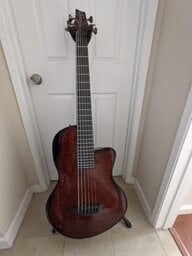
Jatoba is awesome as a fretboard wood and there's a lot of really good looking Jatoba boards out there. I have one on my Ray4. It's prettier than any piece of Indian Rosewood I've seen in quite a while.
Pau Ferro is a rosewood.
Even though pau ferro is sometimes referred to as a type of rosewood in common parlance, it actually isn't one, though apparently it's closely related. Two different genera: rosewood is Dalbergia, and pau ferro is Machaerium.
A CF or aluminum guitar is going to be more rigid than a wood guitar. The frame is not going to rob as much energy from the strings, making them sound brighter. Many describe it as sterile, but you're actually hearing a wider freq range from the string. A wood guitar, even if rigid, is going to have at least some amount of flex as the strings are pulled on and vibrate. That will absorb some of the strings energy and higher freq. What some describe as "character", "darker", "color", etc.
The cardboard used in that strat was definitely infused with some type of resin, making it a composite and probably just as strong as wood. The fact that it still sounded like a strat is a testament to how large of a role the pickups play in a guitar's sound.
The cardboard used in that strat was definitely infused with some type of resin, making it a composite and probably just as strong as wood. The fact that it still sounded like a strat is a testament to how large of a role the pickups play in a guitar's sound.
As a side note,.....it's the action of the frame flexing that is affecting the string's energy and frequency.
Meaning, you can make a maple neck that flexes a little, or you can make a maple neck that's super stiff. They will affect how the strings vibrate and sound in different ways.
So, maple doesn't have a signature sound. A bass won't always have a specific sound, just because the neck or FB is maple or rosewood. A bass won't always sound a specific way, because the body is alder. It has everything to do with how the frame is constructed and that can vary based on many factors.
That cardboard strat is a great example. It doesn't sound like cardboard, because cardboard doesn't have a sound, as far as pickups are concerned. As long as that frame is rigid enough, that guitar is gonna sound like a strat because it used strat pickups, placement, controls, etc.
Meaning, you can make a maple neck that flexes a little, or you can make a maple neck that's super stiff. They will affect how the strings vibrate and sound in different ways.
So, maple doesn't have a signature sound. A bass won't always have a specific sound, just because the neck or FB is maple or rosewood. A bass won't always sound a specific way, because the body is alder. It has everything to do with how the frame is constructed and that can vary based on many factors.
That cardboard strat is a great example. It doesn't sound like cardboard, because cardboard doesn't have a sound, as far as pickups are concerned. As long as that frame is rigid enough, that guitar is gonna sound like a strat because it used strat pickups, placement, controls, etc.


