• TalkBass has been independent since 1998. Add your voice.
    Create a free account to reply to discussions, view embedded media, and browse with fewer display ads.
    Join freeLog in
    Want zero display ads or expanded classifieds tools? Compare plans.

Lets talk about the Yamaha BB

getBAK

Supporting Member
Sep 21, 2006
2,123
3,938
San Jose, CA
www.levijack.com
Lately, I've become somewhat obsessed with the Yamaha BB series basses. They seem to have taken on some of the engineering problems that basses suffer from in some creative ways.

The two most interesting things
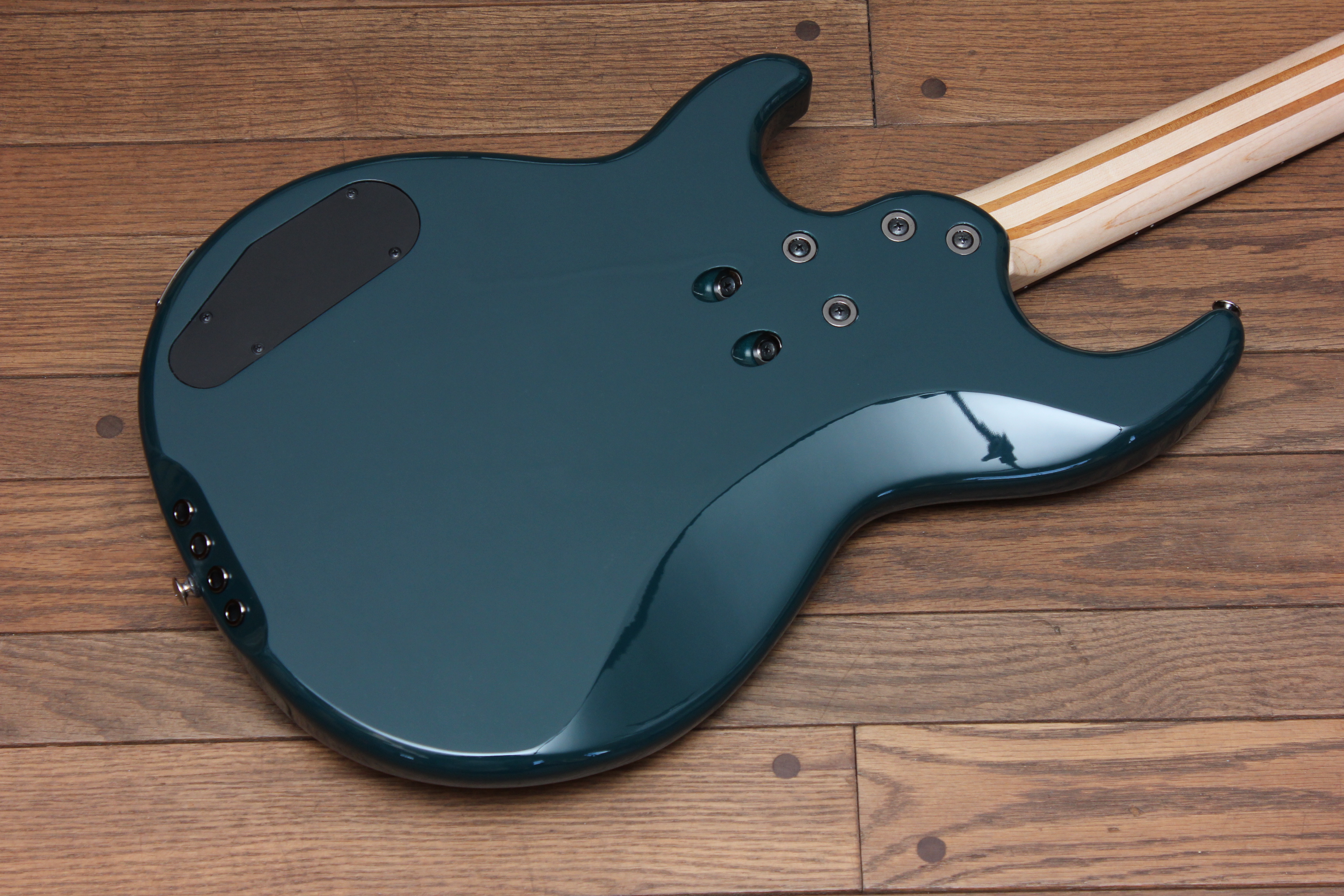
  • The 45- deg string-thru-body - detractors of string-thru-body seem to cite the bridge break angle as the problem... well this seems like this takes care of that
  • The Miter Jointed Neck - it's just a stronger design than a 90 deg 4-5 bolt heel.

IMG_8039.jpg


But here's the thing... no other Bass seems to use either of these items off the shelf at any price-point.
Why?

To be clear, I'm looking to explore these aspects of the BB basses from a luthier's/engineering perspective.
I'm not a luthier, but I'm very interested in engineering here.
 
Last edited:
Maybe they have a solution to a problem that does not exist?
I don't see any remarkable gain in either of those features. They both work very well.
String thru angle does not effect the vibrating string length and that's the only thing that counts.
Bolt on neck leans on the end of the neck pocket, no need to pull it with screws if the neck pocket and neck fit together properly.
 
. . . . . pulling your leg (although there is such a thing as Japanese Phillips . . . . )

Yamaha, as @agedhorse points out, is nothing if not an engineering company. In this round of BB's, Yamaha asserts that the string-through under the bridge is better at a 45 instead of a 90. I'm part of the crowd that believes this has no effect on tone, but I do believe that breakover angle affects how tight the string feels, apart and separate from the tension (in lbs/ft) tuned up to pitch. They do as well.

I'll have to beg off as to which ones, but I'm assuming the top model BB's (made in Japan by Yamaha's MusicKraft shop, their best) use their A. R. E. process where they take the wood for a given instrument and subject it to a heat/humidity/pressure process they invented that makes wood generally more predictably resonant.

They also think the 45-degree pull on the last two neck bolts draws the neck into the pocket with their own neck joint design. Most people think a bolt-neck instrument will pull the neck up at the head and flip it back towards you if the neck bolts were removed, when actually the strings pull the neck into the pocket. I once watched a guitar tech tune a Tele up to pitch . . . . with the screws out to illustrate that.

Along with their own pickups and their own body design (a bit smaller and the cutaway reaches a lot deeper around that round neck heel), well . . . . we ain't in Fullerton no more.

This is typical of their approach to a lot of instruments. They research these things, and like any company, hopes their innovations draw in the business. With these features and NOW THAT THEY ARE IN THE FULL TIME BASS GUITAR BUSINESS ( . . . . that is, they've FINALLY quit showing gorgeous axes at NAMM that will forever be back ordered after they sell the original batch . . . . .), they are making the inroads they could have made anytime over the last 40 years had they decided to be serious about it. I waited on a BB2000 (and I worked for a dealer ! !) for two years back in the 80's and finally gave up, as did a lot of guys.

They are very interesting designs, not the usual proto-Fender rehash, and are usually wonderful axes. They have the legacy of the 80's BB's to live up to, and I'd have to say they do.
 
Breakover angle I think is important in that one needs enough angle to keep the "speaking length" of the string seated well over the witness points on either end.

Speaking length I'm referring to as the length of string that is drawn over the witness points at the saddle and nut and runs between them - or the long part of the string that we bring up to tension for a particular open frequency (e.g. ~41.2 Hz for an E string).

The witness points refer to the point at which the speaking length of the string is "terminated", so the point at the nut and the point at the saddle. Strings on an instrument are not actually terminated there, but have a short length of string that breaks over the witness point, and terminates at the tuner (nut end) or bridge terminus/string thru holes/tailpiece, etc.

Functionally, the speaking length of the string is where we have the perceived tension under our fingers. This remains "the same" overall in the vast majority of instruments because the speaking length is many units of length in comparison to the non-speaking length that goes from the witness point to the terminus on either end.

Now if we use a little thought experiment here and take this to absurdity this might shed some light. Let's say you had a 34" scale bass, but 340" long strings (yes, 28.3 feet). The string terminates at the bridge end and nut end about 153" away from the witness point. Now you have a 34" "speaking length" on your bass string, but you also have 153" of string on either side brought up to tension to support that 34" E string. I imagine (as you might too) that the 34" e string, despite being brought up to tension will be dang floppy, as there is so much string distance on either end, that the inherent flexibility of even a heavy gauge string would cause major tuning instability and the fretted note to be warbling and have other overtones caused by reverberation down those super long "non-speaking" lengths of string.

This is taken to the absurd, but can illustrate the point - for all intents and purposes when we are using short "non-speaking" length strings such that they cannot stretch the way the absurd example above demonstrates, then the length of string beyond the witness point for the most part, becomes an irrelevant factor. The flexibility of the speaking length has a greater magnitude of effect over the sound of the string than the non-speaking length.

At what point the increased non-speaking length becomes more relevant is surely something that could be measured, but it's pretty easy to see on it's face that the non-speaking length would likely have to be pretty darn long (many, many inches) in order to start having an influence on the speaking length of the string in the system as the thought experiment explains above.

So what does this all mean? I think that yes, how the string is terminated beyond the witness points is important to the system, but what is the magnitude of the overall influence it imparts? Seems to be it would be negligibly small, and that the most important factors here are clean breakover angles at the witness points so that the string does not break or wear unnecessarily, and that beyond that, it's aesthetics and simple functionality. The Yamaha example possible increases string life by having a less steep angle at the witness point, but the hundreds of examples of 30 year old strings on string thru basses probably also shoots that argument down.

Regarding the double bolts at an angle in the neck pocket - it certainly looks cool and helps keep the neck seated well, but I would also suspect that a well-matched neck/pocket pair is also just as effective, as also evidenced by many thousands of perfectly functional basses without this innovation.

Jeez, I've been working far too many days in a row at this point... :D
 
Thank you - that really helps.
So in a perfect world, the strings would clamp down at the bridge and the nut with a zero "unspoken length". Obviously this doesn't apply in the real world as we need tuners and intonation.
(Kinda thinking about the implications of the [This invalid link has been removed], but that's another thread.)

Ray-Ross-Bass-Bridge.jpg
 
Last edited:
  • Like
Reactions: Squittolo and Beej
when actually the strings pull the neck into the pocket. I once watched a guitar tech tune a Tele up to pitch . . . . with the screws out to illustrate that.
What are you smoking?

It's a well known and handy trick to loosen the screws slightly and let the string tension pull the neck all the way into the pocket and then tighten the screws to hold it --- but in a typical Fender neck pocket fit (loose enough to remove the neck easily) if you string it up without screws, the strings will pull the neck forward. I've seen plenty of vintage instruments with very tight fitting pockets (shrinkage over the years) that might do what you claim but that wouldn't be typical of all Fender neck pockets.
 
Last edited:
True that Yamaha employs extraordinary engineers and craftspeople in every category. In any case you can assume every point of failure has been FEA modeled and bench tested. That's what any really good engineer would do. Nice looking bass, I bet it plays really well.
 
Great thread. I have a BB 734a and I love it—just a tone monster—and this stuff is fun to think about.

I thought the 45 degree angle on the body-through was done to reduce the break angle, because there are a lot of flats that don’t respond well to the 90-degree bend and it reduces this stress. I can’t imagine it would influence tone in any audible way, but I could be wrong.

As for the angled neck screws, again, I’d be surprised if it made any audible difference... but they sure feel more like a neck-through than any other bolt-on I’ve tried. Then again, I’ve only ever played one neck-through briefly at a GC. Still, my BB just feels like a rock (in a good way).
 
What are you smoking?

It's a well known and handy trick to loosen the screws slightly and let the string tension pull the neck all the way into the pocket and then tighten the screws to hold it --- but in a typical Fender neck pocket fit (loose enough to remove the neck easily) if you string it up without screws, the strings will pull the neck forward. I've seen plenty of vintage instruments with very tight fitting pockets (shrinkage over the years) that might do what you claim but that wouldn't be typical of all Fender neck pockets.

Pall Malls, actually.

I saw it done. What else can I say? This was a master guitar and amp repairman (builds his own amps as well as guitars) and I wouldn't doubt it was probably a better-than-average instrument, but I saw it done, right in front of me. I don't know what else I could say, AP. And FWIW, I wouldn't believe it possible had I not seen it. I think me and Dick might have both been smoking Marlboros if I remember correctly . . . .
 
Last edited:
If it's just a clever marketing ploy it's working perfectly. Here's a whole thread dedicated to the novelty of the string through and neck screw angles. How much did this cost compared to ads in magazines and on other websites? They didn't even have to come up with any claim as to why this design is better than previous styles (which is a must for all new products). Just let it out here and see what happens. Brilliant. Yamahas have always been decent instruments and a great value but when they start innovating, too, watch out!
 
  • Like
Reactions: Beej
Yamaha is great stuff, no doubt.

But those 45-degree neck bolts are pointless. There are already four other conventional neck bolts in place, which is plenty. And as others have already mentioned, the strings will pull the neck into the neck pocket anyway.

The 45-degree string-thru is good for avoiding string stress for thicker/less flexible strings. I did that ten years ago myself. It’s a bit more difficult to manufacture, which is why it’s not a common feature on mass-produced basses. But it’s hardly revolutionary.
 

Latest posts