
• TalkBass has been independent since 1998. Add your voice.
    Create a free account to reply to discussions, view embedded media, and browse with fewer display ads.
    Join freeLog in
    Want zero display ads or expanded classifieds tools? Compare plans.

Lifting frets?

Hey all!

I am in the process of conditioning he fretboard and restringing a new to me 2001 Dean European Custom Select Improv 4. I’m really exited to get the action down and hear how it sounds with some fresh steel! I noticed that some, and really a majority of the frets have a small amount of space between the bottom of the fret and the fretboard. When I press firmly in the center there is play, and from what I measured, most can fit a .003 inch and at the worst, .008/.010 inch.

The action was set pretty hit when I got it, and I’m not sure if that was to compensate for fret buzz or not. I have looked for tolerance numbers but haven’t found any thing super helpful as of yet. What do you all think? Am I looking at a re fret?
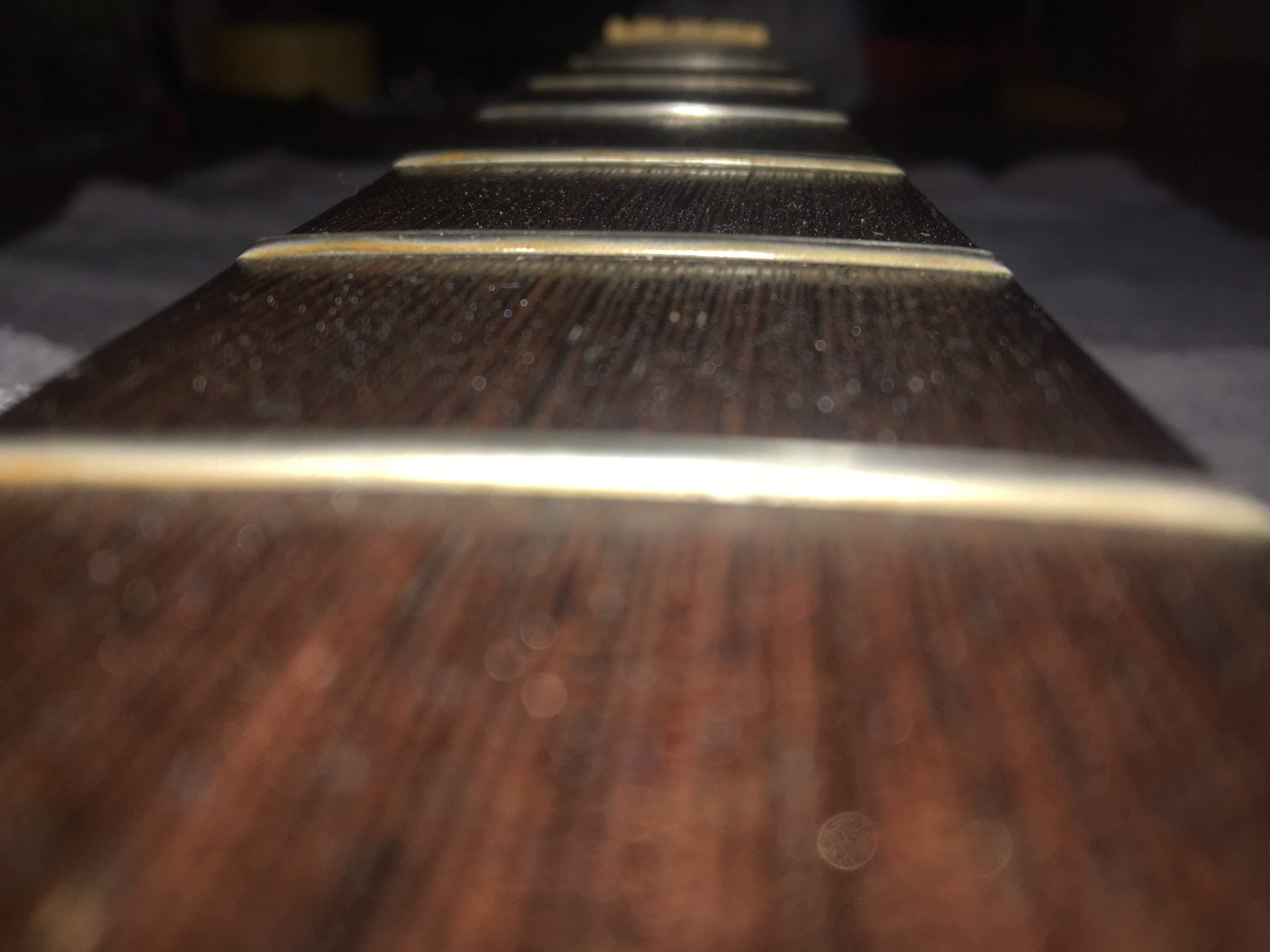
0FC3A5A8-5A50-4B10-B9F3-8199FB6632CC.jpeg
 
Hey all!

I am in the process of conditioning he fretboard and restringing a new to me 2001 Dean European Custom Select Improv 4. I’m really exited to get the action down and hear how it sounds with some fresh steel! I noticed that some, and really a majority of the frets have a small amount of space between the bottom of the fret and the fretboard. When I press firmly in the center there is play, and from what I measured, most can fit a .003 inch and at the worst, .008/.010 inch.

The action was set pretty hit when I got it, and I’m not sure if that was to compensate for fret buzz or not. I have looked for tolerance numbers but haven’t found any thing super helpful as of yet. What do you all think? Am I looking at a re fret?

View attachment 3535858
Remember that this bass is 20 years old.
It could be possible that the bass was neglected for a time in a hot attic or hot storage area or maybe it needs mineral oil rubbed into the fretboard?

Is it in a humidity controlled area now?
Before ripping that beauty up I'd try looking into this.
 
  • Like
Reactions: Carl Hogg
Setting up an appointment tomorrow :) The glue that was holding the nut in place had failed and while the nut was off, I tried to polish it a bit. It actually lost it's coating and revealed what looks like steel underneath. I'm going to let a luthier assess it's condition before I do anything, and will probably pay to have it set up, but that made me curious. From what I've researched it doesn't appear to be used very often this way.


 
  • Like
Reactions: B-Mac
Setting up an appointment tomorrow :) The glue that was holding the nut in place had failed and while the nut was off, I tried to polish it a bit. It actually lost it's coating and revealed what looks like steel underneath. I'm going to let a luthier assess it's condition before I do anything, and will probably pay to have it set up, but that made me curious. From what I've researched it doesn't appear to be used very often this way.
You mean instead of brass? Most likely it goes from looking gold to silver. Two reasons, either it is a silver colored metal with a gold playing and you polished the playing off, or it is a gold material and polishing actually scratched it which made it harder to see the gold color.
 
  • Like
Reactions: B-Mac
I am always suspect of guitar hardware that's gold, even the very best loses the gold look eventually.
If you are gonna spend money at a luthier, you might as well go all the way and get a brass nut made.
Or get one made from black GraphTech Tusq.
I don't think a bass with those EMG's and EMG Pre really needs the extra "ring" of a metal nut.
 
Last edited:
This is not uncommon - I have to repair things like this pretty regularly on production instruments (even brand-new ones).

A competent luthier can glue them back down and do the necessary leveling/recrowning to make it play right.
It will sound better too - loose frets don't make for good-sounding notes.

Since you're in Boulder, try calling Michael Bashkin in Fort Collins.
He may or may not be doing repair work at the moment, but he'll have the right recommendation for a qualified person.
 
  • Like
Reactions: Carl Hogg
I just got back from the local shop, Woodsong Lutherie and have some answers! From what they could tell, given that all of the frets are behaving similarly: ends are seated and the center is lifted, the issue is not that the frets are actually lifting - it's that the frets on the fingerboard are a tighter radius than the board itself. I am not well versed on the finer details but here are the numbers I can recall. The frets are for a 12" radius board, and the board is a 20" radius, so while they were tight at first, they eventually sprung out under their own tension. It is apparently uncommon to have such a flat fingerboard, so the Czech shop used what they had and settled on that compromise. They set the action for me and basically told me to leave it alone until it needs fret work in the future, and since it isn't technically broke...don't fix it!

As I suspected, the nut is not actually brass but possibly a steel or iron that has been plated to appear as brass. The finish came off with a light polish, but certainly has a good weight. The bridge is some sort of pot steel judging by the porosity of the finish and reacted the same way to a light polish, so i let it be. I'm a bit bummed to find out it's not a real brass bridge, but you know, I love the way it sounds, whatever it is!

Thanks for all your input on the subject, I feel a lot better knowing the fret situation isn't a result of neglect or exposure to extreme temperature. All there is to do now is play on!
 
In my opinion you either misinterpreted what was said or you got some sketchy advice.

When fretting an instrument it is considered to be best practice to form the frets to a tighter radius than the board. This helps to seat the fret ends Which have a tendency to spring up. The fact that they have lifted in the centre may be the result of an number of factors - poor seating initially, shrinking fretboard, expanding fretboard, glue failure, etc.

Regardless of why they have sprung, they should be attended to. Until they are properly seated you will likely encounter unusually deadened notes, unnecessary fret buzz, and lack of sustain. Any decent luthier or technician should be able to reseat the frets at far less than the cost of refretting.
 
The Warwicks wenge fretboards are 20" radius.
Spectors are 16" radius.
I bet these Deans are 16" radius like the Spectors.
I have not checked my Dean Improv but it does not feel as flat as the Warwick Rockbass $$ I had which was 20" radius.
Schecter basses are 16" radius.
Ibanez SR Series are 16" radius.
Yamaha is at 10" radius.
Ernie Ball new stuff at 11" radius.
ESP/LTD don't say what theirs are but I bet 16 like Schecter.
Seems a number of the "new school or shred" companies are making flatter fretboards than the Fender standby 9.5" or most Peavey USA basses at 8" radius.
 
  • Like
Reactions: Carl Hogg