@HaphAsSard yes I'm in the midlands of Ireland & I'm a blow in from Australia, so I attract a bit of attention doing quirky things with their music. The tenor guitar & tenor cello (half size) turn heads the saxophones blow them away & I can play all their million mph reels & jigs. But no one plays bass at their acoustic pub sessions hence the reso bass, it is very good but the sound is projected out away from me & being new to bass I need to hear it (not just when I play wrong notes). The cello size bass with a strap means I can straddle it on my lap on a 60 degree incline & angle it to hear it. Of course there are compromises which is what music is all about & I'm not performing soloists work. Our job is to get the right compromise!I rarely use the bow when I'm out mainly due the extra space it requires. At home bowing to ballads is pure magic. I really want to get the silicone string bass to work as well, that should work nicely on a 1/2 size cello & the piezo will be nesessary, maybe there is a material that could replace horses hair on the bow?

Enjoy the benefits of a premium membership!
Upgrade Account
-
TalkBass has been independent since 1998. Add your voice.
Create a free account to reply to discussions, view embedded media, and browse with fewer display ads.
Join free Log in
Want zero display ads or expanded classifieds tools? Compare plans.
You are using an out of date browser. It may not display this or other websites correctly.
You should upgrade or use an alternative browser.
You should upgrade or use an alternative browser.
Looking for Microbass Knowledge
- Thread starter Mark Wybierala
- Start date
More options
Who Replied?The resonater bass is limited to the strength of my plectrum the new Jim Dunlop.73mm pinks. The cello size bass has a much larger body and the limit is on how much finger strength can the string take! Mark a longer neck could be the go if it could be done easily & cheaply, ideally to match the 1/4 DB scale of the strings! Oh another strong point is that if the session gets really loud I place a tuning peg up to my left ear, try that with a bass guitar

I've done the longer neck on a cello many years ago. The instrument was more of a stick bass with a cello body slid over the stick. The luthery gods turned away in disgust but it actually played. My major problem with a cello bass is the very short length of exposed neck and the need to bring your hand around over the body for the higher area of the fingerboard. This is from the perspective of a guitar player -- its not natural to do that.
Back to the microbass subject. Yesterday, I stopped at a competitor's music store and discovered that Taylor is now making a little acoustic bass. Its called a GS Mini Bass and it has a 23.5" scale. I played it and it was a lot of fun. Priced at $699 -- but it is a Taylor, looks like a Taylor, feels like a Taylor and has the mojo like a Taylor. Apparently, Taylor has worked with D'Addario to develop the strings for it and they has a set in stock so I purchased a set ($42.00 and found them for $39 on Musician's Friend). Clearly marked on the package, they are intended for the Taylor GS Mini Bass at a 23.5" scale. I don't have an acoustic on hand right now that is of the caliber I want to use these on but guitars come into the shop every day so I'll wait or I might just build something. The GoldTone strings I ordered will work on the Yamaha FG-Junior with its 21" scale.
Back to the microbass subject. Yesterday, I stopped at a competitor's music store and discovered that Taylor is now making a little acoustic bass. Its called a GS Mini Bass and it has a 23.5" scale. I played it and it was a lot of fun. Priced at $699 -- but it is a Taylor, looks like a Taylor, feels like a Taylor and has the mojo like a Taylor. Apparently, Taylor has worked with D'Addario to develop the strings for it and they has a set in stock so I purchased a set ($42.00 and found them for $39 on Musician's Friend). Clearly marked on the package, they are intended for the Taylor GS Mini Bass at a 23.5" scale. I don't have an acoustic on hand right now that is of the caliber I want to use these on but guitars come into the shop every day so I'll wait or I might just build something. The GoldTone strings I ordered will work on the Yamaha FG-Junior with its 21" scale.
@HaphAsSard Sorry to lead you astray on the volume reso to cello bass I sat in & played all 3 basses for a spell today the resonator is louder than the cello convert & of course has a cutting growl, compared to a softer more refined sound of cello & uke bass. Of course having frets, it has more sustain until the bow is engaged. What surprised me is the sound that comes out of the ukulele bass, it has been sitting lonely in the corner for a while with its' rubber band strings & 21" fretless scale. Maybe what I need is a stethoscope for a foldback option.
Mark, there was a shortbass one for sale here on an auction site about 3 months ago they look very nice, but a bit pricey. I'm wondering if the 3/4 guitar is going to be over engineered for the GoldTones. It's braced to take 6 steel strings, probably 14s. Maybe a 3/4 nylon is worth a thought . I bought a 1/2 nylon at auction & strung it up GDAE using the middle 4 of a set of 10s took the bridge out altogether & it sounds great! All for €10. If I get those GoldTones or the D'Addarios I have my eye on a 1/4 cello
Mark, there was a shortbass one for sale here on an auction site about 3 months ago they look very nice, but a bit pricey. I'm wondering if the 3/4 guitar is going to be over engineered for the GoldTones. It's braced to take 6 steel strings, probably 14s. Maybe a 3/4 nylon is worth a thought . I bought a 1/2 nylon at auction & strung it up GDAE using the middle 4 of a set of 10s took the bridge out altogether & it sounds great! All for €10. If I get those GoldTones or the D'Addarios I have my eye on a 1/4 cello
I'm going to assume the Taylor GS Mini Bass has a well engineered strategically graduated top. Its just one of the things that Taylor does to get their guitars to sound as good as they do. This Yamaha FG-Junior I have is from the '70s and I'm counting on the old wood and better build quality to yield some tone. It won't be up to the quality of the Taylor but it will probably be better than some of the lesser expensive UBasses. Yamaha builds good gear. This whole adventure is about learning about short bass scales, the new strings, and what kind of fun I can have inexpensively.
I have a Hohner travel guitar. Its a little electric guitar with a 25" scale that is a lot like the Pignose PG. I'm making a piezo-acoustic bridge for this Hohner and installing bass tuners on it today and will find out if these DAddario strings will cope with a 25" scale. I haven't decided about the preamp yet but I have a few options on hand. The Hohner was given to me and its a good no-risk easy mod to check out what these strings will do. If it works, it'll be a cool little bass that either I'll enjoy or I'll sell it onward to fund a continuation of this adventure. I want to hold out for one of those Mexican made Martins or a Big Baby Taylors at a good price before I put these strings on an acoustic and I'll do the work properly if I get the chance. 25 to 26" scale is what I'm wanting to achieve.
I have a Hohner travel guitar. Its a little electric guitar with a 25" scale that is a lot like the Pignose PG. I'm making a piezo-acoustic bridge for this Hohner and installing bass tuners on it today and will find out if these DAddario strings will cope with a 25" scale. I haven't decided about the preamp yet but I have a few options on hand. The Hohner was given to me and its a good no-risk easy mod to check out what these strings will do. If it works, it'll be a cool little bass that either I'll enjoy or I'll sell it onward to fund a continuation of this adventure. I want to hold out for one of those Mexican made Martins or a Big Baby Taylors at a good price before I put these strings on an acoustic and I'll do the work properly if I get the chance. 25 to 26" scale is what I'm wanting to achieve.
I wish I could be playing in pubs in Ireland. I spent 16 years in the American forces in the UK and very much miss pubs, barmaids and good beer. The average yank becomes totally confused until they catch on to the sharp wit of Irish humor (if they ever do). I ended up going native over there and am now just a shell of a man drinking over hopped and over-priced craft beers in New Jersey. God bless the Irish and Ireland.
 You mentioned octave mandolins. Here's my last build. I built 6 copies of the Rickenbacker Capri but with a 24.75" scale and the last one I built as an octave mandolin. Its built generally the same as Ric did with the same neck joint and chambered body. Tuned GDAE with octave splits on the G and A strings. The body is ash and the neck is maple and mahogany. I built this for myself and as a guitar player, I'm doing my best to learn mandolin chords and technique. The tone is to die for. This one was built with a 24.5" scale but I plan to do more with a 23" scale making the mandolin chords a little easier to play.
Very nice indeed! A shorter scale will make a huge difference for comfort especially when you are running with the extra wide neck that's required for 8 strings. Recently I got a semi acoustic tenor guitar from Eastwood guitars, well worth looking at for a fella with your skills. Not being a luthier I bought a Harley Benton Jnr short scale electric from Thomann & restrung it in fifths down from the top E, so that made it FCGDAE it took a 130 gauge & some butchering to make the F work, the C is an 80. It can play bass runs on the two bottom strings & tenor guitar melody/chords on the 4 top stringsI wish I could be playing in pubs in Ireland. I spent 16 years in the American forces in the UK and very much miss pubs, barmaids and good beer. The average yank becomes totally confused until they catch on to the sharp wit of Irish humor (if they ever do). I ended up going native over there and am now just a shell of a man drinking over hopped and over-priced craft beers in New Jersey. God bless the Irish and Ireland.
View attachment 1124919 You mentioned octave mandolins. Here's my last build. I built 6 copies of the Rickenbacker Capri but with a 24.75" scale and the last one I built as an octave mandolin. Its built generally the same as Ric did with the same neck joint and chambered body. Tuned GDAE with octave splits on the G and A strings. The body is ash and the neck is maple and mahogany. I built this for myself and as a guitar player, I'm doing my best to learn mandolin chords and technique. The tone is to die for. This one was built with a 24.5" scale but I plan to do more with a 23" scale making the mandolin chords a little easier to play.
Another experiment that I play all the time is Harley Benton 6 string grand symphony size I think it's 25", as a 5 string tuned in 5ths CGDAE. I only ever chord 4 strings so I can swap between either tuning, the slightly longer scale makes it a real bitch to get some of those (Mandola/Mandolin) chords, but it needs to be that way to get the C to work acoustically. Back to basses, l think that if the scale length of a bass is 25" or less it should be tuned in fifths! There are some virtuoso bassists (super human) that have their Double Basses tuned in fifths. I don't know what the tuning should be? but tuning in fourths is wasting a lot of range in my opinion. Last night I took the uke bass to the pub & used three fingers easily just for the craic (Irish word for fun). Whoever starts to make a small bass tuned in fifths I reckon will sell plenty of them

while I agree that fifths tuning is great, I use it on my 3 string basses to get a little more range and I also have a tenor banjo tuned fifths, but I don't think a sub short scale bass tuned in fifths would really catch on. It takes a different mindsets to play in fifths, combine that with the already niche market of sub-shirt scale basses and I don't see a recipe for success.Very nice indeed! A shorter scale will make a huge difference for comfort especially when you are running with the extra wide neck that's required for 8 strings. Recently I got a semi acoustic tenor guitar from Eastwood guitars, well worth looking at for a fella with your skills. Not being a luthier I bought a Harley Benton Jnr short scale electric from Thomann & restrung it in fifths down from the top E, so that made it FCGDAE it took a 130 gauge & some butchering to make the F work, the C is an 80. It can play bass runs on the two bottom strings & tenor guitar melody/chords on the 4 top strings
Back to basses, l think that if the scale length of a bass is 25" or less it should be tuned in fifths! There are some virtuoso bassists (super human) that have their Double Basses tuned in fifths. I don't know what the tuning should be? but tuning in fourths is wasting a lot of range in my opinion. Last night I took the uke bass to the pub & used three fingers easily just for the craic (Irish word for fun). Whoever starts to make a small bass tuned in fifths I reckon will sell plenty of them
Tuning to fifths is what makes the mandolin and tenor guitars have such a different character. On an octave mandolin its just heavenly and my octave mandolin is always getting unsolicited praise for sounding what people describe as being such a pretty sound. Tuning it to be the standard four last strings of a guitar, it just doesn't chime or delight at all. But a 25" scale mandolin is just awkward for mandolin players and its totally alien to guitar players because of the tuning. Its an instrument that requires study and a desire to learn it. Some people have the brain power to swap between fourth and fifths at will but they are quite the minority.The same goes for basses. If you're a player with the capacity to dance between fourths and fifths, you really won't understand the problem for us less gifted players. Bass tuned to fifths for me would be a disaster. Four strings tuned EADG is already a challenge.
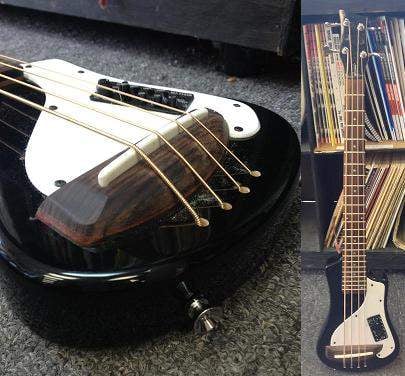
Hey, I made a mistake in an earlier post. The little travel guitar I have is made by Hofner not Hohner. Its up and running with the DAddario strings at a 24.7" scale tuned to EADG and its really cool to play while it stays in tune. I put these strings on it three days ago. Initiallially there was an anticipated stretching of the strings in the first few hours that seemed to be stabilizing. But every day I'm having to tune it up to pitch by a bit more than a full step. This scale is 1.2" longer than what these strings are designed for and I think that maybe I might be exceeding the design limitations of the strings and if this continues, these strings are going to break. It is quite fun to play and I've made some observations that I'll share that might be valuable if anyone wants to try what I'm doing. The D'Addario strings require significantly less intonation compensation. Over 1/4" less than a what I observed using a conventional electric .105" E-string on this same scale. The intonation compensation in nearly linear without the large compensation step you normally see between the E and the A-strings so a straight non-offset saddle is intonated quite well. There is an increased ability to play chords both major and minor without there being an unpleasant dissonance in lower pitches -- hard to describe but you can add a 3rd at lower notes with a better outcome than is typical. Vibrato as you would accomplish on a cello is more pronounced even though the neck is fretted. Note bending is quite a bit less of a pitch shift per distance traveled across the fretboard. The lower tension of the strings compared to conventional strings is a little odd but not something that is worth a complaint. The strings are very dynamic when it comes to having control of the volume via how you play the string -- you can be quite delicate or really emphasize at will and this requires more discipline and in my case a compressor/limiter if I were to play this instrument at a gig. The string action needs to be a little higher to prevent fretbuzz but this is offset by how easy it is to fret with the lower tension and I don't mind the higher action at all. Understand here that I am not an accomplished bass player but rather someone who fakes playing bass reasonably ok. The tension of the individual strings are quite balanced and the response of my piezo is quite balanced between string despite the piezo being the type with the six elevations intended for a guitar. Its a guitar piezo and a cheap Ibanez preamp and it works great. The saddle is made from corian and note the really significant break angle over the saddle which I believe is responsible for the piezo working so well. Output from the piezo is quite strong even with the lower tension strings. If these strings survive for six months, I'll build a few basses.
Hey, I made a mistake in an earlier post. The little travel guitar I have is made by Hofner not Hohner. Its up and running with the DAddario strings at a 24.7" scale tuned to EADG and its really cool to play while it stays in tune. I put these strings on it three days ago. Initiallially there was an anticipated stretching of the strings in the first few hours that seemed to be stabilizing. But every day I'm having to tune it up to pitch by a bit more than a full step. This scale is 1.2" longer than what these strings are designed for and I think that maybe I might be exceeding the design limitations of the strings and if this continues, these strings are going to break. It is quite fun to play and I've made some observations that I'll share that might be valuable if anyone wants to try what I'm doing. The D'Addario strings require significantly less intonation compensation. Over 1/4" less than a what I observed using a conventional electric .105" E-string on this same scale. The intonation compensation in nearly linear without the large compensation step you normally see between the E and the A-strings so a straight non-offset saddle is intonated quite well. There is an increased ability to play chords both major and minor without there being an unpleasant dissonance in lower pitches -- hard to describe but you can add a 3rd at lower notes with a better outcome than is typical. Vibrato as you would accomplish on a cello is more pronounced even though the neck is fretted. Note bending is quite a bit less of a pitch shift per distance traveled across the fretboard. The lower tension of the strings compared to conventional strings is a little odd but not something that is worth a complaint. The strings are very dynamic when it comes to having control of the volume via how you play the string -- you can be quite delicate or really emphasize at will and this requires more discipline and in my case a compressor/limiter if I were to play this instrument at a gig. The string action needs to be a little higher to prevent fretbuzz but this is offset by how easy it is to fret with the lower tension and I don't mind the higher action at all. Understand here that I am not an accomplished bass player but rather someone who fakes playing bass reasonably ok. The tension of the individual strings are quite balanced and the response of my piezo is quite balanced between string despite the piezo being the type with the six elevations intended for a guitar. Its a guitar piezo and a cheap Ibanez preamp and it works great. The saddle is made from corian and note the really significant break angle over the saddle which I believe is responsible for the piezo working so well. Output from the piezo is quite strong even with the lower tension strings. If these strings survive for six months, I'll build a few basses.
Irish guys play mandolas' tuned GDAE a fair bit. They sound good acoustically & recorded, but are painful to get them sounding decent through a PA in any room with the slightest bit of life in it! That's the price they pay to have a more comfortable fretboard. Bouzoukis' & mandolin-cellos' are popular but way too much stretch for tunes.Tuning to fifths is what makes the mandolin and tenor guitars have such a different character. On an octave mandolin its just heavenly and my octave mandolin is always getting unsolicited praise for sounding what people describe as being such a pretty sound. Tuning it to be the standard four last strings of a guitar, it just doesn't chime or delight at all. But a 25" scale mandolin is just awkward for mandolin players and its totally alien to guitar players because of the tuning. Its an instrument that requires study and a desire to learn it. Some people have the brain power to swap between fourth and fifths at will but they are quite the minority.The same goes for basses. If you're a player with the capacity to dance between fourths and fifths, you really won't understand the problem for us less gifted players. Bass tuned to fifths for me would be a disaster. Four strings tuned EADG is already a challenge.
View attachment 1126923
Hey, I made a mistake in an earlier post. The little travel guitar I have is made by Hofner not Hohner. Its up and running with the DAddario strings at a 24.7" scale tuned to EADG and its really cool to play while it stays in tune. I put these strings on it three days ago. Initiallially there was an anticipated stretching of the strings in the first few hours that seemed to be stabilizing. But every day I'm having to tune it up to pitch by a bit more than a full step. This scale is 1.2" longer than what these strings are designed for and I think that maybe I might be exceeding the design limitations of the strings and if this continues, these strings are going to break. It is quite fun to play and I've made some observations that I'll share that might be valuable if anyone wants to try what I'm doing. The D'Addario strings require significantly less intonation compensation. Over 1/4" less than a what I observed using a conventional electric .105" E-string on this same scale. The intonation compensation in nearly linear without the large compensation step you normally see between the E and the A-strings so a straight non-offset saddle is intonated quite well. There is an increased ability to play chords both major and minor without there being an unpleasant dissonance in lower pitches -- hard to describe but you can add a 3rd at lower notes with a better outcome than is typical. Vibrato as you would accomplish on a cello is more pronounced even though the neck is fretted. Note bending is quite a bit less of a pitch shift per distance traveled across the fretboard. The lower tension of the strings compared to conventional strings is a little odd but not something that is worth a complaint. The strings are very dynamic when it comes to having control of the volume via how you play the string -- you can be quite delicate or really emphasize at will and this requires more discipline and in my case a compressor/limiter if I were to play this instrument at a gig. The string action needs to be a little higher to prevent fretbuzz but this is offset by how easy it is to fret with the lower tension and I don't mind the higher action at all. Understand here that I am not an accomplished bass player but rather someone who fakes playing bass reasonably ok. The tension of the individual strings are quite balanced and the response of my piezo is quite balanced between string despite the piezo being the type with the six elevations intended for a guitar. Its a guitar piezo and a cheap Ibanez preamp and it works great. The saddle is made from corian and note the really significant break angle over the saddle which I believe is responsible for the piezo working so well. Output from the piezo is quite strong even with the lower tension strings. If these strings survive for six months, I'll build a few basses.
Maybe the intonation compensation relates to the internal diameter of the nylon core. It looks like you are onto a winner Mark. Thomann have them in stock, I might get a set or two with my next order of saxophone reeds. Hmmm will I put then onto a 3/4 classical guitar, a 1/4 cello? Maybe my humbucker guitar might pick up them or the GoldTone silver wounds.
I am concerned that the scale length is a challenge for these strings. I want a $42 set of strings to last me six months at least. They do however provide you will more than ample length out of the package. I easily cut off six inches when I installed them. The tuners I used have average post diameters for bass tuners. I used the hole down the center of the post and precut the strings three finger widths longer than the distance to the post resulting in 2 1/2 to 3 full wraps on the post when tuned to pitch -- so they don't stretch excessively.
The tone of the strings is full with none of the blarbling of some short scale basses but you do need the action to be a little higher. Its exactly the tone you'd expect from a piezo equipped 34" scale acoustic bass but with a feel that is kind of fun. There is no iron content in these strings so they won't work with magnetic pickups. I haven't dissected a string yet but I think they are something like weedwacker cord wrapped in copper winding. I'll post any future discoveries.
The tone of the strings is full with none of the blarbling of some short scale basses but you do need the action to be a little higher. Its exactly the tone you'd expect from a piezo equipped 34" scale acoustic bass but with a feel that is kind of fun. There is no iron content in these strings so they won't work with magnetic pickups. I haven't dissected a string yet but I think they are something like weedwacker cord wrapped in copper winding. I'll post any future discoveries.

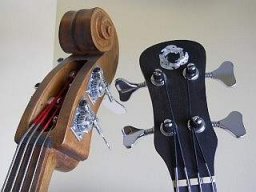
Taylor's website details the GS Mini Bass strings as D’Addario EXP PBB190GS custom strings composed of nylon core with a phosphor bronze outer wrap.
I love my 30" with Labella black tape wounds but I'd like to try the Taylor out someday to see what a 23-1/2" scale feels like with the overwrapped strings. My experience with the soft strings such as found on the Kala U-Bass was underwhelming as I found the strings "sticky" and not comfortable to play due to their feel.
I do own a mahogany GS Mini 6 string that's really a very nice instrument. I think this would make a superb travel bass and seems to be in line with what Bruce is working on, since it was made to fit the overhead compartment for air travel.
I love my 30" with Labella black tape wounds but I'd like to try the Taylor out someday to see what a 23-1/2" scale feels like with the overwrapped strings. My experience with the soft strings such as found on the Kala U-Bass was underwhelming as I found the strings "sticky" and not comfortable to play due to their feel.
I do own a mahogany GS Mini 6 string that's really a very nice instrument. I think this would make a superb travel bass and seems to be in line with what Bruce is working on, since it was made to fit the overhead compartment for air travel.
Last edited:
Taylor makes wonderful guitars and as a professional tech I can without hesitation say that their technical and customer support is second to none. If you have a chance, test drive the GS Mini Bass. I'm also a fan of the GS Mini guitar. What I'm doing is just experimentation and although I'm encouraged in my adventure, Taylor has the resources to address things that I haven't even considered.
This morning, I noticed that when I first plug in my new bass, the E-string is thunderous and just plain impressive despite the munchkin size of the bass. But after I play for about two minutes, it starts to lose some of its thump and the A-string becomes louder in comparison. Not enough to be a problem but enough to be noticeable. My guess is that the cheap preamp is being pushed too hard by the low frequency of the E-string or maybe the battery is getting low. The battery now sits under the pickguard in the place that the humbucker pickup used to occupy and it was a bit of a fiddle to get the pickguard in place with all of the wires sitting as they needed. As soon as I clear enough room on my bench again, I'm going to cut through to the back and make an access plate to get to the battery. I'll make it so I'm running two batteries in parallel. I'm cruising Ebay for a better preamp. There are a lot to choose from including ones with tuners for under $40. With exception of the DAdaario strings, everything I did on this bass was from materials that I had laying around I didn't even replace the nut or bother to plug the extra two holes in the headstock. The bridge is bits of rosewood glued in a sandwich to make it tall enough and I didn't have any string ferrules for the top where the strings come out. I didn't even bother to check the condition of the fretboard and thankfully it has a two-way adjustable trussrod to force relief into the neck. If I decide to build, as much as I don't like to employ two-way trussrods, I think it'll be a necessity due to the low tension of the strings -- that is to make sure that the instrument will be functional for many years if the wood decides to take a turn south.
Ergonomically, the bass has absolutely no farfignugan. With the exception of three chord cowboys songs, its just not something you can play sitting down without a strap. It just doesn't allow you to hold it properly without the left hand being overly tasked holding the instrument in place. Standing up with a strap, the mass is so small that you still need to work a little harder keeping the instrument where you want it with one hand or the other. Its impossible to use both hands at once to engage all of your skills toward playing bass -- its like a happy puppy that wants to play and tries to get out of your arms. Again, if I build a bass, I need to think of ways to address this problem too.
This morning, I noticed that when I first plug in my new bass, the E-string is thunderous and just plain impressive despite the munchkin size of the bass. But after I play for about two minutes, it starts to lose some of its thump and the A-string becomes louder in comparison. Not enough to be a problem but enough to be noticeable. My guess is that the cheap preamp is being pushed too hard by the low frequency of the E-string or maybe the battery is getting low. The battery now sits under the pickguard in the place that the humbucker pickup used to occupy and it was a bit of a fiddle to get the pickguard in place with all of the wires sitting as they needed. As soon as I clear enough room on my bench again, I'm going to cut through to the back and make an access plate to get to the battery. I'll make it so I'm running two batteries in parallel. I'm cruising Ebay for a better preamp. There are a lot to choose from including ones with tuners for under $40. With exception of the DAdaario strings, everything I did on this bass was from materials that I had laying around I didn't even replace the nut or bother to plug the extra two holes in the headstock. The bridge is bits of rosewood glued in a sandwich to make it tall enough and I didn't have any string ferrules for the top where the strings come out. I didn't even bother to check the condition of the fretboard and thankfully it has a two-way adjustable trussrod to force relief into the neck. If I decide to build, as much as I don't like to employ two-way trussrods, I think it'll be a necessity due to the low tension of the strings -- that is to make sure that the instrument will be functional for many years if the wood decides to take a turn south.
Ergonomically, the bass has absolutely no farfignugan. With the exception of three chord cowboys songs, its just not something you can play sitting down without a strap. It just doesn't allow you to hold it properly without the left hand being overly tasked holding the instrument in place. Standing up with a strap, the mass is so small that you still need to work a little harder keeping the instrument where you want it with one hand or the other. Its impossible to use both hands at once to engage all of your skills toward playing bass -- its like a happy puppy that wants to play and tries to get out of your arms. Again, if I build a bass, I need to think of ways to address this problem too.
Mark,
As a point of interest I purchased a couple of those e-bay barn door pre-amps that come with a piezo element and my experience is that although they were very economically priced, in the end they aren't worth purchasing. They are built very cheaply and I found the output would vary quite a bit if you thumped the controls with a fingertip. YMMV.
I had very good results from using a single Baggs Element and it's 9 volt powered end pin pre-amp. These are a bit pricey when new but they often come up on acoustic guitar forum for around $50.
As a point of interest I purchased a couple of those e-bay barn door pre-amps that come with a piezo element and my experience is that although they were very economically priced, in the end they aren't worth purchasing. They are built very cheaply and I found the output would vary quite a bit if you thumped the controls with a fingertip. YMMV.
I had very good results from using a single Baggs Element and it's 9 volt powered end pin pre-amp. These are a bit pricey when new but they often come up on acoustic guitar forum for around $50.
Oh yea, they are cheaply made. But I've found that more than half of them end up working reasonably and they're good for evil luthery experiments. If you buy a bulk of 25 piezo pickups, typically more than 20 of them will be okay and you can get piezos for under a dollar each. Its hard to say from what circumstances these pickups and preamps originate. Are they rejects from quality control of some Chinese guitar manufacturer, are they just overstock from the actual manufacturer, or are they illegal clones from somebody copying existing products and inferior because of cheap components? Generally speaking these preamps are better than not using a preamp at all.
Last night I routed from the back of my munchkin bass through to the humbucker route and created a battery compartment with a cover. I installed a second 9V battery connector so now there are two 9V batteries in parallel. The low E-string doesn't suffer from loss of thump anymore but the original observation was probably due to a low battery. I'm okay with the performance of this preamp but it didn't originate from EBay but rather was a left over from an acoustic guitar that died.
Last night I routed from the back of my munchkin bass through to the humbucker route and created a battery compartment with a cover. I installed a second 9V battery connector so now there are two 9V batteries in parallel. The low E-string doesn't suffer from loss of thump anymore but the original observation was probably due to a low battery. I'm okay with the performance of this preamp but it didn't originate from EBay but rather was a left over from an acoustic guitar that died.


