• TalkBass has been independent since 1998. Add your voice.
    Create a free account to reply to discussions, view embedded media, and browse with fewer display ads.
    Join freeLog in
    Want zero display ads or expanded classifieds tools? Compare plans.

Loose Strings..

Ok, I'm a noob on the bass, but I have a question for you more experienced peeps....

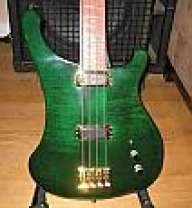
I have a 4-string warwick rockbass. It's my first one and I really enjoy playing it.

I play frequently, however, lately it seems my E string, though in perfect tune with the rest of the strings, is looser than the other 3. In other words, it has more play than the others. Does that make sense?

Would I just need to raise the bridge for the E string, or is there something else I need to do? Am I doing something wrong?

BTW, there's a fret buzz on the 5th fret on the E string. I assume that's a truss rod issue?

Your help is appreciated!!!
 
Hi, same old problem!! If you look at a harp, you will see that all strings differ in length and gauge! A bass has all strings the same length! What a mistake! I use Rotosound strings stainless roundwound in 40, 60, 90, 130 with a 1/2" spacer on the 90 and a 1" spacer on the 130. This gives lovely tone and a nice even tension across all strings. Don't forget, ALWAYS play lightly to improve tone and prevent damage!
 
Hi, same old problem!! If you look at a harp, you will see that all strings differ in length and gauge! A bass has all strings the same length! What a mistake! I use Rotosound strings stainless roundwound in 40, 60, 90, 130 with a 1/2" spacer on the 90 and a 1" spacer on the 130. This gives lovely tone and a nice even tension across all strings. Don't forget, ALWAYS play lightly to improve tone and prevent damage!
I don't know exactly what "spacers" you are talking about, but nothing you do to a string outside the space between the nut and bridge has any effect whatsoever on the tension in the string. If you want more string tension on a given bass in a given tuning, the only way to do it is to put on heavier gauge strings. You cannot turn a bass with parallel nut and bridge into a Wal (which is more "harplike") by extending the string beyond the bridge.
 
FWIW, Gary Willis suggested the spacer thing in his 101 Bass Tips book. I've never tried it, so I can't comment.

One thing I could suggest, though, is checking on your string gauges. For a long time I played light gauge, but in the past couple years I've gotten to prefer medium (045, 065, 085, 105; 130 or 135 for the B on my fivers). Length of the vibrating string, gauge of the string, and tension all interact at any tuning, IIRC.

And +1 to the earlier suggestion on having the bass set up. It's amazing how much difference in feel a little tweak to the truss rod and and bridge saddles can make. If you have access to a good tech but don't know how to do the setup yourself, it's worth the bucks.
 
Maybe...maybe, it is not looser. It could be that it feels looser to you because your fingers don't "land" on other string when you play it. But if it is looser, the only way is to get a heavier string set. And you can play hard, it all depends on your style.
 
FWIW, Gary Willis suggested the spacer thing in his 101 Bass Tips book. I've never tried it, so I can't comment.
Yeah, I saw that, too. Gary is mistaken. Most of the other stuff in that book is pretty good, but that tip is just wrong. It's one of those ideas that seems pretty good at first blush but won't stand up to a bit of critical thinking.
 
Yeah, I saw that, too. Gary is mistaken. Most of the other stuff in that book is pretty good, but that tip is just wrong. It's one of those ideas that seems pretty good at first blush but won't stand up to a bit of critical thinking.

Yah, I was wondering about it. Been a looooooong time since I took a physics course, but I thought it was (as you said) the stopped length of the string that affected the tension at a given pitch.

OTOH, placebo effects are always cool.